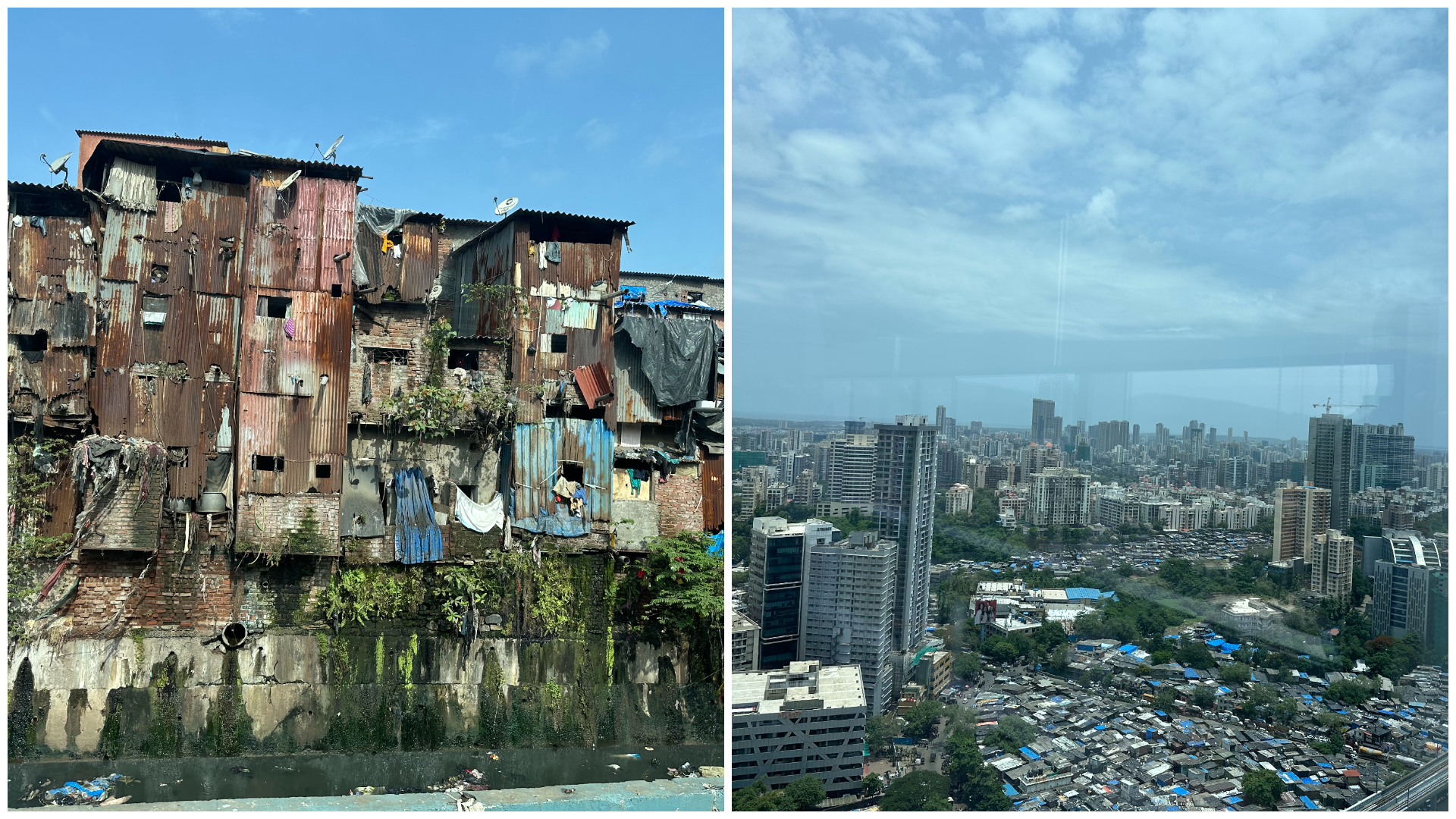
 Mumbai shanties and city skyline / HANDOUT
This set-up is laid bare when you move around. It is not surprising to find a five-star hotel next to an informal settlement right in the city.
However, behind this eyesore of contrasts are efforts to change the narrative by the Brihanmumbai Municipal Corporation, which manages the city of 12 million people.
BMC, the richest municipal corporation in India, is charged with managing the civic infrastructure and administering the city and some suburbs.
Among the key challenges the city faces, just like Nairobi, is waste management.
Every day, between 7,400 and 9,000 metric tonnes of solid waste are generated. Out of this waste, 6,213 tonnes is collected and 4,870 tonnes treated.
This is according to Swachh Maharashtra Mission, an initiative aiming to achieving Garbage-Free Status for all cities.
BMC officials in charge of the waste management admit they are struggling to segregate the waste at source since more than 50 per cent of the population in Mumbai lives in slums.
Presenting to a delegation of African journalists in Mumbai, BMC Disaster Management Department director Mahesh Narvekar said plastic has been the most concerning part.
“Multi-layered plastic, which is not of any use and has been lying everywhere, has become one of the key challenges,” he said.
HOW NAIROBI COMPARES
Comparatively, Nairobi, with a resident population of about 4.4 million, produces about 3,200 tonnes of waste per day.
This amount is estimated to increase to 3,990 by 2030, less than five years away.
Often, littered garbage in the city has become a public discourse as the city chokes in waste.
Despite recurring promises to streamline garbage management in the city, Nairobi significant challenges remain.
A large portion of the waste generated daily is not collected, and even what is collected is often disposed of improperly.
This leads to overflowing dumpsites, illegal dumping and a general degradation of the environment.
Among the most affected areas is Nairobi River.
It is heavily polluted by industrial effluent, raw sewage and solid waste from informal settlements.
This pollution has transformed the river into a source of environmental and health problems for the city, a problem yet to be solved by multiple river rejuvenation initiatives by the national and county governments.
Governor Johnson Sakaja has made a number of interventions, such as the Green Army, which is largely focused on cleaning and garbage collection. The sustainability aspect of it, however, has been lacking.
He attempted to establish a county-owned Green Nairobi Company to deal with the garbage menace, but the proposal went cold after it was tabled in February.
In April 2023, President William Ruto also announced plans to make the Dandora dumpsite an energy city.
In June last year, the city signed a Sh50 billion Public-Private Partnership deal with a foreign firm to build Kenya’s first waste-to-energy plant in Dandora.
Governor Johnson Sakaja said all the necessary groundwork relating to the project had been completed, paving the way for the start of works on site.
Due to legal suit, however, the process is yet to commence.
BORROWING A LEAF
The capital could learn from Mumbai City’s BMC and undertake various initiatives to properly manage its waste.
To manage the 7,400 to 9,000 metric tonnes of solid waste generated daily, BMC has 949 waste collection centres, 47 dry waste segregation centres and 1,483 refuse collection vehicles.
To improve on its waste management, BMC is undertaking various innovative interventions, among them the construction of a 600 TPD (tonnes per day) waste to energy project at the Deonar area, the largest dumping ground.
In the plan, 600 TPD waste will be processed to generate 7MW electricity.
“Right now, we have two to three ambitious projects in the pipeline for Mumbai. One is waste-to-energy. We are going for waste-to-energy because we have such a huge quantity of waste being generated at the rate of more than 7,000 tonnes per day,” Narvekar said.
“We are hoping to have one of the biggest waste-to-energy projects, where electricity will be generated and taken back to the city, which is as big as 66 megabyte generated per day.”
The generated electricity will cater for almost 40 per cent of the power requirement of the city.
Mumbai city is also tapping into biogas production, targeting wet waste from hotels, restaurants and eateries.
While they have had some success in highrises, they face challenges in informal settlements.
“You have seen the photographs of plastics lying in river Nalla and everywhere it has been lying,” Narvekar said.
“So that has become one of the important challenges for us.”
River Nalla refers to the city's four rivers of Mithi, Dahisar, Poisar and Oshiwara. They are heavily polluted and are frequently used as drains or sewers.
REDUCING EMISSIONS
BMC officials are undertaking a Bio-Reactor Landfill (BLF) — an engineered landfill designed to accelerate the decomposition of waste — at Kanjur, targeting to produce 66MW of energy.
The plant has an automated Supervisory Control and Data Acquisition system that controls operating parameters, such as temperature, humidity through water sprinklers and blowers.
It also has a scientific processing of mixed municipal solid waste with an installed capacity of 6,500 TPD. The current operating rate is at 4500 TPD.
“This is the only technology that yields compost, RDF and landfill gas, which can be converted into electricity,” Solid Waste Management chief engineer Siraj Ansari said.
The corporation also has a system in place to monitor waste carrier trucks through real-time vehicle tracking and management systems.
This ensures efficiency of the 1,483 refuse collection vehicles in 1,753 routes, with 22,415 pick-up locations that are geo-tagged.
Mumbai is also taking advantage of carbon credits. Gorai dumping ground is the first in India to be scientifically capped, and the first garbage dump in the country to earn carbon credits.
The dumping site was closed in 2007 and converted into a scientific landfill.
The initiative involved capping the landfill and installing a system to collect methane gas, which is a potent greenhouse gas.
It was then flared to prevent its release into the atmosphere. As a result, the project reduced emissions.
BMC sold the carbon credits to the Asian Development Bank's Asia Pacific Carbon Fund, adding to its revenue.