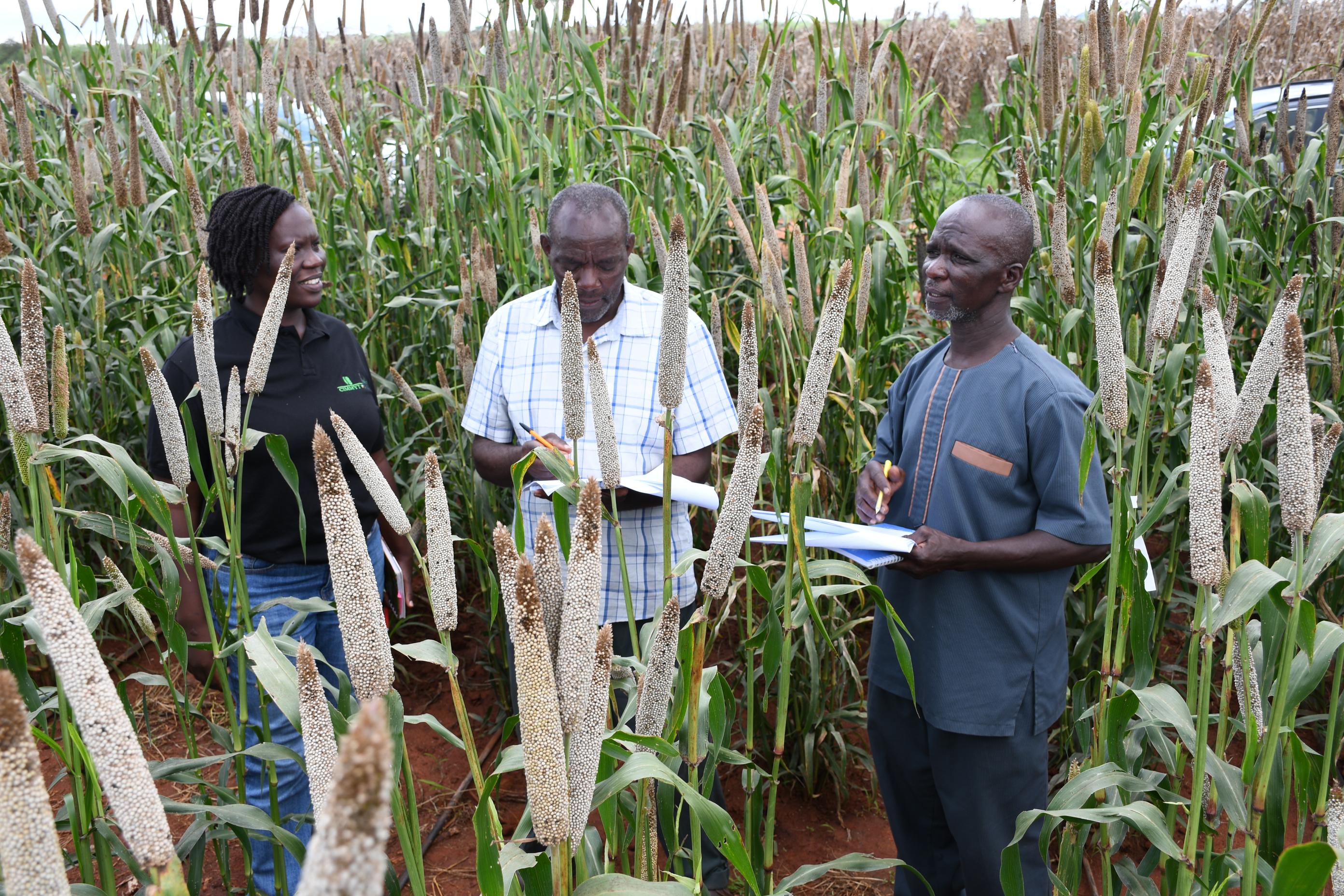
 CIMMYT research associate Molly Okoth with farmers Leonard Mbwiko and Kyaati Yambu in a Pearl Millet field at the Kiboko site / WILLIAM INGANGA
Under the relentless sun of Kiboko, where the earth often cracks before it yields, a quiet transformation is taking root. Rows of pearl millet stretch across demonstration plots at the International Maize and Wheat Improvement Centre, their grain heads swaying gently in the dryland breeze, in an understated but powerful symbol of resilience.
“I devote most of my free time to farming,” Yambu says with quiet conviction.
Though he teaches during the day, his heart, and increasingly his livelihood, lies in the soil.
For more than 20 years, Yambu has worked as a contracted farmer with the Kenya Agricultural and Livestock Research Organisation (Kalro), growing green grams, cowpeas and sorghum. His 40-acre farm has sustained him well, particularly through green grams, which fetch up to Sh130 per kilo and yield as much as 35 bags per season.
But on this day in Kiboko, something new caught his eye. “When I came here, I was very much pleased to see a variety of crops, mostly the pearl millet,” he says. “I hope I’ll get some seeds and that will get me money in my pocket.”
For Yambu, pearl millet is not just another crop, it is an opportunity.
Pearl millet is not new to Africa. For generations, it was a staple crop across dryland communities. But over time, it faded from prominence, pushed aside by maize and other cereals, and challenged by labour-intensive processing and vulnerability to bird damage.
Now, in the face of climate change, it is making a return. “Among the cereals, this is one of the most drought-tolerant crops,” explains Dr Lilian Gichuru, a Seed Systems Specialist at CIMMYT. “In this environment, within just two and a half to three months, it is ready for harvest.”
That speed, and resilience, makes pearl millet a powerful alternative in regions where rainfall is increasingly unpredictable. But this is not the pearl millet of the past.
At Kiboko, researchers are introducing hybrid varieties sourced from global partners in India, Brazil and Europe. These are being tested under Kenyan conditions to evaluate yield, adaptability and market potential.
HYBRID TECHNOLOGY
“This is a first of many activities showcasing hybrid technology,” Dr Gichuru says. “We are moving from traditional open-pollinated varieties to hybrids that can significantly improve productivity.”
The goal is clear: faster results, higher yields and crops that can withstand the pressures of a changing climate. The field tour at Kiboko was not just about observation, it was about connection.
Scientists from Kalro and CIMMYT walked side by side with farmers and private seed companies, bridging the often-wide gap between research and real-world application.
“We are bringing different partners together to evaluate these materials,” Dr Gichuru says. “But also to entice seed companies to take them into their production portfolios.”
This is where innovation meets scale. By involving private sector players early, CIMMYT hopes to accelerate the journey from experimental plots to farmers’ fields. Already, about five seed companies have shown interest in co-testing and potentially commercialising the varieties.
“This is about market-driven selection,” Dr Gichuru adds. “We don’t want to take products forward that farmers and companies don’t actually want.”
For farmers like Yambu and his fellow attendee Leonard Mbwiko, the stakes are deeply personal. Mbwiko, a retired special needs teacher who once taught visually impaired students at Machakos Technical Institute for the Blind, now spends his time farming a 10-acre plot in Mtito Andei.
“Braille was my stuff,” he says with a smile, reflecting on his teaching days. Today, his tools are seeds and soil.
Like Yambu, he grows green grams and sorghum, selling his produce through Kalro. His yields, about 10 bags of green grams and 15 bags of sorghum per season, are modest but reliable.
Yet he, too, sees promise in pearl millet. “I was introduced to it here,” he says. “I believe it can be grown in my area again.”
PEARL MILLET’S POTENTIAL
His words carry both hope and history. There was a time when pearl millet thrived in regions like Mtito Andei. But its decline tells a broader story, not just of agriculture but of social change.
“In the past, children who did not attend school helped protect millet crops by scaring birds away,” Mbwiko says. “Now, with more children in school, that is no longer possible.”
The result? Farmers gradually abandoned the crop. But new hybrid varieties are changing that equation. “That makes a big difference,” Mbwiko says.
He is already planning his next move: reaching out to Kalro to access seeds for planting. Walking through the Kiboko plots, the diversity is striking.
“This field has 28 pearl millet varieties,” says Molly Okoth, a research associate at CIMMYT. “We are testing them for yield and traits like panicle length, dual-purpose use and water efficiency.”
These trials are not limited to Kenya. Similar evaluations are ongoing across East and Southern Africa, in Tanzania, Zambia and Zimbabwe, ensuring that the best-performing varieties can be scaled across regions with similar climates. The focus is not just on survival but also on productivity.
“We want farmers to start seeing pearl millet as a hybrid crop,” Okoth says. “Because these hybrids can produce much more than what farmers are currently getting.”
Higher yields mean more food, and more income. Pearl millet’s potential extends beyond the plate.
“It has space in food, in brewing and even in animal feed,” Dr Gichuru says. “Some varieties are excellent for forage; you can see the crop is mature, but the leaves are still green.”
This ‘stay-green’ characteristic is particularly valuable for livestock farmers, offering a dual-purpose solution in regions where feed shortages are common.
Still, challenges remain. Processing millet can be labour-intensive, particularly when it comes to threshing. But here, too, innovation is catching up.
MECHANICAL HARVESTING
“Partners in mechanisation are developing equipment to ease this work,” Dr Gichuru says. “And with hybrid uniformity, mechanical harvesting becomes more viable.”
In other words, the crop is advancing, not just in the field but along the entire value chain. Back in the fields, Yambu walks slowly between the plots, listening to scientists’ explanations, observing, calculating, imagining and even taking notes. For him, the decision is already taking shape.
“Now I have something else to add onto my crops,” he says. “That is pearl millet.” It is a simple statement, but one that captures a much larger shift.
Across Kenya’s drylands, farmers are searching for crops that can withstand the realities of climate change while still delivering income. Pearl millet, long overlooked, is emerging as a strong contender. But its success will depend on more than just science.
It will require collaboration between researchers, farmers, seed companies and policymakers. It will also require investment in seed systems, mechanisation and market development. Above all, it will require trust from farmers willing to try something new. At Kiboko, that trust is beginning to take root.
As the sun dips lower and the field tour draws to a close, the message is clear: the future of farming in Kenya’s drylands may not lie in reinventing the wheel but in rediscovering and reimagining crops that have always belonged.
Pearl millet is one of them. Time will tell if it will stay.