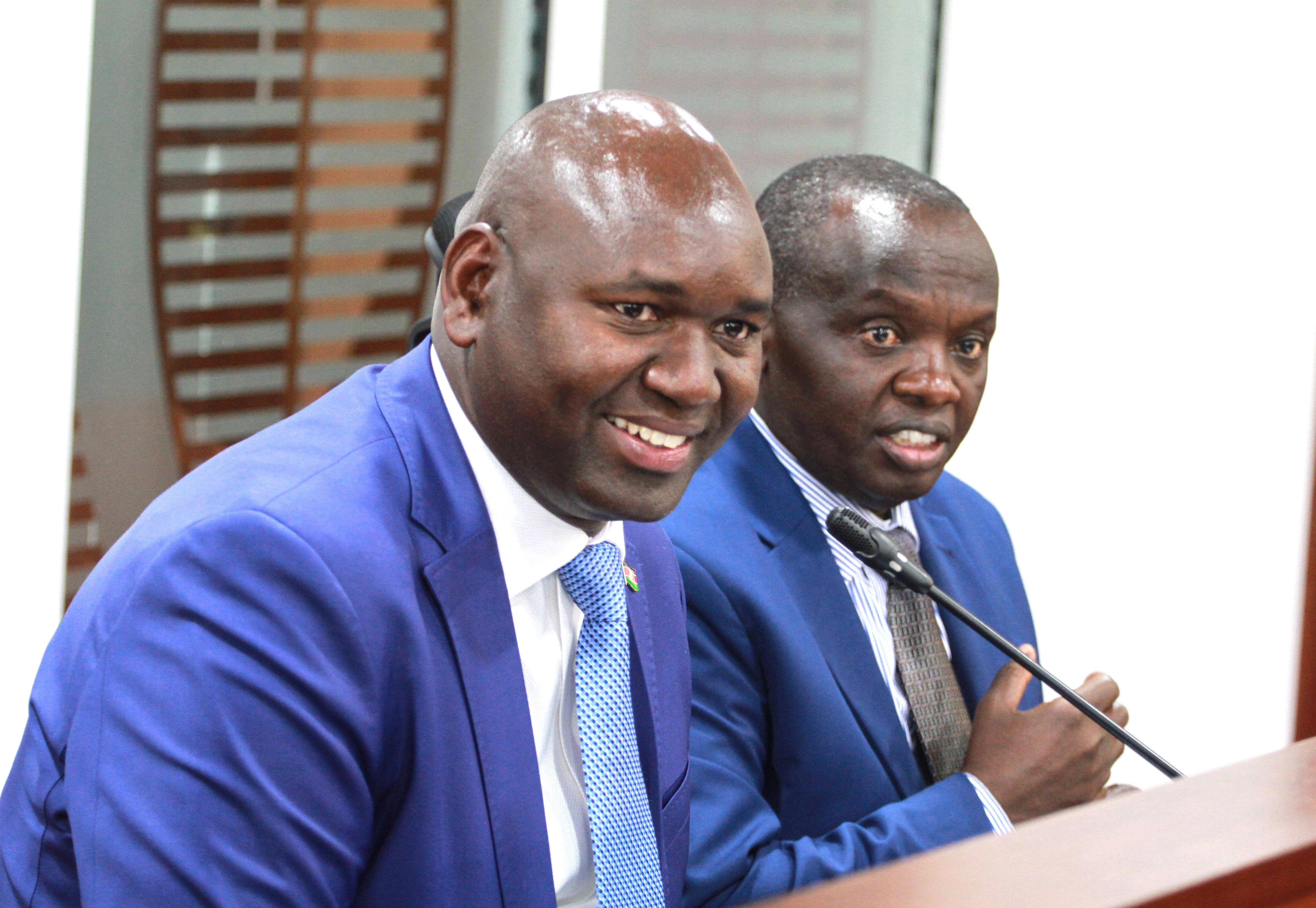
Basic Education PS Julius Bitok and Ministry of Education deputy accountant general Emilio Mukira /ENOS TECHE
The education sector is making unprecedented progress under the Kenya Kwanza Administration, says Basic Education Principal Secretary Julius Bitok.
From the hiring of 100,000 teachers to the construction of thousands of classrooms and a major shift to Competency-Based Education (CBE).
In this conversation, Bitok breaks down the milestones achieved, the challenges experienced and the government’s long-term vision of using education as a foundation for national transformation.
Give us a preview of the state of education
Our education sector is in the strongest position ever, with a number of firsts recorded in the recent past. The Kenya Kwanza Administration has hired the highest number of teachers compared to any previous regime. When President William Ruto promised to employ 100,000 teachers, some said it was not possible, but this is a promise that has been fulfilled. This is historic.
The government has also built 23,000 classrooms in the last two years. We are currently building 1,600 labs across the country. The ministry has ensured a smooth transition from 8-4-4 to CBC, then to CBE. The budgetary allocation has increased substantially, from about Sh500 billion when President Ruto came into office to an estimated Sh700 billion today.
Why is the hiring of 100,000 teachers historic?
President Moi’s administration hired 5,000 teachers per year; President Kibaki employed 1,000 yearly, which added to 10,000 teachers in 10 years. President Uhuru Kenyatta employed 2,000 yearly, totalling about 20,000 in his two five-year terms. These numbers clearly indicate that the Kenya Kwanza administration has achieved a remarkable milestone.
How does this impact the attainment of the country’s education goals?
Having enough teachers is essential in delivering quality education. By employing 100,000 tutors, the country is inching closer to the UNESCO-recommended ratio for basic education, which is one teacher for 25 students. We have one teacher for 26. Achieving this globally recommended ratio will guarantee quality education. In addition to striving to employ an adequate number of teachers, we are equally addressing gaps in classrooms and labs.
How far are we in addressing the challenge of insufficient learning spaces?
The government is making remarkable progress in building classrooms. A few weeks ago, I accompanied the President on an inspection of schools in Nairobi. We went to Kangemi Primary School, where we have built 16 classrooms. We visited Westlands Primary, where an additional 20 classrooms have been constructed. We went to Lenana Primary School, where the government has built 48 classrooms. It is worth noting that Lenana School did not exist one and a half years ago. So we have created more than 2,000 spaces for learners from scratch in Lenana.
Across the country, we have built about 23,000 classrooms, which have created an additional 1.1 million learning spaces, considering that each class accommodates 50 students. The ministry has constructed 16,000 classrooms, while 7,000 classrooms have been built in partnership with NG-CDF. The total cost of the project is Sh2.3 billion. The classrooms built by the ministry have been undertaken under the Kenya Primary Education Equity in Learning programme, which is a World Bank initiative.
How many labs have been built so far, and how important are they to CBE?
In collaboration with the World Bank, we are building 1,600 laboratories in schools that do not have any. Establishment of the labs aligns with the CBE model, which seeks to ensure all children in every corner of the country have access to quality education. Labs are vital, especially for STEM subjects, and we are, therefore, working towards ensuring that all students at senior school have a lab. The project is projected to cost about Sh5 billion. Expansion of major education infrastructure will be a continuous process.
Is the budgetary allocation meeting the needs of education?
The government has been increasing the sector’s allocation over the years. But in the last two years, we have witnessed rapid budgetary growth. When Kenya Kwanza took over, we were at Sh500 billion. Currently, we are at Sh700 billion. For the next financial year, we expect about Sh750 billion. We need an additional Sh50 billion to meet the sector’s growing needs. One of the reasons the budgetary allocation for education is going up is the rapidly growing population. It is projected that by 2030, our population will hit 75 million. I foresee our education budget hitting the trillion mark in the next three to four years.
What role does education play in Kenya’s dream to attain first-world status?
Education is at the heart of our plans to transform this country from third world to first world. The Singapore ambition can only be achieved if we get education right. If we get it right in other things but not in education, our progress will be significantly constrained. The people who will develop this country are Kenyans. Our people must, therefore, be adequately prepared by equipping them with the requisite skills. Singapore achieved transformation by investing in its people. According to global metrics, a country must allocate 25 per cent of its national budget to education to industrialise and achieve first-world status. Kenya is at 23 per cent, which is commendable.
Why did we move from 8-4-4 to CBC, then CBE?
When I came to the ministry, the new system was called Competency-Based Curriculum (CBC). But we changed this to Competency-Based Education (CBE) through a national dialogue to reflect the depth of the reforms we are undertaking. CBC focused on the design of the curriculum, but CBE is about the entire education ecosystem comprising curriculum, pedagogy, teachers, labs, classrooms, exams, practicals, assessments, co-curriculum and the learning environment. I am happy to have played a key role in this process. My background as a teacher came in handy in understanding the kind of reforms we need to implement.
We shifted from the 8-4-4 system because it was exam-oriented. If you didn’t get an A or B, you were doomed. Initially, the 8-4-4 system was practical-oriented, but along the way, we lost it. It was therefore critical that we shift to CBE, which is not so much about exams. CBE is about talent, skills, and ability. It is about giving everyone an opportunity to do what they can do best and an environment in which they can excel.
To achieve this end, CBE offers three pathways comprising STEM, Social Sciences, and Arts and Sports. And learners start these pathways early. This is different from the 8-4-4 system, where everyone did almost similar subjects up to Form 4. For instance, under CBE, we have Core Maths and Essential Maths, which students choose to pursue early. Previously, we just had Maths up to Form 4. By choosing pathways early under the CBE, learners get ample opportunity to perfect their talents and skills.
Overall, an education system ought to be dynamic enough to meet the evolving needs of society. The trend globally is to shift to CBE, where learners are given an opportunity to be the best in careers that match their talents.
There were a number of challenges in transitioning learners to Grade 10, with many parents complaining their children had been placed in the wrong schools. Why was this the case?
Let me start by saying we were transitioning 1.1 million learners this year to senior schools, where there are 1.5 million spaces available. So there were more than enough spaces to accommodate all learners. The challenge arose as students were interested in only 20 schools, which are the former national schools, now categorised as C1 schools. Everyone wanted to join Alliance, Lenana, and Mangu. This was not possible.
We gave the learners 12 choices. They were required to choose three C1 schools, which are the former national schools, three C2, formerly extra-county schools, three C3, formerly county schools, three C4, previously sub-county schools, which are also known as day schools.
Interestingly, the students focused on the first three schools, then the rest they just picked without due consideration. And that is where the problem began. We are using a digital placement system that can place learners in any of the 12 schools they have chosen. This led to some students being placed in day schools far away from home.
It is worth noting that the students were placed in schools that they chose themselves. It is also important to disclose that we used a county revenue allocation formula that was able to distribute the students around the country based on their abilities and the population of the respective counties. This system placed students equitably, enabling the Ministry to achieve 100 per cent transition.
How were the complaints regarding placement addressed?
After the first placement process, about 300,000 learners said they were unhappy with the school they had been put. We then allowed them to revise their choices, after which an estimated 200,000 students were placed. Still, some were not satisfied, and we gave them another chance to revise their choices, this time we placed about 150,000 in new schools. All the learners are now in school in accordance with the President’s directive. We ensured all the students transitioned to Grade 10.
Another important point to note is that we were not taking students in terms of marks per se. It was understandable for parents to complain that their children performed very well, yet did not get places in C1 schools. When conducting student placement, we are looking at other things, such as regional balance. We needed to ensure that C1 schools take students from across the country.
How will this challenge of placement be dealt with going forward?
To remedy this situation, we will reduce the number of schools that students pick from 12 to around four or five. They will then be well informed that they can be placed in any of the schools they have chosen. This way, they will be able to take a keen interest in the school they select.
Why are we changing from Nemis to Kemis?
The system we currently have, called Nemis (National Education Management Information System), needs an upgrade. This recommendation was made by the Presidential Working Party. The upgrade seeks to establish a more robust system capturing critical learner data. The new system, known as Kemis (Kenya Education Management Information System), is more flexible and integrated than Nemis.
It is essentially a one-stop shop solution linking junior school, senior school, university, as well as technical vocational education training (TVET) colleges. It will also onboard the Kenya National Examination Council (KNEC), Teachers Services Commission (TSC), Higher Education Loans Board (HELB)—virtually everybody in the education ecosystem. The system will provide complete and relevant details on all students. It will also be able to tell you whether or not someone went to school at the click of a button.
How are teachers prepared to handle the unique demands of CBE?
We have retooled 2,500 teachers to bring them up to speed with CBE. We have imparted to them new pedagogy, or teaching methods, in line with the paradigm shift from 8-4-4 to CBE. Every teacher needs to have the necessary training, skills and predisposition suited to the new education system. Retraining of teachers is essential in translating CBE into a success story. We have mapped areas for specialised training.
We also need to scale down the number of teachers we are training. The current national demand for teachers stands at about 40,000 yearly, yet we train between 70,000 and 80,000. More students are now enrolling in a teaching course because the President has promised jobs. Starting this year, we will seek to reduce by half the number of those pursuing teaching. This is a controversial conversation, but it is one that we must have.
Parents appeared not to have understood the new grading under CBE. How much explanation have you had to do?
A lot. When parents saw that their children were graded EE, they complained, thinking they scored an E, which was a failure in the previous system. Under CBE, EE means Exceeded Expectation, which is actually excellent. ME means Met Expectation, AE Approached Expectation and BE Below Expectation. Under 8-4-4, A was excellent, B was good, C was average, D was poor, and E was fail.
Having said that, under CBE we don’t believe anyone is stupid. Even BE grade doesn’t mean you have failed. There must be something you are good at. Perhaps the grading did not capture that, or what was captured may be something you are not good at. CBE will strive to ensure that the talent and capabilities of every learner are taken into account.
Many schools have been having a problem accessing books for CBE. How have you addressed this?
The government released Sh5.6bn in January to pay suppliers. I want to confirm that most books are in schools now. The process is ongoing to ensure all the necessary books are supplied on time. We are finalising books for grade 10. Soon, we will start the evaluation of grade 11 books. A team of quality assurance officials have been on the ground to ensure books are in schools and learning is going on smoothly. Books are important when you are rolling out a new system. But I want to call on schools to use the materials they have on a temporary basis as they wait for new books to reach them.
Capitation has always been a major setback, with schools always saying what they get is not enough and even what they are allocated is delayed. What is the correct position on this?
For the first time, we have sent capitation to schools before they opened this year for the first term. I received the funds on December 20, and by January 3, schools had received them. When they opened in January 5 the money was already in the accounts. It never happened under Kibaki and Uhuru. In fact it has never happened in like 30 years. This is another first for this administration. We have a reason to be proud as a country.
Parting shot?
In conclusion, the dream to Singapore is quite within reach. The amount of investment in education is one of the clear indicators that the journey to the First World is real. I call on all stakeholders in the sector to work together to attain and sustain quality education we yearn for. It is through reforms such as CBE that we will achieve our development aspirations.