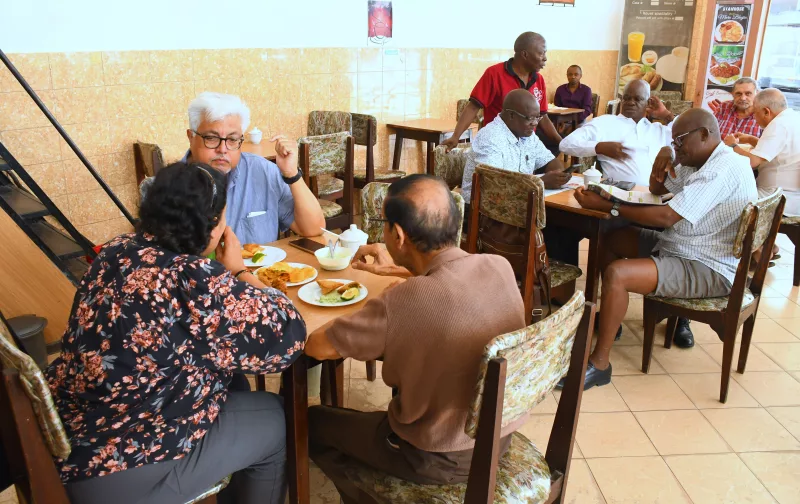
There is a particular kind of silence that falls across Kenyan tables when someone brings a partner whose age doesn’t “match the math”. It’s the same silence that appears at a nyama choma joint in Roysambu when a man in his late 40s orders choma and bottles of beer with a woman young enough to still be mistaken for a first-year university student.
Or at a family gathering in Nyeri when an aunt pauses mid-sentence because the “new addition” holding hands with your cousin looks like they could either be his spouse or his classmate’s younger sibling.
Nobody says it outright, of course. This is Kenya—where opinions are often served hot, but politely wrapped in silence, side-eyes and well-timed coughs. Still, age-gap relationships remain one of those social topics that quietly refuse to sit still.
Relationship counsellors in Nairobi often note that age-gap unions are increasingly visible across urban Kenya, from Kilimani apartments to Eldoret suburbs and Mombasa’s coastal enclaves. While exact figures vary depending on how “age gap” is defined, many agree that a significant share of these relationships feature partners with at least a seven to 10-year difference.
But success? That’s the real mystery. Some say it depends less on age and more on power, intention and emotional maturity—three things that do not always show up in the same person at the same time. And so, beneath the laughter, judgment, admiration and whispered gossip, there are stories.
In a quiet café tucked behind the bustle of Lavington, sunlight spills lazily through glass windows, landing on a woman stirring her tea as if she is measuring patience itself. Her name is Beatrice Njeri, 26, and she laughs softly before she speaks, like someone used to being misunderstood before she even opens her mouth.
Her fiancé, Daniel Otieno, 38, is not present, but his presence lingers in her tone.
“My parents thought I was bamboozled,” Njeri says, smiling. “They said a 12-year gap is not love, it is a delayed crisis.”
Njeri met Otieno in Nakuru during a professional networking event that mostly involved pretending to understand jargon while munching on uninspiring samosas. She was 24 then, ambitious, restless and done with men her age who, in her words, “still needed emotional GPS to locate accountability”. Otieno, a project consultant, was calm in a way she was not used to. Not flashy. Not loud. Just steady.
“At first I thought he was boring,” Njeri admits. “He didn’t do the TikTok humour thing. He didn’t perform masculinity. He just listened. In Kenya, that alone can feel like luxury.”
Their relationship grew quietly, away from the noise of approval or disapproval. When she eventually introduced him home in Kiambu, the reaction was immediate.
“My mother didn’t even greet him properly,” Njeri recalls. “She just asked him, ‘So when did you decide to become a father figure?’”
But Njeri insists the relationship is not built on rebellion—it is built on clarity.
“Daniel is not perfect. But he is intentional. He is not competing with me, and that changes everything.”
Njeri pauses, then adds with a small grin: “Also, he knows how to budget. That alone should be in the relationship guideline book, if there ever was one.”
In their case, age is not a ladder of control—it is a bridge of negotiation. She is planning her wedding. Her parents are still “fasting for revelation", as she jokes. But Njeri is not waiting for approval anymore.
Across town in Karen, under the shade of jacaranda trees and manicured lawns, another story unfolds with a different kind of calm.
Peter Lenana, 47, sits on a wooden bench outside a home that smells faintly of fresh paint and brewed coffee. His wife, Zuwena Kadzo, 36, is inside taking a call, but her presence is everywhere—in framed photos, in the way Peter smiles mid-sentence, in the ease of his posture.
“This is my second marriage,” Lenana says slowly. “And I came into it with baggage the size of a 90kg mkokoteni load.”
His siblings were sceptical when he remarried a younger woman. His children from his first marriage, then teenagers, were openly suspicious.
“They thought she was after my money,” Lenana says. “My daughter even asked her directly if she had come to ‘finish what the first wife left unfinished’."
But Kadzo did not retreat. She stayed present. She attended school events. She learned the children’s routines. She built trust not with speeches, but with consistency.
“Age difference is loud at the beginning,” Lenana reflects. “But silence and routine either kill it or stabilise it.”
Over time, the suspicion softened. The children began calling her “mum” without hesitation. His siblings eventually ran out of arguments.
“What surprised me,” Lenana adds, smiling faintly, “is that I am the one who feels younger in this relationship. Not in age—but in peace.” For Lenana, the gap is not a danger zone. It is a recalibration of life after chaos.
Not all stories, however, come wrapped in stability or gentle laughter. At a busy roadside café in Thika, the hum of matatus and roadside vendors forms a constant background rhythm. Plastic chairs creak under shifting weight as Brian Wandera, 30, stares at a cold cup of tea he has barely touched.
His story begins when he was 22. Fresh out of campus life with energy and uncertainty, he met a woman 15 years older than him, whose name he declines to emphasise—almost as if naming her would reopen a door he carefully closed.
“She was everything I thought was maturity,” Wandera says. “She had a car, her own apartment and confidence that made me feel like I was still downloading adulthood.”
At first, it felt like growth. Then it became dependency disguised as love.
“She would say things like, ‘No one your age will understand you like I do.’ At first, it sounded romantic. Later, I realised it was isolation dressed as affection.” Wandera explains.
By the time Wandera understood the imbalance, he was 28—six years deep into a relationship he struggled to exit.
“My friends would joke that I was being taken care of,” he says. “So I stayed longer. I didn’t want to look stupid for leaving her. In Kenya, men are not taught how to recognise emotional manipulation and leave such situations.”
He describes his experience of emotional manipulation not as dramatic shouting, but as subtle control—withdrawal of affection, guilt, comparisons and constant reminders of inexperience. Leaving was not sudden. It was gradual, like peeling off a tightly stuck plaster.
“I didn’t leave because I stopped loving her,” Wandera says quietly. “I left because I stopped recognising myself.”
If Wandera’s story is about emotional entanglement, 52-year-old Tabitha Cherono speaks about something heavier—survival dressed as endurance.
In a modest home in Naivasha, where the wind moves through iron sheets with a rhythmic clatter, she sits upright, hands folded, as if holding herself in place.
Her relationship with a man 10 years younger began with confidence.
“I thought dating younger meant I had control,” Cherono says. “After all the abusive relationships I had experienced from older men, I thought dating younger would protect me.”
But control, she learned, is not guaranteed by age.
“He started with charm,” Cherono recalls. “Then came anger. Then came apologies. Then came fear.”
The abuse escalated slowly, almost invisibly at first. She stayed longer than she should have, not because she didn’t see the signs, but because she was ashamed of them.
“In Kenya, most people will ask, ‘How did you allow a younger man to beat you?’ That question keeps many women silent.”
For Cherono, leaving was not just emotional—it was a social risk.
“I had endured so many things in life. I thought I could endure this too. But endurance is not the same as living.”
She left two years ago. Healing, she says, is not linear. It is maintenance.
“I don’t regret loving a younger man. I regret ignoring toxic patterns,” Cherono explains with a sigh.
In a small consultation office in Westlands, the walls lined with soft-toned books and framed psychological diagrams, Dr Samuel Karanja, 44, listens intently before he speaks. His tone is measured, careful not to overgeneralise human chaos.
“Age-gap relationships are not inherently good or bad,” he says. “They simply amplify what is already there—maturity, insecurity, control or emotional stability.”
Karanja explains that in Kenya’s evolving social landscape, these relationships are becoming more visible due to urbanisation, financial independence among younger women and shifting gender expectations.
“The real issue is imbalance,” he continues. “Not age. Power imbalance disguised as love is what leads to most problems.”
Karanja advises three core principles. First, clarity of intention. Why is each person in the relationship? Second, emotional independence. “If one partner feels they are rescuing or being rescued, that is a warning sign.”
Third, social resistance. “If your relationship only survives in isolation from friends and family, it is not yet stable.”
Dr Karanja pauses, then adds: “Age gap relationships in Kenya are not unusual anymore. But healthy ones require deliberate emotional honesty. Not romance alone.”
In Kenya, age-gap relationships are not short of criticism. They come with raised eyebrows, unsolicited advice, WhatsApp family group debates, and that one uncle who always asks, “Are you sure?”
Some of them survive all that noise and grow into calm, steady partnerships that surprise even the sceptics. Others collapse under the weight of imbalance, control, or expectations that were never spoken aloud.
But perhaps the real story is not the age difference at all. It is what people are willing to ignore in the name of love—and what they eventually learn they cannot ignore anymore.
Because in the end, age is just a number. But power, silence, respect and self-awareness? Those are the real currencies. And in Kenya, as in everywhere else, they decide everything long after the side-eyes at the restaurant have moved on to the next table.