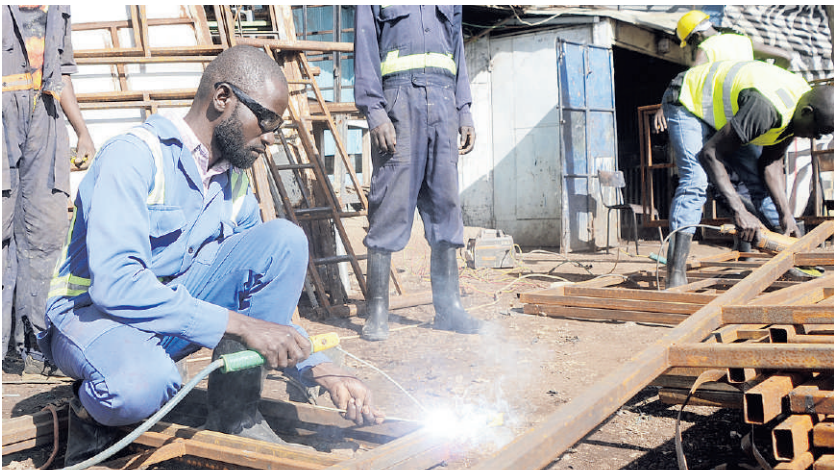
It is a brisk Thursday morning in Nairobi’s South B and everyone is up and running trying to make ends meet.
The estate bustles with activity, handcart pullers with bulging muscles weave through narrow lanes delivering goods.
In the middle of this morning rush, artisans are quietly minting money.
They are helping turn the government’s housing plan into a reality.
At Stephen Odhiambo’s metal workshop, work has started in earnest.
Sparks fly and hammers clang as he and his team of welders bend metal into window frames, the kind that will soon find a home in the government’s affordable housing projects.
His association, South B Mariguine Welders, is among dozens of small-scale enterprises contracted by the government to fabricate doors and windows for the Affordable Housing Programme (AHP).
Inside his modest workshop, a rhythm of grinding and welding plays out, metal rods being cut into shape and length for sturdy windows and gates.
For Odhiambo, the opportunity is more than just another contract, it is a lifeline for his once-struggling workshop.
He believes the affordable housing project will improve the livelihoods of the 38 members of the association.
Before landing on the affordable housing contract, Odhiambo says they used to work on small projects.
The association has now shifted from handling individual orders to managing large-scale production, thanks to the government’s housing initiative.
Read Also
“We have delivered 80 pieces of windows that are 1,500x1,500mm as per the local purchase order,” he says.
"We didn’t have enough money to buy all the materials at once, but we are pushing through.”
They have also completed and delivered 21 windows of 900x2,400mm and 20 more measuring 1,200x1,500mm.
“We are still working on 20 windows and doors,” he explains.
In Kamukunji, a similar transformation is taking place.
Kamukunji Jua Kali Association vice chairperson Pamela Akinyi oversees a team of five technicians at her workshop.
The hum of machines signals progress.
She recently delivered 40 doors to the Mukuru affordable housing site and anticipates to deliver 120 more, once pending payments are cleared.
“I was also a contractor for the Park Road project, where I did 400 doors,” Akinyi recalls.
"This work sustains us and we are hopeful we shall get more jobs moving forward.”
The Mukuru project is the largest affordable housing initiative currently underway in Kenya, spanning 56 acres and delivering 13,248 units.
Odhiambo and Akinyi are some of the jua kali entrepreneurs contracted to supply doors and windows.
Ruiru Bypass Jua Kali Association chairman Edwin Ochieng says his members expect a boom after they were awarded a contract to make doors and windows for the affordable housing projects in Ruiru town.
“We have 46 members but those working are more than 150 as there is a lot to be done,” he says.
Ochieng says that before the affordable housing was implemented, they used to have a small workshop.
In block 2, they are now on the fifth floor, fixing doors and windows. There are 84 windows and 28 doors per floor.
In block 3, they have done the first to 12th floor, with each taking 84 windows and 28 doors.
Block 4, has a similar number of doors and windows.
In block 5, the association has fixed windows up to fourth floor. Each floor has 98 windows and 28 doors.
In block 6, they have done up to fifth floor, with each taking 98 windows and 28 doors.
The association has done eight floors in block seven, with 64 windows and 24 doors in each.
Ochieng says they expect a boom once the developer pays them for their services.
The state is putting up 1,050 housing units at the Ruiru Affordable Housing Project.
The project construction that has been ongoing for the last one year is expected to be ready by August 31, 2025.
The project comprises bedsitters, which will go for Sh1.25 million, one-bedroom apartments will cost Sh1.5 million, two-bedroom (small) at Sh2 million, two-bedroom (standard) with go for Sh3.75 million, two-bedroom (master ensuite) will cost Sh4.25 million and three-bedroom will be Sh4.7 million.
Government Spokesman Isaac Mwaura says the AHP has created 244,232 jobs.
He says of the total number of jobs created, 100,000 have been taken by youth from Technical and Vocational Education and Training (TVET) institutions.
Mwaura says Sh4.4 billion has been paid out to jua kali artisans across the country.
“There is a group from Kibra that received more than Sh750 million, another group in Ruiru got Sh100 million and one in Thika got the same and counting,” he says.
Mwaura says 130,988 units are under construction, with 127,476 in the procurement stage.
“As a result of the new impetus in housing, there is actually low cost of mortgages, which have reduced by 6.2 per cent,” he says.
The Affordable Housing Programme (AHP) is an initiative by the government that targets to deliver decent and affordable housing to low and middle-income households.
Several affordable housing projects are nearing completion, with 24 project sites offering 4,888 units for sale across the country.
Under the affordable housing programme, all Kenyans above the age of 18 can benefit from the scheme.
Those interested may register by dialling *832# or log onto the Boma Yangu platform www.bomayangu.go.ke or visit the Boma Yangu desk at the Huduma centres countrywide.
Once registered, they should activate their account with Sh200 and start their journey of selecting and saving for a deposit on the housing unit of choice.
The amount payable for the house will depend on the type selected and allocated.
The pricing per unit may vary from one geographical location to another, though the unit cost will be significantly lower than the prevailing market value in that region.
Houses will be allocated through a fair and transparent system, free of any human intervention or contact, on a “first past the post” basis.
This means those qualified for allocation will be ordered on a list by the date and time when they fulfilled all the requirements for allocation, including saving the deposit.
The ministry says all occupants get equal rights to purchase and own a home under the programme, including the protected and affirmative action groups, those living with disabilities, youth, women, the elderly.
A sectional title will be provided to buyers as proof of ownership, once the house is fully paid.
When one purchases an affordable home under the programme, they own it even if it has been built on government land, as long as they have completed payment.
In the event of death, the housing unit can be transferred to the registered next of kin.