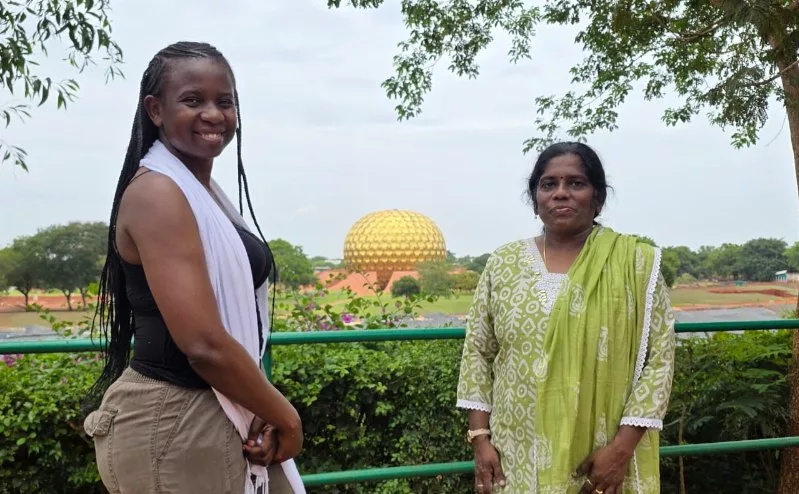
 Claret Adhiambo with Itec course coordinator Prof T Subha at the Matrimandir meditation centre in Auroville, India / CLARET ADHIAMBO
Flight 6E184 on August 11 carried us from Nairobi across the Indian Ocean and immersed us into India’s thriving tech world of Artificial Intelligence, Augmented Reality and Virtual Reality.
After six hours thousands of miles above sea level, we landed at the Chhatrapati Maharaj International Airport in Mumbai. Another two-hour flight took us to the culturally conservative and warm coastal city of Chennai in Tamil Nadu State.
Our taxi glided through the crazy honking and traffic jams to the National Institute of Technical Teachers Training and Research (NITTTR) for a two-week course on Emerging Trends in Multimedia Content Creation with AI and Immersive Technologies. The course was powered by the Indian Technical and Economic Cooperation programme (Itec).
Upon entry into the NITTTR, the buildings appear unremarkable, but the knowledge and technology inside are not just present but futuristic.
About 30 diverse professionals from 19 different countries — all the way from the Carribean Islands of Trinidad and Tobago to the land of the ‘Upright People’ in Burkina Faso (represented by the bubbly Jackie Yameogo and Ibrahim Sawadogo — met inside the seminar hall the following day for the inauguration ceremony.
The group’s designated photographers, Mostafizur Mahim from Bangladesh and Augustino Kasale of Tanzania, captured moments on their lenses from the very first day and eventually created very beautiful memories for everyone.
With his ‘million-dollar photo’ phrase, Mahim not only captured moments but also won the hearts of many with his kindness and good social skills.
Notably, most professors at NITTTR, including director Prof Usha Natesan, are women.
“Where are the men in this profession? I am beginning to get worried, Claret.” a Tanzanian friend, Richard Mayunga, asked me during the training.
“Indian women work as hard as men, that’s why we have many female professors,” Prof Thangarajan Subha, the course coordinator, explained to me later on during our one-one-interview.
“But teaching comes naturally for us as well. It helps us manage our careers and families simultaneously,” she added.
One by one, the female PhD scholars, dressed in their elegant sarees and in deep Indian accents, churned tech knowledge to us just like the ocean churns pearls from its depth.
With utmost patience and humility, led by Subha, they handled our diverse personalities, cultures and different learning capabilities, leaving us richer after every lesson.
“We all know how we can put a cheetah on the digital platform using photos and videos,” one lecturer said during one of the Augmented Reality classes.
“But can we remove the cheetah from the digital space and bring it into the classroom?” she asked, to which we all answered no.
Let’s just say by the end of the lesson, we not only brought cheetahs in the classroom but lions and cows, and took videos with them. Mind-boggling, right?
From Gen AI to immersive technologies to multimedia content creation, every day, the lecturers left us marvelling at how India is already using AI it to improve lives.
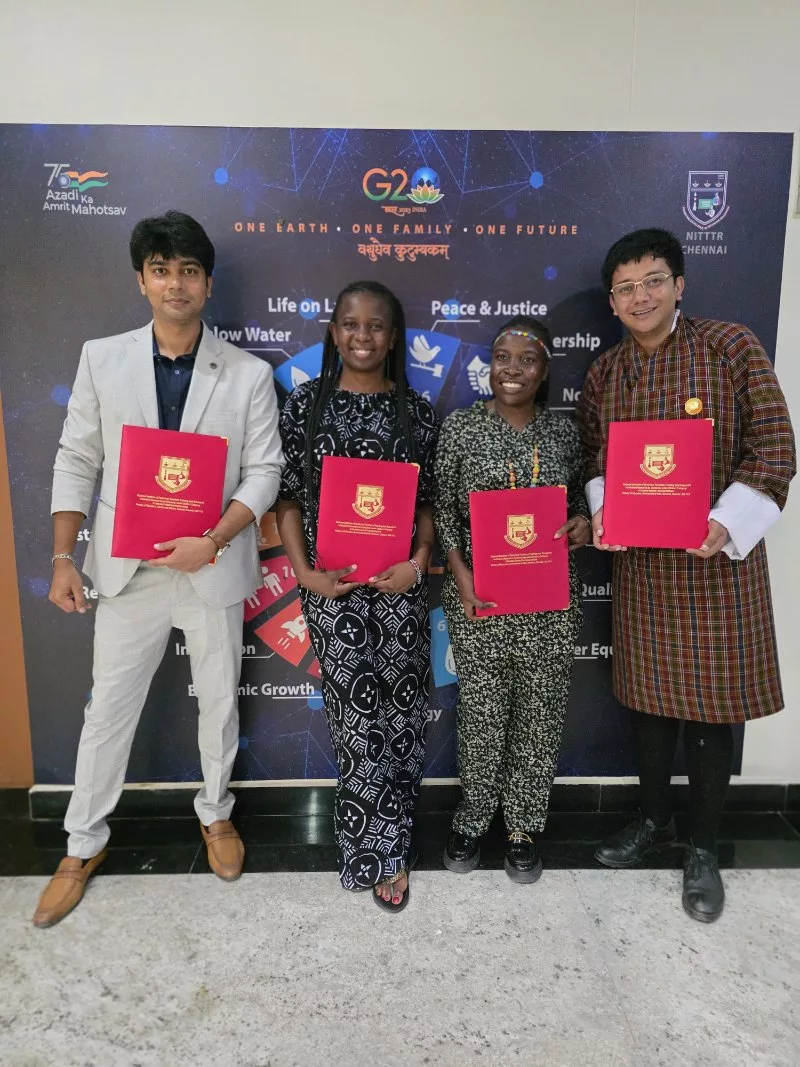
LIFE-CHANGING TECH
“What I appreciated the most was that we not only learned about these technologies but also had the opportunity to experience them,” Khusal Jagurnath from Mauritius said.
“As a lecturer, this was particularly useful to me, and I come back home with ideas I can apply in my teaching, research and development of digital learning content.”
Subha said the course could not have come at a better time since the knowledge and skills gained can be applied across different professions following the world’s current dependence on AI.
“AI is here to stay. And because the entire world is currently dependent on AI and immersive technologies, we said, ‘Why not train these professionals on these latest technologies?’” Subha said.
Immersive technologies, on the other hand, help people learn content visually, rather than just using text.
A visit to one of the workshops and science laboratories at NITTTR emphasised Subha’s point. When the institution is not making drones, it is building robots that speak multiple languages, including Kiswahili.
“Ningetaka kujua Rais wa Kenya ni nani (I would like to know who the President of Kenya is?” my Kenyan colleague from KBC, Ruth Were, asked one robot in Kiswahili.
To our amazement, the robot replied, “Kwa sasa, Rais wa Kenya ni William Samoei Ruto. Alianza kuhudumu mwaka wa 2022. Kuna jambo lingine ungetaka kujua? (The current President of Kenya is William Samoei Ruto. He became President in 2022. Is there anything else you would like to know?)”
We did not just find familiarity in the robots; we found it in their dishes, too. Every spoon of Biryani, bite of chapati and sip of chai masala was a constant reminder of how food can bring people of diverse cultures together.
Except for the very hot spices, the Indian street foods were also quite similar to the Kenyan ones.
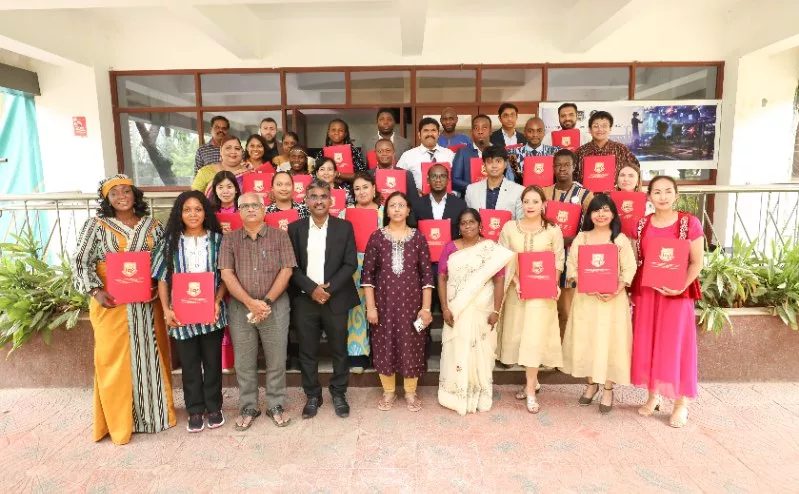 Claret Adhiambo with Itec participants during the valedictory ceremony at NITTTR in Chennai, India /CLARET ADHIAMBO
A study tour at the Kalaignar Museum showed us how India has used immersive technology to give visitors a more interactive and immersive experience.
“This experience reinforced a powerful lesson: the only constant in technology is change,” Marsha Persad from Trinidad and Tobago said.
“The course demonstrated how AI and immersive technologies can complement human creativity and transform the way we learn, teach and work.”
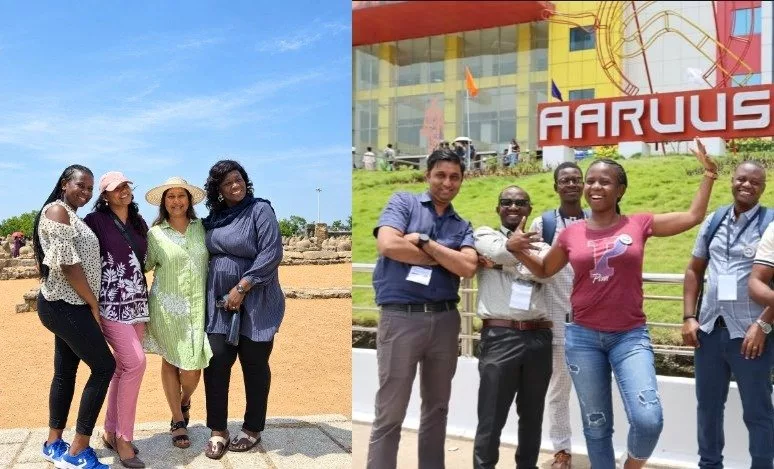 Claret Adhiambo with other participants in Chennai, India /CLARET ADHIAMBO
TEMPLES AND TRIALS
A visit to the historical temples, some as old as 1,300 years, not only revealed the deep spiritual realms of India but also demonstrated how, through their carvings and layouts, the country was ahead of time in terms of technology and infrastructure development.
Amid the tech madness in India, there is a place that it all goes quiet, where not even a chime of a phone should be heard: the meditation centre in Puducherry.
“Maam, you have to switch off your phone or leave it outside before you enter,” a person manning the gate told us.
Obediently, we removed our shoes and left our phones outside. Entering the centre evoked a divine feeling. A thick veil of incense and beautiful beds of flowers greeted us inside.
There were people meditating in different corners, while some prayed at the tomb of the centre’s founder. The few minutes spent there were some of my most cherished moments.
But it was not all bliss. While the shopping sprees were fun and enriching, the language barrier and lack of Internet connection made communication and commute difficult.
I, for instance, made sure I left campus at all times with someone who spoke Tamil or had Internet connection, such as Khusal or Praba from Sri Lanka.
The coastal heat of Chennai was also not enjoyed by many.
“I gained a lot of knowledge and enjoyed every part of the training, but the heat took a toll on me. I have never experienced such humidity in Ethiopia,” Kifle said.
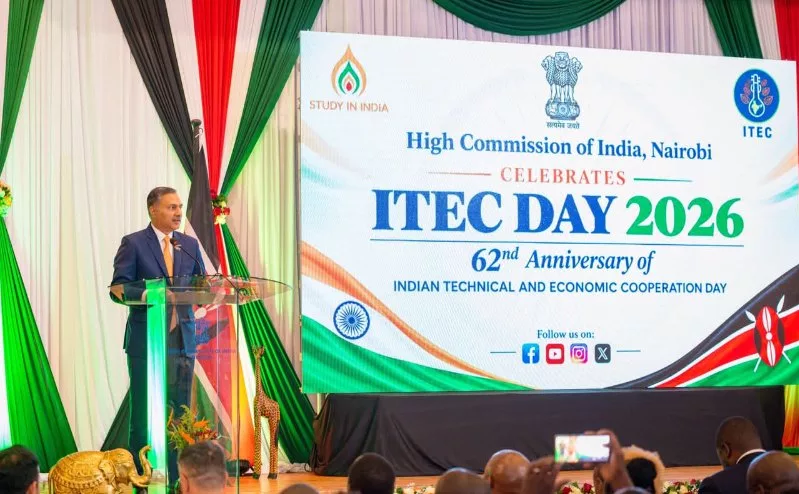 High Commissioner of India to Kenya Ardash Swaika during Itec Day celebrations on September 15 in Nairobi /HANDOUT
BILATERAL TIES
India has trained more than 3,000 Kenyan professionals through Itec over the past decade, Indian High Commissioner to Kenya Ardash Swaika said during Itec Day celebrations on September 15.
He said Kenya's participation in the programme has grown over the years, with the country now receiving more than 400 training slots annually.
"We believe that knowledge grows when it is shared, and an investment in one profession can benefit an entire institution, and a stronger institution can improve the lives of a vast number of people," he said.
Globally, the programme has trained more than 200,000 officials from more than 160 countries over the past six decades. Some of the notable figures who have undergone the training include Tanzanian President Samia Suluhu.
“Itec was conceived in the true spirit of South-South cooperation. It reflects India’s firm belief that development is most meaningful when it is shared,” said NP Singh, second secretary for education and culture at the High Commission of India.
Kasale gave the vote of thanks during the valedictory ceremony.
“The Itec programme is not only about acquiring knowledge; it is also a powerful bridge that strengthens cooperation and friendship between India and our respective countries,” he said.
“As we return home, we do not leave India with knowledge alone. We leave with skills that can open new possibilities in our workplaces and communities.”
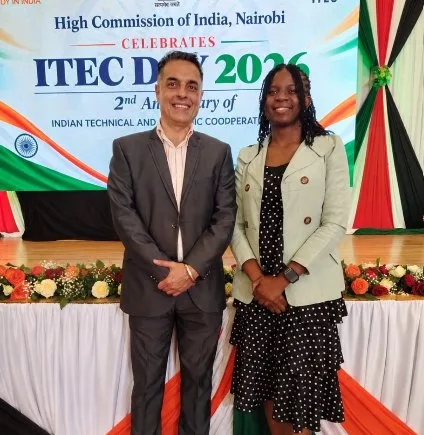 Claret Adhiambo and NP Singh, second secretary of culture and education at the High Commission of India on September 15 /CLARET ADHIAMBO