
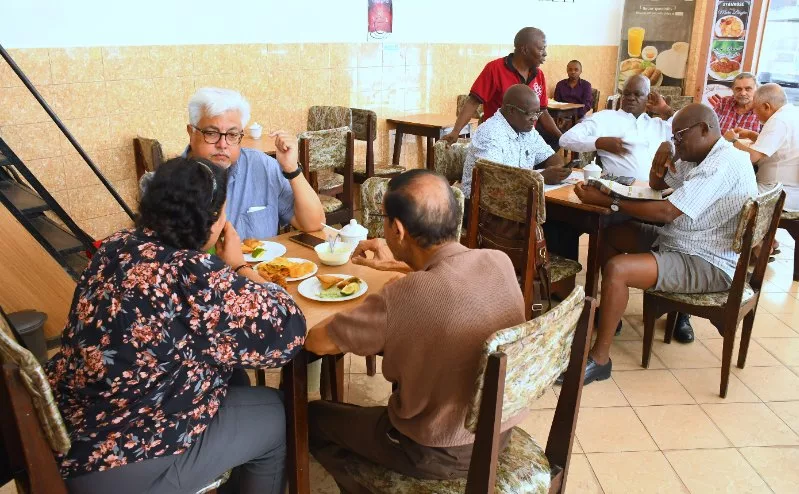
For nearly 60 years, Café Stavrose has served generations of Mombasa residents the same samosas, kebabs and cups of tea, building a legacy around familiar flavours, quality and a sense of belonging.
Tucked into a corner of the Syndicate Building off Moi Avenue, the family-run eatery has retained its original menu since opening in 1967. It has survived economic challenges, changing tastes and growing competition from hundreds of restaurants across the coastal city.
Its 35 seats, furniture and decorations preserve the character of an establishment that has barely changed in more than five decades. Apart from an interruption during the Covid-19 pandemic, it has never permanently closed its doors.
For proprietor Yasmin Bhanji, however, longevity alone does not define the café’s success.
Its greatest achievement is the emotional connection it has maintained with customers who once visited with their parents and grandparents and now return with their own children.
“I feel that Stavrose has a kind of nostalgic feeling for those who are here, who used to come with their parents and grandparents. Today, they come with their children and grandchildren to the same place, to the same feeling, the same snacks,” she says.
The experience, she explains, goes beyond food. It is about revisiting childhood memories and finding something familiar in a city that has changed considerably.
“When somebody comes here, sits after 15 or 20 years and has a bite of the samosa, they feel like they have come back home. This place reminds them of the home they had left,” Bhanji says.
She recalls customers telling her how their fathers once held their hands and brought them to the café for snacks. Today, those same customers bring their children to enjoy the samosas and kebabs they remember from their own childhood.
That continuity has become the foundation of Café Stavrose, which has resisted the temptation to overhaul its menu to follow changing food trends.
Its signature samosas remain the biggest attraction, alongside black and white kebabs, meat pies, kachoris, maru bhajia, tea and passion fruit juice.
“I believe in a smaller menu, but a menu that I can retain the quality of, rather than having 200 items and being unable to manage the quality,” Bhanji says.
“I don't like to compromise. I manage my quality.”
The samosas have become synonymous with the establishment, with customers ordering hundreds for family gatherings, engagements and celebrations, including events outside Mombasa.
Some customers living abroad arrange to have the snacks collected for their functions before sending photographs and messages of appreciation. Others insist that their Friday biryani is incomplete without Café Stavrose samosas.
Such loyalty has kept the business recognisable across generations, even as competition has intensified.
When Café Stavrose opened in 1967, Bhanji says Mombasa had only a handful of restaurants. Today, eateries ranging from small neighbourhood outlets to modern dining establishments compete for customers.
Maintaining quality amid rising competition and price pressures has become one of her biggest challenges.
“The greatest challenge for us has been maintaining quality because of the number of restaurants that have opened in town,” she says.
Although the business may not generate the profits it once hoped for, its established reputation has helped it endure.
Bhanji says she has received offers from investors interested in opening branches in Diani and Nairobi but has been reluctant to expand beyond the original premises.
Maintaining the same standards across several locations would require close supervision and frequent travel, which she says would be difficult at her age.
She is also unwilling to risk customers finding that samosas sold at a branch taste different from those prepared in Mombasa.
Instead, she has chosen to protect the identity of the original establishment.
“Stavrose is like an Arabian dhow. We are going on,” she says, comparing the café’s endurance with that of traditional vessels that continue to sail into Mombasa’s old port.
Bhanji took over its management after the death of her father, Haiderali Bhanji, who had bought the café from its founders after they had run it for two years. Haiderali was also the first Asian to play for Feisal Football Club in the 1940s.
Beyond its food, Bhanji believes the café’s hospitality has been central to keeping customers loyal.
Unlike establishments where diners may feel pressured to vacate tables after eating, Café Stavrose allows people to sit, talk and enjoy their time without unnecessary interruptions.
Customers often arrive in the late afternoon, particularly around 5.30 pm and 6 pm, to unwind after a long day. They order tea and snacks, discuss their experiences and prepare to head home refreshed.
Others use the café for informal business meetings and social gatherings, including Saturday afternoon chama meetings.
Customers can occupy a table for a meeting after ordering tea without being required to spend a minimum amount on food.
“We have so many people who come in the evening. This becomes a place for them to unwind. They come with their friends, sit, talk about their day, have their nice warm cup of tea and their samosas and snacks,” Bhanji says.
Staff are expected to remain courteous, even when the café is busy and other customers are waiting for seats. If a table is needed, the request is made politely rather than making customers feel unwelcome.
The approach reflects Bhanji’s belief that patrons should be treated as guests, not merely as sources of revenue.
Maintaining familiar flavours requires close attention to how food is prepared.
The kitchen opens at 7 am, giving staff two hours to prepare before customers arrive at 9 am. Tea is made to order rather than stored in thermoses, while leftover snacks are not kept for reheating the following day.
“We don't have pre-cooked things. There is no thermos or whatever. We cook the tea for you while you wait,” Bhanji says.
Any food remaining by evening is used that day or given away, allowing the team to start the next morning afresh.
The café typically operates from 9 am to 7 pm, concentrating on the core offerings that established its reputation.
In its early years, it also served barbecue and operated for longer hours, sometimes closing at 12.30 pm before reopening at 4 pm and continuing until 10.30 pm. Bhanji recalls that her parents, brother and other family members were actively involved in running the business.
Over time, operations became more focused, with the café concentrating on its signature snacks and tea.
The café’s place in customers’ lives is illustrated by Anwar, an elderly patron who began visiting during the 1980s and 1990s.
Bhanji recalls that Anwar, who traded in imported cars, was such a regular that his morning arrival signalled the start of the day, while his evening visit often marked the approach of closing time.
Decades later, despite his advanced age and health challenges that have affected his mobility, he continues to visit.
A gentleman using a tuk-tuk now collects him on Saturdays and brings him to the café, where he enjoys his usual tea and snacks before returning home.
For Bhanji, his visits demonstrate that the relationship between a business and its customers can extend well beyond a transaction. The familiar surroundings and people he knows remain part of a routine that brings him happiness.
The relationships sustaining the café also extend to its employees.
Bhanji says maintaining consistency over decades requires treating workers with dignity and respect. Manager William Maundu joined the establishment in 1996 following her father’s death and has worked alongside her for 30 years.
She describes him as a brother and says his presence has been a blessing, particularly when she is away.
“I have never abused a staff member or insulted them. They work hand in hand with me. They call me by my name, and I call them by their names,” she says.
Bhanji acknowledges that employees make mistakes but believes problems should be addressed without humiliation or abuse. Honesty and fair treatment, she says, are among the most important lessons she has learnt from running the business.
Café Stavrose’s story is intertwined with the history of Mombasa, whose culinary traditions reflect centuries of trade and cultural exchange across the Indian Ocean.
Swahili, Arab, Omani and Indian influences have shaped the coastal city’s food culture. The café’s samosas, kebabs and bhajia reflect that heritage, while its modest wooden tables and vintage wall signs preserve the character of an older Mombasa.
For customers who have watched the city transform, the establishment offers a familiar space amid changing buildings, businesses and lifestyles.
Patron Paul Nalyanya describes Café Stavrose as one of Mombasa’s most recognisable traditional cafés. He says its continued ownership by the same family, familiar flavours and friendly service have helped preserve its reputation.
“This is the perfect place to step back in time and relive the charm of the classic bygone era of the vintage-inspired menus from the 1960s,” he says.
Nalyanya adds that the consistency of its flavours has made the café a familiar destination for snack lovers who value tradition.
For Bhanji, the task remains simple: protect the quality, preserve the atmosphere and keep the doors open for the next generation of customers who will discover that, at Café Stavrose, a familiar taste can feel like home.