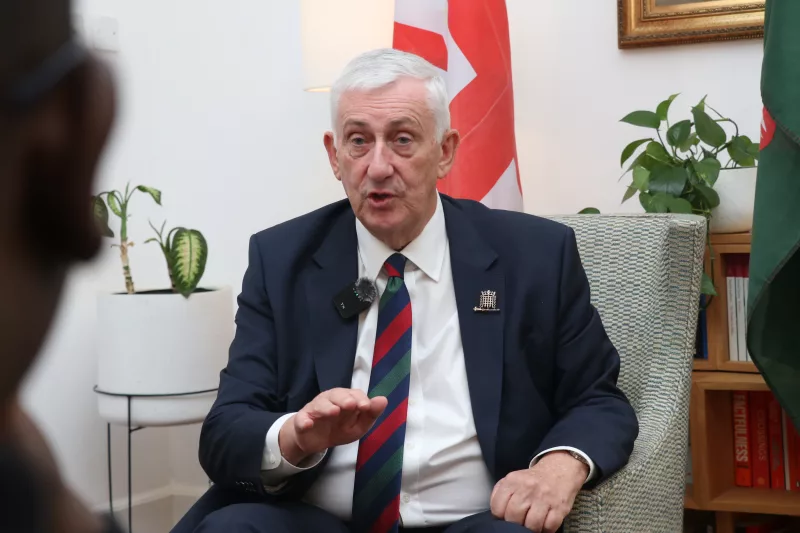
Britain’s House of Commons Speaker Sir Lindsay Hoyle has defended Parliament’s role as a check on government, saying legislators must scrutinise the Executive rather than protect it.
In an exclusive interview with the Star during his visit to Nairobi, Hoyle said Parliament must give elected representatives the space to hold ministers to account, stressing that scrutiny is central to a functioning democracy.
“I am not there to represent the government. I am not there to protect the government. I am there to scrutinise the government,” Hoyle told The Star..
The Speaker also spoke about the need to rebuild trust in democratic institutions, engage young people in politics, protect parliamentarians from physical and online attacks and encourage citizens to use their vote.
As Kenya prepares for the 2027 General Election, Hoyle urged Kenyans to exercise their democratic right, saying: “Somebody has laid down their life for the right to vote. Use your vote.”
In the interview, Hoyle also discussed the future of Commonwealth relations, parliamentary diplomacy between Kenya and Britain, the safety of MPs and the growing threat posed by social media abuse and misinformation.
Q: What brings you to Kenya at this particular time?
Hoyle: This is my first experience of East Africa and of Kenya. I have met the Kenyan Speaker many, many times, and he has always said to me, “You’ve not been. I hope you’re going to come. I hope you’re going to call in.” So, part of it was that.
I am on my way to Tanzania for the Inter-Parliamentary Union conference, where we will see countries from all over the world coming together. But as I was so close, how could I not come to one of the most important parts of Africa? So I wanted to put that right.
I have to say I am overwhelmed by the beauty, the friendliness of everybody and, of course, by seeing the Speaker. That is so important to me.
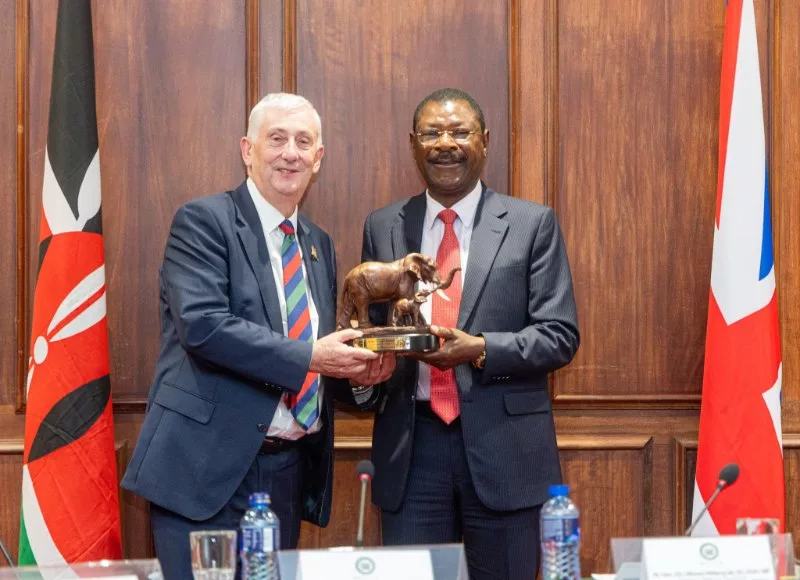
Q: You are also meeting the Speaker of the National Assembly, Moses Wetang’ula. What do you see as the relationship between Kenya and Britain, given the long history of parliamentary engagement between the two countries?
Hoyle: There is lots of history — some of it good and, to be very honest, some of it not so good. But this is about creating new history. This is about a new relationship, and relationships are so important.
I always say the Commonwealth matters to me. This is one family, but it has to be a modern Commonwealth, with a new family setting and a very grown-up relationship. It is about a modern working relationship between each other.
Let’s build on the ties that we have. The fact that education matters, that so many students from Kenya are choosing to go to the UK, really matters. Trade matters. Building up our trading relationship is so important.
We also have so much to share through knowledge. Your tech industries, the fact that you are transforming energy, your geothermal energy — these are things I want to learn more about. You are ahead of us in some areas. We need to know how you have done it and what we can do to share in the technology that you have built.
So, it is all about this grown-up relationship. Trade, education and security matter — all the things that we should be working together on. That is why the Commonwealth really matters to me.
My opinion was that when we joined the Common Market, we turned our back on Africa, Australia, Canada and elsewhere. What I would say is that we neglected those relationships. Now is the time to reignite them, to work together and take them forward.
What binds us together is democracy. We have got to stand shoulder to shoulder across the Commonwealth, showing how democracy works and how we represent people — that we work on behalf of our constituents, the people and the electors.
The world is splitting at the moment. There is the democratic world and the non-democratic world. I am flying the flag for the democratic world, along with Kenya and others. We must stand shoulder to shoulder to protect democracy.
Q: There is a growing concern that democratic space is shrinking in some parts of Africa, including Kenya and How can democracy continue to thrive in this environment?
Hoyle: Politics has got to be accountable to the electorate, wherever you are in the UK or anywhere else in the world.
We are elected because people put their trust and faith in us to represent them. We must not give up on the trust that we have been elected on or the faith people have placed in us to deliver for them.
That is where we can work together. We have got to recognise that, as representatives of the people, we have got to do the right thing by the people.
We see it in the UK. The number of people voting in elections has begun to shrink. We have got to re-engage.
Young people are the future, and they are the ones that we have got to invest heavily in. I always believe democracy starts not when you are entitled to vote, but when you are at school.
Part of that should be school elections, having representatives and getting involved in democracy from the earliest age. Your belief should be installed at a very early age. That is part of what I try to do in the UK.
As a Commonwealth, we have got to share the best examples of getting people to vote. In Australia, for example, you have to vote. It is illegal not to vote.
Now, is that good or bad? I think it is a good thing that people have to vote. People laid down their lives for freedom and democracy. We should recognise that democracy matters.
People should go and vote because they want to be part of it. They want to be part of change; they want to be part of the future.
But we have got to engage more with young people because, in the end, they are our future. That is where the country has to build, whether it is through education or business.
We have got to work with young people and install the idea that democracy matters. We have all got to be part of the same machine, and that is why the Commonwealth family matters.
We have got to stand shoulder to shoulder when people want to interfere with democracy or act in a way that is not democratic.
We have already seen a good example with Russia. The sovereign country of Ukraine was invaded illegally by Russia. We have got to call that out. We have got to support each other and protect each other because, in the end, we are protecting the values that we stand for.
Q: Youth engagement in democracy has become a major issue in Kenya, particularly following the protests around the Finance Bill in 2024 and 2025. How can governments become more accountable to young people and ensure they are actually listened to?
Sir Lindsay Hoyle: Public engagement is so important. It is vital in that relationship wherever you are. It is not just about young people; it is about everybody. There should be public engagement.
But I always say we are tested at the ballot box. I always remind colleagues that, at some point, you have got to face the electorate. If you want to win, you have got to have been seen to be working for them, not against them.
If you are not satisfied, put your name forward. Stand. Become the next Member of Parliament. I was involved in politics and was the youngest councillor elected at 22. I was on the council, ended up as deputy leader, was the mayor of the town and then went to Parliament at Westminster.
The one thing that worried me was that I was still one of the youngest politicians. After 17 years, still being one of the youngest was not acceptable.
From that day forward, I tried to persuade people to get involved in politics. My record of being the youngest councillor has been broken five or six times, and we have had councillors elected at 19 because it is about representation.
It is very easy to complain. The only way to do something about it is to put your name forward.
I have always tried to make sure that the future of democracy is only as good as the next generation. Investing in that next generation and getting them involved in a democratic movement is so important — listening and being engaged.
That is why I say to people, if you are in a political party, go to meetings and make them accountable at the meetings. What are your views? What are your opinions? Shape the agenda that you want to see.
But coming back to why young people matter — they are the future of the country. That is why they are so important to me, and that is why I spend a lot of time trying to ensure that young people get involved in politics.
Q: In Kenya, there has been a debate about whether Parliament has been sufficiently independent in holding the Executive to account. What can Parliament do to engage the public while maintaining its independence from the Executive?
Hoyle: I have a slightly different role. I am a Speaker who has given up his political affiliation. I am a neutral politician, but I am also the trade union representative. I am the person who represents MPs, regardless of what party they belong to.
I represent the backbenchers of Parliament and give them a voice to hold the Executive to account. That means bringing government ministers to account and doing questions, including Prime Minister’s Questions. That is about accountability.
I say to government, and I challenge government, that statements should be made to Parliament first. MPs are elected to hear them first, not on the BBC or Sky News, whatever suits the government.
As much as I am with journalists, I am still the trade union representative for the backbenchers — those MPs who are holding the Executive to account.
Scrutiny matters, and making sure their voices are heard matters. That is my job.
I am not there to represent the government. I am not there to protect the government. I am there to scrutinise the government.
The government has to be accountable to Parliament, and Parliament is where I have been elected to serve as the representative of its members.
Q: Kenya goes into an election year next year. What message would you have for Kenyans ahead of the election?
Hoyle: I always say somebody has laid down their life for the right to vote. Use your vote. That is always my message.
I am not going into the politics. All I say to people is, please always use your franchise.
People have fought hard for the freedom to vote. Wherever I go in the world, I say: use your franchise.
Q: Looking ahead, what do you see as the biggest challenge, and equally the biggest opportunity, for parliamentary democracy in an age of declining trust in institutions?
Sir Lindsay Hoyle: We have got to rebuild trust.
We have also got to call out social media. The fact that we have fake news out there is a problem. Fake news should not be around.
We come back to what we were saying about social media companies. The correction should be made clear that something is not fact and is not the case.
A lot of the undermining of politicians happens through social media. Those companies need to be accountable.
I want them to be honest. I want them to put accurate information out there. If it is true, fine. But if it is not, take it down.
Because, in the end, where would we be without the trust of a democracy?
We have seen the world shifting in different ways. We are seeing the rise of the right across Europe, which is where it would have been many years before.
That is why we have got to get people back involved and recognise that politicians have to do it for the right reasons — and that is to represent the people.