For photojournalists, a byline is the ultimate badge of pride, carrying more weight than almost anything else.
This is because a single photograph conveys stories and emotions that words often cannot, driving readers to pay attention to the photojournalist behind it.
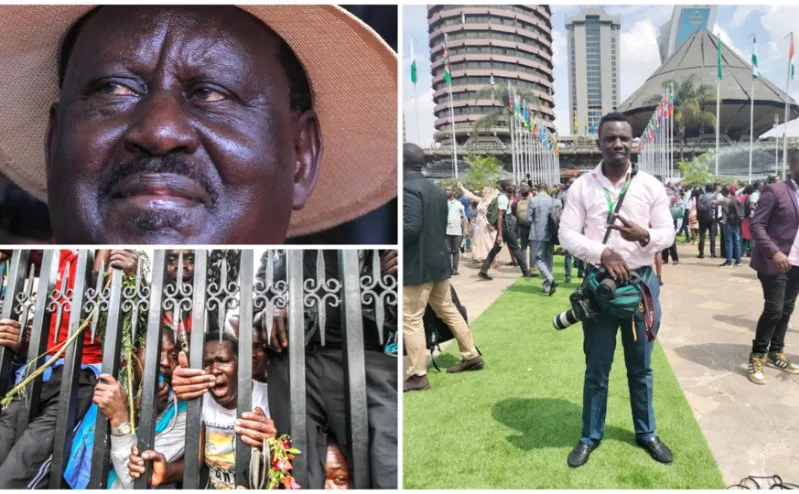
I still remember the excitement of walking past newspaper vendors early in the morning and finding people gathered around, discussing Raila Odinga’s photograph splashed across the front page alongside a screaming headline.
To me, that was motivation enough. Many years ago, when I was still a rookie in the profession, I would have been tempted to walk up to the vendor and proudly declare, “That is my picture!”
That is how magical it felt photographing Kenya’s opposition leader Raila Odinga.
His political rallies offered photojournalists endless opportunities to tell compelling stories through our lenses.
Talk of the colour, the energy and the sheer numbers of his supporters created scenes that were impossible to ignore.
His followers always found unique ways to express their loyalty, from dancing in the crowds to chanting.
Every gathering had a story, every face carried an emotion and every moment presented an opportunity to document a piece of Kenya’s political history.
From his declarations to the countless political moments that defined an era that brought him into direct confrontation with the police, there was never a dull moment around him.
Raila was not just a politician in front of my camera; he was a central character in a national story that kept unfolding before my eyes.
PASSIONATE SUPPORTERS
I have always been drawn to human emotion. It is what guides me in every assignment I undertake.
Beyond the spectacle, the political slogans and the cheering crowds, I look for the human experience. The fear in a protester’s eyes, the determination on a supporter’s face, the pain of a mother caught in a confrontation or the defiance of a crowd unwilling to surrender its voice.
Raila’s rallies gave me many such moments.
In 2017, Raila and his NASA brigade had planned a rally at Uhuru Park. However, police dispersed the crowd that had begun gathering. The operation was far from peaceful, and there were casualties.
Amid the chaos, I photographed a protester who had been cornered by plainclothes police officers at Uhuru Park.
He was handcuffed and beaten before suddenly beginning to convulse. What followed was deeply disturbing. Even as his condition deteriorated, the officers refused to uncuff him and provide the necessary first aid.
I kept documenting what was unfolding before me. It was a painful scene to witness, but it was also a moment that needed to be recorded. Through my lens, I captured an image that exposed the brutality meted out against a defenseless supporter.
That photograph would later be published and go on to win me my first-ever Kenya Press Photojournalism Award, a defining milestone in my journalism career, followed by many more assignments and recognitions.
Looking back, I realise that some of the most powerful photographs in my career were made during moments when the country was at its most vulnerable.
Many of my most iconic and chilling assignments involving ‘Jakom’ came during his 2017 swearing-in ceremony at Uhuru Park, his much-anticipated “Baba while you were away” homecoming reception, and the post-election protests of 2022-23.
These were among the most difficult assignments I have ever covered.
Through my lens, I witnessed raw violence as police officers attempted to stop Raila Odinga’s convoy from the airport to the expected meeting point at Uhuru Park. The streets became battlegrounds along Jogoo Road.
At Burma market, widespread looting broke out as the protests turned violent. A Forward Travelers bus and a police vehicle were set ablaze following the killing of a protester by police. The situation was chaotic, and the danger was real.
I was shaken. However, I kept pressing the shutter, determined not to miss the unfolding moments. Stones flew through the air as protesters and police confronted one another, while water cannons swept through the crowds. I had to remain alert, documenting without becoming part of the story myself.
That is the paradox of photojournalism, where you are human enough to feel the fear, the anger and the pain, yet you must remain focused enough to document them.
I saw a determined crowd, coordinated in its defiance, with supporters wearing ‘Resist’ caps and jackets as they relentlessly pursued their cause.
On the other side were police officers equally determined to disperse the marching crowds. It was a confrontation that revealed the deep divisions, frustrations and democratic struggles in our country.
THE HANDSHAKE
When Raila Odinga shook hands with President Uhuru Kenyatta, the unexpected public embrace at Harambee House transformed a moment of intense national dread into a shared sigh of relief in the country. He later did the same with President William Ruto, forming the broad-based government.
Then came his death. Through my lens, I witnessed the outpouring of love of Kenyans, mourning a man who had shaped their political lives for decades. From the agitated crowds that gathered outside Parliament from early morning, with some attempting to force their way in after news broke that Baba’s body would lie in state, to the massive procession on Thika Road towards Kasarani Stadium, every scene told a story of a nation struggling to come to terms with its loss.
As I raised my camera, I was conscious that these were not just news pictures. They were memories being made in real time.
Raila’s life was lived on a public stage, but his death reminded us that history is ultimately about people. It is about the ordinary Kenyan who travelled miles to see him, the supporter who cried at the sight of his body, the young person who saw in him the courage to question authority, and the citizen who believed that democracy must always be defended.
Years from now, someone should look at those photographs and remember where they were, what they felt and how the country mourned Raila Odinga.
That, perhaps, is one of the greatest responsibilities of a photojournalist — to preserve moments that time will try to erase.
AN ELECTION WITHOUT RAILA
As Kenya looks towards the 2027 General Election, many of us in the media can only yearn for a peaceful election.
And to the photographers of my time, there is a more personal realisation about one of the most photographed political figures in our lifetime: that Raila will no longer walk into our viewfinders.
There will be no more anticipating his arrival, no more searching for that defining expression in the middle of a charged rally, and no more waiting for the fleeting gesture that could turn an ordinary frame into an extraordinary photograph.
Yet in a way, he will never completely leave us. He remains in the negatives and digital files we have preserved, in the newspaper front pages that carried our photographs, in the awards that recognised our work, and in the memories of the moments we risked our safety to document.
I began this journey believing that there was something special about seeing my byline beneath a photograph. Today, I understand that the real privilege lies beyond the byline. It lies in knowing that, through a camera, you have preserved a piece of history that future generations can return to and learn from.
Raila Odinga gave us countless moments to photograph. In return, we have left behind images that tell his story, reflect the struggles of his time, shape his sculptures and capture the emotions of a nation that loved, challenged, debated and mourned him.
You gave me history to document and stories to tell my children. Through my lens, I witnessed your political journey, the passion you inspired, the battles that defined your legacy and the grief that followed your departure.
And as long as these photographs survive, a part of that story will continue to speak.
They will speak of the struggles for democracy, the cost of freedom of expression and access to Information as a journalist.
They will speak of the courage of ordinary citizens and the sacrifices made by those who believed in a better Kenya.
And as the country marks the first-year anniversary, may the many photographed pictures remind us how you created a unique competitive spirit among Kenyan photojournalists. How we challenged one another to find fresh perspectives, anticipate defining moments and tell stories with greater creativity. Our photographs sold newspapers, animated social media pages and shaped public conversations.
May this anniversary remind politicians that political rallies can still become spaces where journalists document the contest between power and dissent without fear of being attacked by goons or police officers.
May it also remind their supporters that elections in Kenya need not to be a matter of life and death, and that we can all have shared lighter moments, just like the way the late former Prime minister entertained the crowd as he took on his political opponents.
Perhaps a reminder that even in the heat of political confrontation, we can still enjoy political theatre, humour, colour and humanity.