 The author, Lawyer Willis Oduor Oluga / BRIAN OTIENO
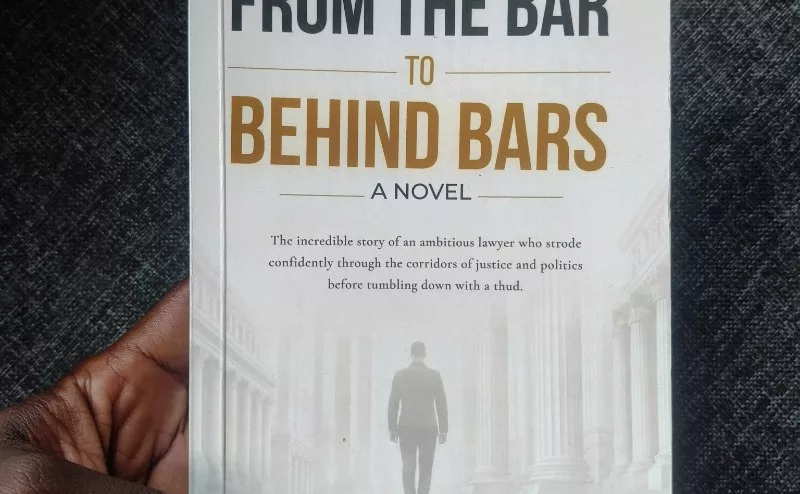 The novel ‘From The Bar To Behind Bars’ / BRIAN OTIENO
When Joseph Musyoka was preparing to leave Kamiti Maximum Security Prison after eight years, he had only one thing in mind.
He wanted to have a final word with the one person who seemed to have a brilliant mind and a powerful command of the legal system. This man had helped him get his sentence overturned, from life imprisonment to freedom, but talked very little.
Musyoka had been convicted by a magistrate’s court of defiling an 11-year-old girl and sentenced to life imprisonment.
His appeal to the High Court was unsuccessful because he was unrepresented due to poverty and he had subsequently resigned himself to fate.
But Josiah Midhiambo Otada, his relatively new cellmate, became inquisitive when he saw Musyoka looking downcast after his appeal was rejected by the High Court. He asked him to share more about his case.
After listening to Musyoka’s account, Otada encouraged him to lodge a second appeal at the Court of Appeal.
Since Otada appeared well-versed in legal matters, Musyoka had no option but to try his luck a second time.
After all, there was no harm in trying.
The appeal was successful, and Musyoka was declared a free man, prompting his desire to thank the man he strongly believed was responsible.
It was then, on Musyoka’s final night in prison, that Otada narrated to him how he himself had ended up there in the first place.
The two names are fictional and feature in the novel From The Bar To Behind Bars, authored by Willis Oduor Oluga, an advocate of the High Court, and set in Kenya.
The novel explores the dark realities of corruption, greed and moral decay, highlighting the devastating impact these vices can have on an individual’s life and on those around them.
The story follows Otada, an ambitious lawyer who rises through the legal, judicial and political ranks but is ultimately consumed by his own dreams, desires and perversity.
Despite coming from a humble background, Otada realises his dream of becoming a lawyer, driven by the injustices he witnessed and experienced in his early life, despite several heartbreaks along the way.
He achieves his dream but quickly discovers that having a dream is far easier than living it.
Instead of becoming the reformer he once envisioned, he turns into a wrongdoer, blinded by ambition and undone by his own wayward excesses. This sends him spiralling downwards, a decline that also affects those closest to him, including some of his kith and kin.
Oluga is a keen observer of how life is supposed to work and how it actually does, particularly when he is not in court vigorously defending his clients’ rights.
He told the Star he was inspired to write the book by the need to expose the ills in Kenyan society, which many people pretend do not exist or simply choose to ignore.
“The book is intended to provoke the thinking of the reader to look at life with a new lens and make sense of a country where the rulebook changes faster than the weather,” he said.
He said the book focuses on four areas of societal ills: social, judicial, governance and professional. These combine to disadvantage others but ultimately also consume those who perpetrate them.
“From The Bar To Behind Bars is a fictional book that captures what actually happens in Kenya, but is told in a funny and captivating manner,” he said.
In the novel, Otada’s social life is a stark reminder of the ills that occur in society.
“He is a Christian Union chairman and when he gets married, he projects the image of a perfect husband and father. He even goes to church with his family every Sunday," Oluga explained.
“But behind the scenes, he is cheating on his wife.”
“These things happen daily in our society, but people pretend they don’t. Kenya is predominantly Christian, but we pretend a lot," Oluga added.
“My idea is to highlight the social ills that happen daily in our lives. I do so in a humorous and satirical way so that any person reading the book can reflect on their own life.”
He said he had so far received numerous calls from readers who told him the book had touched them by making them think about the kind of lives they were leading.
“Others have told me that when they read the book, they think that I wrote about them. The book is practical, real and relatable,” he said.
The book also highlights misconduct in the workplace, focusing on the Judiciary.
For instance, Justice Bubu and Ochieng, the investigating officer, received bribes and bungled the murder trial of Oliech.
Justice Otada received a bribe and ruled in favour of a developer who had built a faulty building.
The building later collapsed, killing several people, including Otada’s own relative.
“Corruption is expensive. It carries along devastating consequences, including the loss of the most precious possession — life,” Oluga told the Star.
“But people involved never really get away with it. They always pay the price. Justice Bubu lost his own life while on his way from collecting a bribe. Ochieng lost his job when he was caught receiving a bribe. Justice Otada was compelled to resign from being a judge,” he said.
The book also highlights sexual misconduct in the workplace.
Justice Otada was involved in an illicit affair with his married deputy registrar, which led her to break up with her husband.
He also sexually harassed his legal researcher.
The novel highlights how elected political leaders abuse their offices for personal gain.
Governor Warrior and Governor Otada are in office not to serve the people but to steal public funds.
“But the book doesn’t just highlight bad leadership. It reminds the electorate that those bad leaders are their choices. Kenyan voters like electing bad people into office. The book is intended to provoke the minds of voters to vote wisely,” Oluga said.
The book reminds professionals to practise their trades diligently and with the utmost professionalism.
When Otada was a practising advocate, he was negligent and signed land sale documents without caring to establish whether the landowner was actually selling the land.
The matter escalated into a major family dispute, in which it emerged that prime property worth billions of shillings had been sold fraudulently without the owner’s knowledge.
As a result of his failure to act professionally, Otada lost his job as a judge.
The negligence came back to haunt him seven years later and cost him dearly.
“As professionals, we should do our work professionally; otherwise, the consequences of being casual can be expensive.
“Also, young professionals should not be greedy. Because of his greed and desire to get rich quickly, Otada edged his bosses out of the law firm but ended up failing spectacularly in his legal practice because the firm was getting clients through the owners’ connections and networks,” Oluga said.
Instant analysis
The 226-page novel is set in Kenya and is relatable to millions of Kenyans. Otada’s story is told through a satirical but realistic takedown of legal practice, justice, power, social life and the rot in between. With deadpan humour and a Kenyan lens, Oluga highlights the contradictions of everyday life.