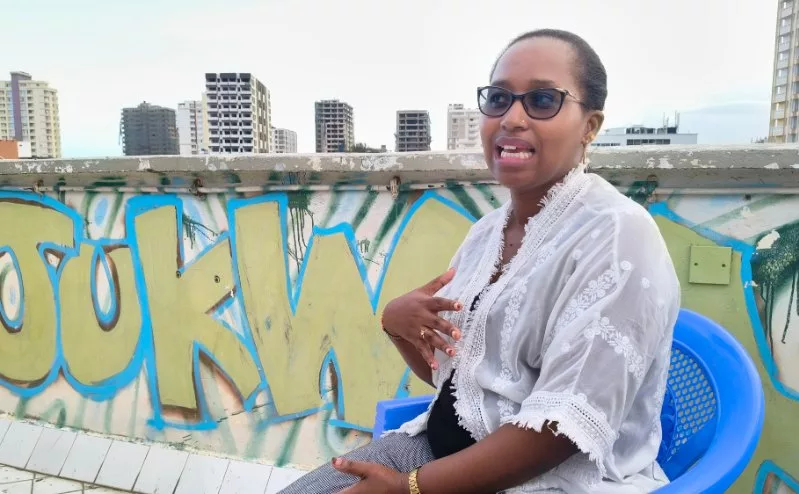
 Meet Caroline Ngorobi, the founder of Jukwaa Arts Productions.
She was born in Tana River county and describes herself first as a woman, and then as a theatre-maker, director, producer and festival curator.
Meet Caroline Ngorobi, the founder of Jukwaa Arts Productions.
“I think I’ve always had an interest in the arts, but I got active in the arts immediately after high school, going to the theatre at Alliance Française and the Kenya National Theatre in Nairobi," she says.
“Just before I joined campus, that is when I started going to the theatre,” she says.
She was lucky the first time.
Her first-ever audition in 2005 was successful, and she got a role with Heartstrings Entertainment, the most popular authority in Kenyan theatre and live stage comedy in the country.
“So, I started as an actor, and since then I have been in the arts. I have worked with different production houses and even tried my stint on TV and a bit of film, but eventually I just went back to theatre. Theatre is what spoke more to me,” she says.
Since she was a baby, she has always taken a liking to performing. Whether it was throwing tantrums, making an entrance or an exit — it always had to be with a bang!
And so, when she was learning her ropes at Moi Nyeri Complex Primary School in Nyeri, her trait was easily spotted, and she was quickly drafted into the primary school’s skits and dramas that were performed on special occasions, including during drama festivals, before sitting her KCPE examination in 1999.
An avid reader of books and any written material, and an excellent writer herself, Ngorobi found herself gradually falling in love with theatre.
At Naromoru Girls High School, her acting was perfected as she fell deeper and deeper in love with the performing arts.
“In high school, I knew I wanted to do arts. I was keen. But after high school, after my KCSE examination in 2003, is when I literally started going to the theatre to watch shows. That was in 2004,” she says.
That is how she found herself auditioning for a role in 2005 and getting it with Heartstrings Entertainment at the first time of asking.
“The first play I did was called It Runs In The Family and it was my first professional experience with theatre. I got paid for it too, and so that was my first job,” she says.
She performed the role so well that she received newspaper reviews — her first time featuring in the national press.
From then, more roles came with different plays and different experiences, making it her livelihood.
She joined the University of Nairobi, where she undertook her Bachelor’s degree in Arts, graduating in 2009, and later her Master’s degree in the same field, graduating in 2015.
“I had an experience with doing performances, especially around social change, around the post-election violence of 2007-08," Ngorobi says.
“Going to communities with a play to speak on peace, for me, that really spoke to me and I felt the impact of the work. So that is what really drew me to what I am doing today.”
She says although the post-election violence (PEV) did not affect her personally as much, she lived the experiences through other people while she performed in different parts of the country.
She recalls them being bittersweet moments for her.
Bitter because she could see the pain that her audiences had to relive as she performed plays centred on the PEV and peace, but sweet because the plays they produced triggered conversations around topics that most people were afraid to address.
“It was around 2009 and there was a lot of conversation around Agenda Four towards the Katiba Mpya. There were a lot of peace conversations,” she said.
Around that time, there was a project under Heartstrings Entertainment called Kenya Burning. The project was aimed at spreading peace.
“We toured a good part of this country, performing plays on peace. For me, it was very moving. Some were very difficult because you meet people who actually lived through the centre of PEV, the proper victims of PEV.
“For me, Naivasha was a very hard show. Eldoret and Kericho were also very hard places. You see, I had only watched the PEV in the news, but here we were, talking to the people who experienced it first-hand,” she says.
Some of their audiences became cold during their performances because they could relate, and the shows triggered emotions they would have rather left in the past.
“That was a very difficult time for me too. It made me take a step back and relook at life. We should not take peace for granted,” she says.
Ngorobi says the arts industry in Kenya has been improving, with artists securing better pay compared to earlier years.
This is because, she says, more people have dignified the arts and appreciate the sector as an industry and a viable career.
“Even my parents now appreciate that I have a job. Before, they could not understand why I was not looking for ‘a job’ but was only concentrating on acting. They did not understand that I already had a job and it was acting,” the Jukwaa Arts Productions founder says.
Now, parents themselves take their children to theatres and stage plays, showing appreciation for the career and seeking guidance for children who show interest in the arts.
She says the audience has grown across the country, as have production houses, signifying overall industry growth.
“Before, tickets used to go for as low as Sh250, and still people would not come to watch plays in theatres. Today, tickets go for as much as Sh3,000 and people still purchase them. It is really encouraging,” Ngorobi says.
However, she laments the lack of public theatres, especially in Mombasa, where the Little Theatre Club (LTC) is the only public theatre available. The venue is also embroiled in a dispute with the Kenya Railways Corporation, which claims ownership of the land where the LTC sits.
The state corporation has since issued an eviction notice to the LTC, which, at a 180-seat capacity, is seriously restricted, leaving its operations in limbo.
“Sometimes we do our shows at private theatres like the Nyali Cinemax, which are expensive to secure. For Mombasa, we don’t have infrastructure. We don’t have spaces for arts,” Ngorobi says.
She says Kenya is lagging behind in terms of government support for the arts and creative industry, unlike other countries she has toured.
A member of the International Society for Performing Arts, Ngorobi has travelled globally through her craft and seen countries like Singapore, the US, India, and Ivory Coast support their artists.
“We should have something like an Arts Council where artists can go and seek funds to support the production of work,” she says.
Ngorobi is now archiving culture to prevent it from being lost to younger generations.
Kenya is underselling its culture, she argues, and aspects of it risk being lost because younger generations, such as Gen Z, are less engaged with it.
“I am a lover of culture and very curious about different cultures. I started working around Mijikenda culture and did a project called Chimidzimidzi. We worked with Mijikenda elders and artists on this to bring back to life ceremonies of the Mijikenda. These include naming ceremonies, wedding ceremonies, and death ceremonies, among others,” she says.
Ngorobi is preparing to host a five-day multi-disciplinary festival in Mombasa called the Wimbi la Sanaa Festival, set for October 6-10.
“This covers all art forms. We built this festival to create a platform for emerging artists. There are no festivals that programme artists without a name. You have to have a name for people to call you for their events,” she says.
The festival will be hosted at the Little Theatre Club for three days, before moving to Alliance Française in Nyali for the fourth day, and concluding at Wild Waters on the fifth day.
More than 300 artists, including performers from Spain, Uganda, Zimbabwe, Togo, and other parts of the world, will participate.
“Out of the five days, we will have one day dedicated to female artists,” she says.
Ngorobi emphasises that financial literacy is vital for artists, as it is where many face challenges.
“We need to be taught financial literacy and fame management, because I think those two things go hand in hand. And fame is probably harder to manage than being rich,” she says.
Given the unpredictable nature of the industry, an artist cannot predict how a month, a quarter, a half year, or a full year will unfold financially.
“This month, I earn Sh100,000, next month I earn Sh21,000, and the next I earn Sh300,000. So, the month I earn Sh300,000, I live like that is what I earn every month, but that is not my reality,” Ngorobi says.
“But because I am famous and I have an image to portray or keep up, I do it, and it affects me.”
However, she notes that contemporary artists are faring much better than older generations by living more responsibly and within their means.
“It’s still a work in progress. But it is important for artists to realise that this gig is not the same as the next one, lest one gets frustrated,” she says.
That is why she argues the industry needs standardisation.
“That is why we need something like a council to regulate the industry,” she says.
Ngorobi notes that although working with Gen Z can present challenges, mutual understanding yields exceptional commitment.
“They are not afraid to do things. They can be go-getters. I have seen them do things that I wouldn’t do in the name of pushing for something. They are not embarrassed to push for something,” she says.
“I borrow from them. Let’s dare like them.”