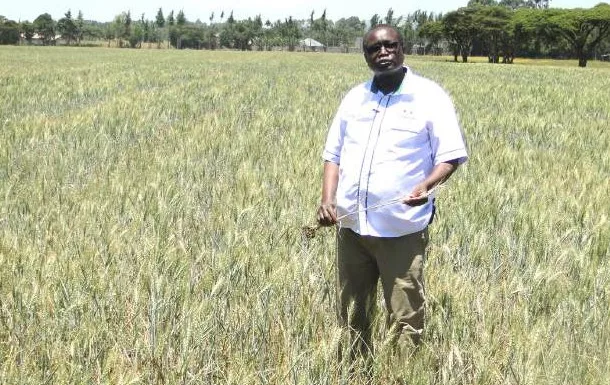
WHEN Vincent Chelule walks through his wheat fields in Chesoton, Njoro, he sees more than a crop. He sees a family tradition that began with his father, a livelihood he once abandoned, and a business he returned to despite the growing difficulties of producing wheat in Kenya.
Chelule started growing wheat in 1994 after watching his father farm the crop. He admired the work and decided to follow in his footsteps.
But after several years, rising production costs and declining yields made him question whether wheat could continue to sustain him. “I realised that there were many challenges and that my production was going down instead of increasing,” he says.
He eventually stopped growing wheat and later returned to farming with a different interest — producing seed. Today, he works with the Kenya Agricultural and Livestock Research Organisation (KALRO) as a contracted seed producer, growing varieties developed through research at the organisation’s Njoro centre.
Chelule has about 20 acres of land, although he rotates crops and does not plant wheat on all of it every season. Last year, about 10 acres were under wheat.
On another two-acre plot, he planted seed wheat, including the KALRO variety Jacana, which he had grown before. “I planted the Jacana variety last year and the seed performed well, so I decided to plant it again,” he says.
His decision to remain in wheat farming comes at a time when production costs, unpredictable weather and poor prices are testing farmers across the country’s wheat-growing regions.
Kenya produces only a fraction of the wheat it consumes, with imports making up most of the deficit. The country produced about 350,000 tonnes of wheat in 2024, while annual consumption was estimated at between 2.2 million and 2.4 million tonnes.
Yet the large deficit has not automatically translated into better returns for farmers. “The market exists, but the problem is the price,” Chelule says. The
contradiction is at the heart of Kenya’s wheat problem. There is demand for the crop, but farmers must contend with expensive seed, fertiliser, chemicals, fuel, machinery and labour before they can harvest it.
For Chelule, the market has been particularly difficult in recent years. He recalls a period when farmers harvested their wheat and kept it in stores because buyers were unavailable. Some eventually sold at low prices simply because they needed to clear their stores for the next crop. “Imagine harvesting in August and still having the wheat in your store in November,” he says.
The cost of production has also risen. Chelule estimates that producing an acre of wheat can now cost more than Sh50,000 when land preparation, seed, fertiliser, chemicals, labour and harvesting are taken into account.
Dr Martin Lagat, a wheat breeder at KALRO’s Njoro centre, says, “The high cost of production is among the factors contributing to declining wheat production.”
He adds, “Land, labour and farm inputs have all become more expensive, while land fragmentation has made wheat farming more difficult because the crop is highly mechanised.”
Farmers therefore have to consider whether wheat offers a better return than other crops they could grow on the same land. In some areas, agricultural land is also increasingly being subdivided for other uses, reducing the acreage available for wheat and other food crops.
For Chelule, the calculation is simple: if production costs continue rising while the price of wheat remains low, farmers will look elsewhere. Many have already done so.
One way KALRO is responding is through wheat breeding. Since the mid-1970s, the organisation has released almost 40 wheat varieties, with the aim of improving yields and giving farmers varieties that can withstand some of the stresses affecting production.
According to Lagat, the yield potential of wheat varieties has increased considerably over the decades. Modern varieties can have a potential yield of about eight tonnes per hectare under suitable conditions, compared with about 1.5 tonnes for varieties released in the 1970s.
But a variety’s potential means little if farmers cannot access the seed or do not adopt it. Lagat says limited resources for promoting newer varieties and gaps in seed availability have slowed variety replacement.
At Njoro, breeders work with wheat lines from Kenya and other parts of the world. They select for yield, disease resistance and adaptation to different growing conditions before promising lines undergo further trials and, eventually, national performance testing.
The process is intended to produce varieties that can perform under the realities faced by farmers. These include drought and water stress, acidic soils, declining soil fertility and diseases such as rust.
Chelule’s relationship with KALRO has made him particularly interested in varieties that can withstand disease. He says wheat rust has become one of the biggest threats to production, which is why he pays attention to the varieties he plants.
“The reason I work with KALRO is that wheat rust has become one of the major challenges in wheat production,” he says.
At KALRO’s Njoro research station, plant pathologist Dr Zennah Kosgey spends much of her time studying that threat. The centre is home to an international wheat disease-screening platform established after the emergence of the Ug99 stem rust race, which raised concern because of its ability to attack wheat varieties that had previously been considered resistant.
Today, researchers screen thousands of wheat lines from Kenya and other countries for resistance to stem rust, yellow rust and other diseases. Kosgey says about 25,000 wheat lines can be evaluated for stem and yellow rust.
Stem rust attacks the stem of the wheat plant, while yellow rust mainly affects the leaves. Severe infection can reduce the plant’s ability to develop grain properly and eventually lead to substantial yield losses.
The researchers deliberately create conditions that allow diseases to develop so they can determine which wheat lines are resistant and which are susceptible. Breeders such as Lagat then use the information when developing new varieties.
But resistance is not necessarily permanent. Pathogens can change, allowing a disease to overcome resistance that once protected a variety.
Kosgey therefore advises farmers to combine resistant varieties with good crop management and, when necessary, approved fungicides. She also urges farmers to scout their fields early rather than waiting until disease has become severe.
“You’d rather prevent it than curing it later on,” she says. For farmers such as Chelule, early detection matters because disease can turn an otherwise promising crop into a loss.
Disease is not the only uncertainty facing wheat farmers. Weather has become another major concern. Chelule says the seasons are increasingly difficult to predict.
“You may expect rain and get drought, or expect drought and get rain,” he says. This season, he experienced both extremes. Excessive rain around planting affected germination in some areas, followed by a dry spell when the crop was still developing.
Later rains came when they could no longer fully compensate for the earlier stress. Lagat says breeding work is increasingly focused on varieties that can tolerate water stress and other environmental challenges.
KALRO is also exploring traits such as tolerance to acidic soils and efficient use of nutrients. Kenya’s wheat is grown mainly under rain-fed conditions, making farmers particularly vulnerable to changes in rainfall patterns. Irrigation could provide another option, although it would require investment and suitable water resources.
Weather can also affect harvesting. Too much rain and wind may cause lodging, where plants bend or fall to the ground, making harvesting difficult and potentially reducing yields.
For Chelule, this uncertainty makes variety selection important. He says Jacana may not guarantee a profit in a difficult season, but it can give a farmer a chance to recover the money invested in the crop.
Producing seed also requires more care than growing wheat purely for grain. Chelule says seed fields have to be inspected and off-type plants removed so that the harvested seed remains true to the required variety.
After harvesting, the work continues. Cavin Otieno, a seed scientist at KALRO, says seed lots must undergo inspection by the Kenya Plant Health Inspectorate Services (Kephis) and processing before they can be packaged and sold.
The harvested seed is weighed and taken to storage, where records are reconciled. Before cleaning and packaging, the seed lot is inspected for certification. It is then passed through cleaning equipment that removes weed seeds, chaff, stones, broken seeds and other impurities.
The cleaned seed is subsequently treated to protect it against diseases before packaging. For farmers, access to quality seed is therefore part of the larger wheat equation.
A high-yielding variety developed through years of research cannot benefit farmers if certified seed is unavailable or too expensive. Chelule believes seed production offers better returns than ordinary grain production, which is one reason he has remained in the business.
But he says even seed farmers face high costs and strict production requirements. His experience brings the problem back to where his wheat journey began: economics.
He has seen wheat farming through several cycles — from following his father into the crop, to abandoning it when production became difficult, and then returning through seed production.
He remains in the crop because he believes better varieties can help farmers cope with some of the challenges. But he also knows that better seed alone cannot solve the problem.
Lagat says policy intervention is needed to address production costs, market conditions and the country’s heavy dependence on imported wheat. Without such measures, farmers may continue shifting to crops that offer more predictable returns. Chelule’s own calculation explains why.
“If you sell one 90-kilogramme bag at Sh6,000, eight bags will give you Sh48,000,” he says. “So you need to harvest more than eight bags to cover your costs.”
For a farmer who has spent decades growing wheat, the decision to continue is therefore not simply about tradition. It is about whether the crop can survive the pressures of rising costs, changing weather, disease and an uncertain market.
For now, Chelule is still planting. And he is betting that better seed, better management and better seasons can keep wheat worth growing.