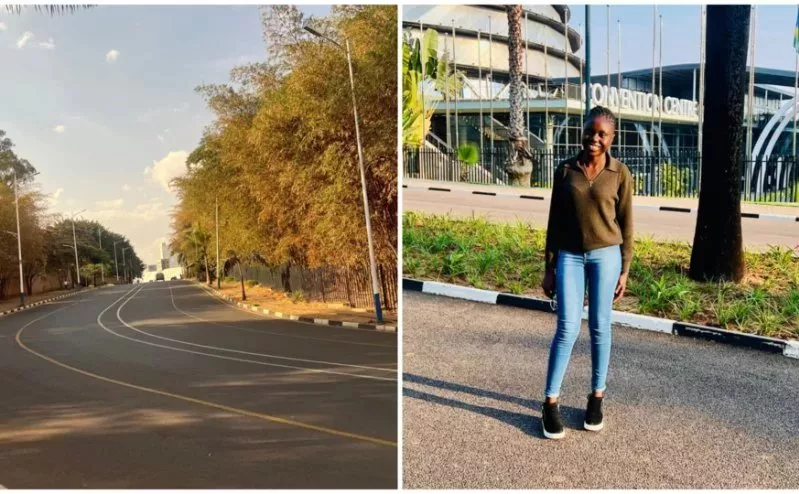
 A clean and marked road leading to Kigali Convention Centre, where the writer poses on the right - PERPETUA ETYANG
I recently travelled for a climate workshop in Rwanda but came back with more lessons than I’d bargained for.
A warm and welcoming weather greeted me when I landed at Kigali International Airport en route to a journalists' training organised by Power Shift Africa. I was eager to learn but also to explore.
We were cleared by immigration and made our way to the exit, where a man held a placard with my name boldly displayed. As we headed to the hotel, he told me stories about the city, and his stories only heightened my curiosity.
Every evening after the training, I set out to explore Kigali. What started as a three-day professional trip slowly became a personal journey through a city that seemed to have lessons waiting around every corner.
FOOD PRICE VOLATILITY
For two days, African media and policymakers discussed climate adaptation priorities for agriculture and food systems. They debated how to move from being the hungriest continent and the media's role in that shift.
Together, we explored the climatic, political, structural and economic factors that keep the continent food-insecure, and how to address them.
In Rwanda, we were reminded that Africa's food import dependency goes beyond climate change and El Niño. Food systems sit at the heart of our societies and economies, determining what people eat, how food is produced, how farmers and other workers earn a living, how natural resources are used and how communities respond to shocks.
Climate change is changing the conditions under which these systems operate. Droughts, floods, extreme temperatures, changing rainfall patterns, pests and other climate-related pressures are piling pressure on communities, with consequences that reach far beyond farms.
From Lagos to Lome and Kinshasa to Kigali, food prices are volatile. This tends to have a negative effect on household incomes and other connected indicators, including nutrition, public health, trade, migration and economic stability.
As Mohamed Adow, director of Power Shift Africa, reminded us, stories about food and climate are scarcely just about environmental pressures on the planet.
“This is most importantly about people, livelihoods, economics, public policy, investment, technology, inequality and development,” he said.
But once the day's discussions ended, I was not ready to return to the hotel and call it a day. Kigali was waiting, and so was my curiosity.
EYE-CATCHING CITY
One of the things that caught my attention was the cleanliness of the city. The roads were clean, the surroundings orderly.
How, I wondered, does a city maintain this level of cleanliness? Who cleans the roads? What happens when people break the rules, and what makes people follow them?
During one of my outings, I met Regis, a boda boda rider at the Kigali Convention Centre. My curiosity was sparked by him having two helmets, one for himself and another for his passenger.
As we talked, Regis explained that the practice was part of a broader culture of order and responsibility that he associates with Kigali’s reputation as a smart city.
“In Rwanda, we are smart. In fact, we are called the smart city,” he said.
“The government has done sensitisation. We clean the city and those who clean are paid per month. Only women do the cleaning because men handle the other hard work.”
Our conversation then turned to Kigali’s greenery and the city’s approach to environmental protection.
Regis said the trees and plants lining the city are part of deliberate efforts to protect and restore the environment.
“All of these trees you see in Kigali, they are planted by the government,” he said.
“Rwanda takes care of its environment and we protect environmental degradation. There is no deforestation here. There is only afforestation and reafforestation.”
The Rwandan government has adopted an approach to urban management that focuses on environmental health and sustainability.
One of the initiatives I learnt about is Umuganda, a national community service day held on the last Saturday of every month.
During Umuganda, citizens clean streets, maintain public spaces and participate in environmental conservation activities.
The idea reinforces a collective sense of responsibility and encourages residents to take an active role in maintaining their neighbourhoods.
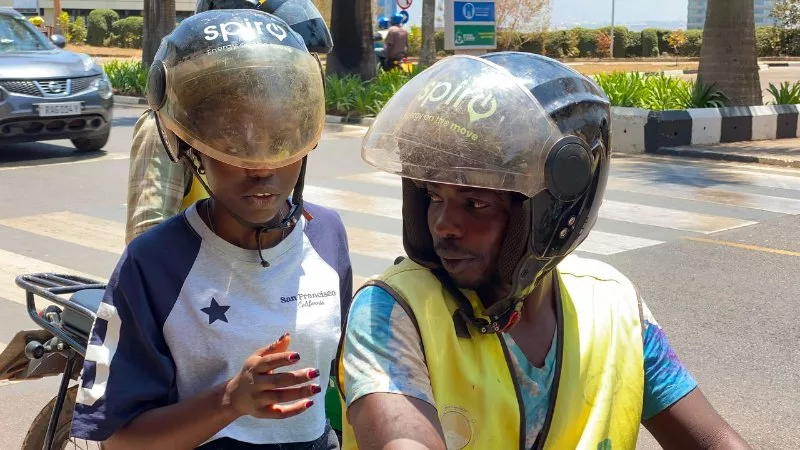 Journalist Perpetua Etyang rides a boda boda in Kigali, Rwanda / PERPETUA ETYANG
That is perhaps what struck me most. Cleanliness is not presented simply as the government's job. It is something citizens participate in, creating a culture in which people are expected to take ownership of their surroundings.
Community-driven efforts extend beyond Umuganda. Neighbourhood committees and local councils work with residents to address issues affecting their communities, while citizens are involved in decision-making processes, particularly in urban development and environmental policies.
The approach encourages residents to take ownership of the city and its sustainability efforts. Perhaps that is one of the lessons Kigali offers: A clean city cannot depend entirely on someone else. It requires systems, enforcement and people willing to take responsibility for the spaces they share.
The government has also adopted strict policies on waste management and environmental protection. Rwanda banned non-biodegradable plastic bags in 2008, making it one of the first African countries to adopt such a legislation [after South Africa introduced restrictions in 2003 and Eritrea an outright ban in 2005]. Laws against littering, illegal dumping and pollution are enforced, with fines imposed on those who fail to comply.
Walking through the city, the effect of these measures was visible. The cleanliness I had noticed was not an isolated feature; it was connected to policy, enforcement and participation.
KIGALI AFTER DARK
One evening, my colleague Fredah and I set out for a walk because we wanted to see Kigali at night. As we walked, admiring the city, our attention was drawn to the Kigali Convention Centre.
Located on Highway KN5, about 6km west of Kigali International Airport, the gigantic Convention Centre covers 53,000 square metres and is the largest in the region.
It has four major components: a five-star hotel with 292 rooms on six floors, a conference centre with a seating capacity of 2,600, the Kigali Information Technology Park and a museum.
At night, the building became part of the city's character, standing out as Fredah and walked through Kigali.
We later went to explore the Kigali nightlife, where we enjoyed the music and some soft drinks. It was a simple but memorable way to wrap up the day. There was more to Kigali than conference rooms, policies and questions about development.
The following day would take me to a very different side of Kigali.
On the last day, I set out to visit the Kigali Genocide Memorial. It was a different kind of exploration, one that took me away from the clean roads and bright city lights and into a painful chapter of Rwanda's history.
The Kigali Genocide Memorial is the result of a collaboration between Rwandan authorities and the Aegis Trust for Genocide Prevention, born from the National Holocaust Centre in the UK.
Opened in 2004, the memorial became the starting point for peace and values education, now built into Rwanda's national schools curriculum.
The memorial also aims to strengthen community resilience against division and is described as ripe for adaptation and use internationally.
After the genocide was stopped in 1994, Kigali's authorities chose the hillside in Gisozi for mass graves, where 250,000 residents murdered during the genocide could have their final resting place.
Memorial buildings were later put up beside the mass graves. Survivors, their experiences and their testimonies are at the heart of the Kigali Genocide Memorial, which also hosts the Genocide Archive of Rwanda.
Many survivors speak of the memorial as their home. Standing at a place of remembrance, I was seeing another side of a country whose story could not be told only through its modern buildings and clean streets.
I arrived in Rwanda for a three-day journalists' training on climate adaptation priorities for agriculture and food systems. But I left with lessons that stretched far beyond the conference room.
The workshop reminded me that climate stories are ultimately stories about people, livelihoods, economics, policy and development.
Kigali added another layer, showing me the visible side of policy through its roads, public spaces, environmental practices and systems that shape everyday life.
At the Genocide Memorial, I encountered a different story of a country confronting its past and preserving the experiences of survivors.
As I packed my suitcase to return to Kenya, I wondered: What could our own cities look like if cleanliness, environmental protection and civic responsibility became everyone's business?