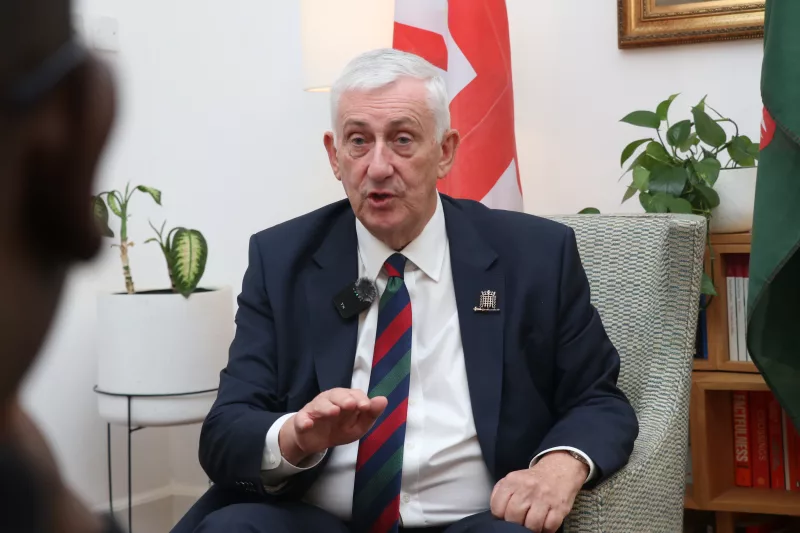
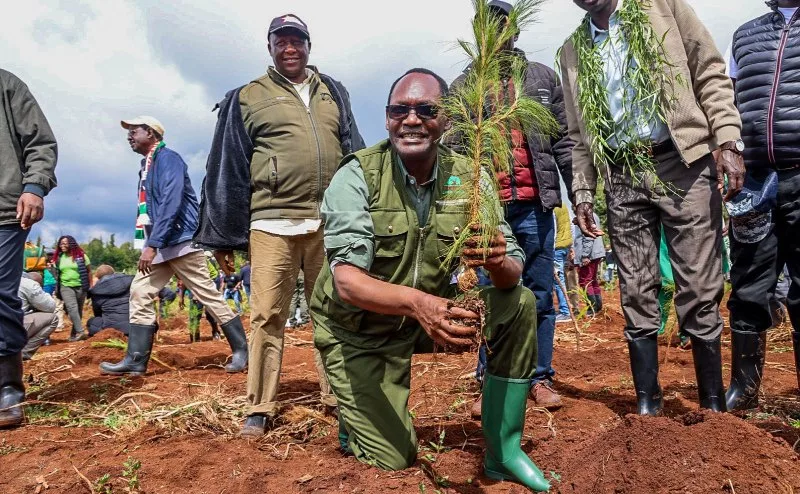
 National Treasury PS Chirs Kiptoo during the 9th Edition of the KICP event at Kibkabus Forest within the Kaptagat Fores ecosystem
When National Treasury PS Chris Kiptoo launched the Kaptagat Integrated Conservation Programme 10 years ago, he did not know the model would become a national movement and a living demonstration that conservation and livelihoods can grow together.
Currently, the model has not only been adopted by other Cabinet Secretaries and Principal Secretaries, but it is also being used to improve forest cover across 30 landscapes and is being applied to meet the15 billion trees target by 2027.
The PS, who is also the patron of the KICP, spoke to the Star about his conservation journey.
What is your personal feeling as KICP marks 10 years of conservation pioneered at the Kaptagat Ecosystem, and which is now being replicated nationally?
It is deeply humbling. I was born in this landscape, the greater Cherangany-Elgeyo hills along the edge of the Great Rift Valley. As I grew up, I watched the rivers dry and the forest recede. I felt I had to do something.
In 2017, we started small: Fifty hectares at Bombo Forest block and 60,000 indigenous seedlings. Ten years later, we have rehabilitated more than 3,500 hectares across the five forest stations (Kaptagat, Penon, Sabor, Kessup and Kipkabus) and planted moret than three million trees, of which more than 1.6 million are indigenous.
The forest cover in the Kaptagat blocks has increased by nearly 28 per cent since 2017. My strongest feeling is gratitude to the community forest associations, the county governments of Elgeyo Marakwet and Uasin Gishu, Kenya Forest Service, World Wide Fund for nature-Kenya (WWF-Kenya), United Nations Development Programme(UNDP), The Nature Conservancy, private partners and thousands of ordinary Kenyans who showed up year after year. One small, consistent action became a national movement and a living demonstration that conservation and livelihoods can grow together.
Looking back on the 10 years that I have served as patron of the Kaptagat Integrated Conservation Programme, one lesson stands out: Never underestimate an economy powered by the forest. Never underestimate the impact of planting a single tree, and never underestimate the power of one person determined to restore a forest.
What is your feeling when you witness what you started being replicated in Ngong and other forest ecosystems?
I feel vindicated, not celebrated. We never started for recognition. We started because we asked a simple question: Wy do people destroy the forest? The answer was survival and livelihoods, not criminality.
A mother needed firewood, a youth needed income and grazing for their livestock. Once we started addressing those drivers, the forest began to recover. Seeing the Kaptagat model adopted by fellow Principal Secretaries and Cabinet Secretaries across more than 30 landscapes, Mau, Mt Elgon, Ololua, Loita, Cherangany, Kakamega, Maasai Mau and others is very reassuring. It confirms our core belief: You cannot conserve a forest without taking care of the people who live around it. The ‘whole-of-government, whole-of-society’ approach that started in Kaptagat is now a national blueprint powering Kenya’s 15 Billion Trees campaign.
Describe your journey in service to humanity in public service and now in conservation.
My entire private and public-service career has been about building an economy that serves people. I started this initiative in 2010 while in the office of the Prime Minister and later as Trademark East Africa Kenya country director. When I became Principal Secretary in 2015, I suddenly had a larger platform and, therefore, started the idea of annual editions in 2017. Conservation is simply an extension of that mandate. For me it has never been environment versus economy. It is an economy powered by the forest, water for Eldoret and the Kerio Valley, the larger Nyanza and Western, carbon sequestration, high-altitude training grounds that produce world champions, and now high-value crops and dairy that put money in farmers’ pockets.
Briefly explain to us the origins of Kaptagat Ecosystem conservation from its nascent stages to date. What inspired the environmental conservation passion in you?
Growing up in the landscape, I saw rivers drying and forests thinning, and this is confirmed by available data. The Cherangany-Elgeyo Water Tower, which has 414,928 hectares spanning four counties and 22 forest blocks, lost 41,547 hectares of forest between 1990 and 2019, while cropland expanded by 115,000 hectares. Grasslands collapsed.
Kaptagat is a critical block of the Cherangani Water Tower. The inspiration was personal and practical: restore the water tower. The first edition in 2017 was simply tree planting. We quickly learnt that without addressing livelihoods, the trees would not survive. That is when passion became a programme.
At what stage did the individual passion in you evolve into what KICP has become?
Immediately after the first edition. I realised that if a mother still needed firewood and a young person still needed cash, they would be back in the forest the next morning. Passion had to become a structured, community-owned programme. We brought together the CFAs, the two county governments, KFS, research institutions, development partners and the private sector. Today, KICP is community-led and a big movement. I am only the patron, supported by a large team of dedicated people.
Briefly expound on the KICP four-pillar model, its inception and the thought behind its beginning.
We decided to address the drivers of degradation, not just the symptoms. That produced four interlocking pillars that form a circular economy that include Mazingira Safi — restore Forest, water catchments and biodiversity; Maji Safi Nyumbani — provide clean water to homes for domestic and irrigation use; Kawi Safi Nyumbani — provide clean energy and reduce or eliminate firewood dependence; Pesa Mfukoni — provide money in the pocket through sustainable income; and, Afya Bora — Good Health as an additional pillar 10 years later.
One pillar feeds the other. It is a circular economy model. biogas unit using waste from a cow reduces pressure on the forest; a dairy cow and an acre of avocado gives a family income and that makes conservation rational.
How have the four pillars spiralled into a real-time environmental and livelihoods enhancement model?
The model works because real benefits are visible and immediate. Households now have milk, fruit, coffee and avocado income, clean water and clean energy. Forest cover is recovering, springs that had dried are flowing again, and the same communities that once opposed fencing now support it because they see the gains. The model is no longer a project; it is a way of life that communities own.
What is the direct impact of the four-pillar model?
Crops and dairy have started to change or enhance the household incomes. Alternative energy has continuously contributed to reduction in firewood pressure and reduction in forest destruction.
Hundreds of improved heifers and Dorper sheep have been distributed; milk production and household nutrition have risen. More than 500 hectares of Hass avocado, thousands of coffee, tea and now cocoa seedlings have been planted. Cocoa in particular offers exceptional returns, a net income of more than Sh550,000 per acre, while adding tree cover; Biogas units and LPG cylinders measurably reduced firewood demand and illegal charcoal production. Water infrastructure has reached thousands of households and created thousands of jobs during dam and pipeline construction and green jobs through irrigation.
Kaptagat is one of Kenya's premier high-altitude sports training destinations, renowned for producing world-class athletes and attracting elite runners and cyclists from around the globe. Combined with its rich cultural heritage, breathtaking landscapes and thriving agricultural economy, Kaptagat is uniquely positioned to become a leading conservation, sports and eco-tourism destination. The Kaptagat forest ecosystem, therefore, offers a range of signature experiences that turn nature into a sustainable conservation economy.
Explain the fencing being undertaken by KFS and its direct bearing on future generations.
The 273km solar-electric fence was announced by President William Rutto during the 9th Edition and was formally launched by Deputy President Prof Kithure Kindiki. The fencing project is not meant to lock people out from accessing the forest. Rather, it secures the boundary and allows natural regeneration and guarantees that Kaptagat remains a water tower, a carbon sink and a world-class athletic training ground for the next generation. More importantly, the 17 user rights guaranteed under the Forest Conservation and Management Act will continue to be enjoyed by surrounding communities through controlled access points.
Briefly outline the working of KICP as envisaged by its founders
KICP is a partnership. Community Forest Associations lead; national and county governments, KFS, NGOs, development partners and the private sector support. Our mobilisation tools are the annual Tree-Growing editions, the Kaptagat Forest Marathon (now including a full 42km race) and the Kaptagat Cycling Challenge, with culture as a key blend and driver of conservation. The simple equation that captures everything is One Kilometre, One Acre, One Cow: every kilometre fenced, run or cycled restores an acre and empowers a family.
As we look back on the last 10 years and the next decade — ‘10 to 20’ — our goals are clear: Restore More, Sustain More and Transform More and turn Kaptagat into a world-class conservation, sports and ecotourism hub with nature trails, running tracks and cycling routes — a Karura of the North Rift.
The lesson of the first decade of the Kaptagat Integrated Conservation Programme is simple: Never underestimate the power of a forest to power an economy.
Never underestimate what one tree can become. Never underestimate what a community united around restoration can achieve. Never underestimate the difference your contribution can make, because every tree planted is an investment.
Every forest restored is an economy renewed, and every person who takes action becomes part of the solution.