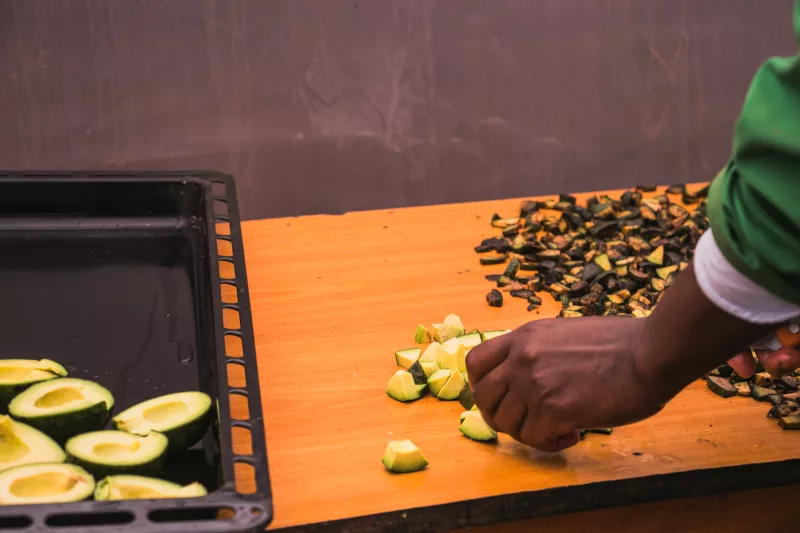
 Slices of avocado displayed before being transformed into oil / HANDOUT
Creamy, green and rich in flavour, the avocado has long held a place on Kenyan dining tables, where it is eaten in its simplest form or added to everyday meals.
Known locally as parachichi, the fruit is commonly sliced alongside ugali, githeri, rice and chapati, mashed into spreads, blended into smoothies or used to make salads and sauces.
Its versatility has made it a familiar part of Kenyan cuisine, while its growing commercial value has turned the humble fruit into an important source of income for farmers and entrepreneurs.
Behind the fruit that often ends up sliced onto a plate is another story, one of waste, innovation and opportunity, as entrepreneurs increasingly find ways to turn rejected or surplus avocados into valuable products such as avocado oil.
For years, farmers in Mukurwe-ini, Nyeri county, watched their avocados rot or sold them to middlemen for as little as Sh5 a kilogram. Nelson Wanjohi has been farming avocados for the past five years. But if you ask him what life was like before 2024, he will tell you plainly: "Life before was not that good."
And he means it.
Wanjohi, a father of four, recalls the gut-wrenching reality of selling his avocados to middlemen.
"They bought at a low price, like five shillings per kilo," he says.
A whole kilogram of the fruit that city dwellers pay Sh20 to Sh70 per fruit was fetching just five shillings at the farm gate. Seven or nine avocados for a mere five shillings. The middlemen, or brokers as the farmers call them, held all the power.
"Some challenges arose. Avocados were being destroyed by wild animals because avocados are perishable. When they die, they are not yet harvested because we don't have a ready market. The avocados go bad quickly. They become rotten, or they decay. They cannot give you anything," Wanjohi says.
According to the Kenya Agricultural and Livestock Research Organisation (Kalro), on average, four kilograms of avocado yield one litre of oil. Yet for years, those fruits were being left to decay or sold at starvation prices.
For a farmer whose livelihood depends on the harvest, produce going bad is not only a loss of food but also a loss of income at the end of months of labour, and for households depending on agriculture, that can affect the ability to pay school fees and meet other basic needs.
It was this gap between what farmers produced and what they were able to earn from their produce that caught the attention of Patrick Mutahi Muthoni, a former nominated Member of the County Assembly for Nyeri who served between 2017 and 2022.
Having witnessed the difficulties facing farmers in his community, Patrick began looking for a way of improving their access to markets.
His solution was not to compete with the existing fresh avocado trade but to find value in produce that was being rejected or could not easily access premium markets.
“As a leader, I saw an opportunity to be able to provide access to markets for our farmers,” Patrick says.
In 2024, he founded Mukurwe-ini Oil Enterprises, an agribusiness that processes avocado, sunflower and castor oil.
The enterprise focuses partly on avocados that would otherwise struggle to find a market, including fruit rejected by exporters because of size, dents or other cosmetic imperfections.
Rather than allowing such fruit to remain on farms until it spoils, the company processes it into oil, creating another market for farmers while turning what might have been considered waste into a commercial product.
Patrick says the motivation was rooted in the circumstances he had observed among farmers who produced agricultural commodities but had limited access to markets beyond the sale of raw products.
“The main motivation was to improve the livelihood of our farmers here. They have so many agricultural products, but they normally sell them as raw products. Others, because of the distant market, are not able to get to the market,” he said.
The enterprise started with only three employees but has since grown to 10 permanent workers and five casual workers.
Its activities now cover three value chains, with the company seeking to create more value from crops that farmers might otherwise sell without processing.
The business has also moved beyond producing plain oil. One of its products is a pain relief oil made from a blend of avocado, sunflower and castor oils.
The blended product sells for Sh1,200 per bottle, compared with Sh800 for plain oil. Patrick believes that processing can increase the value of agricultural commodities before they reach the final consumer.
“We also have realised, instead of selling it as pure as it is, we blend now to make this pain relief oil. Just to add more value. Yes, we are adding value when we produce it as it is. But we felt that we could add more value. Like this one is Sh1,200. But if I were to sell it as pure as it is, we find it is 800. We add more value to our product.”
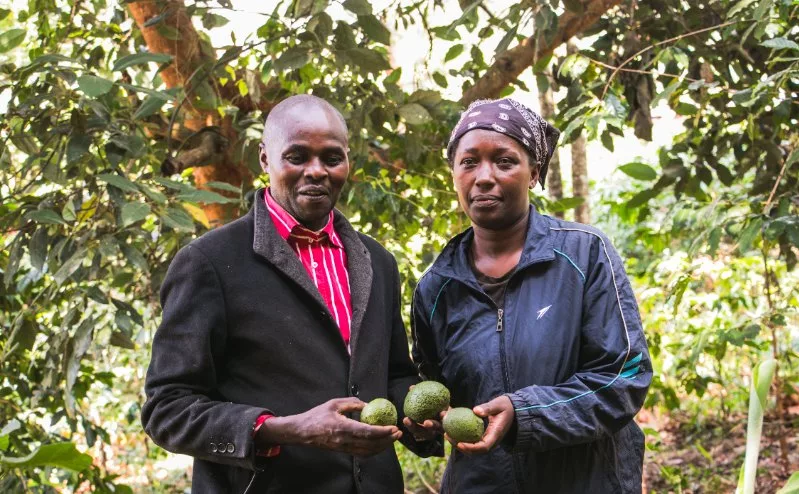 Farmer Nelson Wanjohi and his wife display some avocados in Nyeri County on September 8 / HANDOUT
When the farm-gate price changes
For Patrick, the impact of the enterprise is not measured only by what happens to an avocado after it leaves his farm. It is also reflected in what he receives for it.
The farmer says he previously sold off-grade avocados for as little as Sh5 per kilogramme. Since beginning to supply Mukurwe-ini Oil Enterprises, he now receives Sh20 per kilogram, while premium varieties such as Fuerte can fetch up to Sh40 per kilogramme.
The improved returns have helped him meet some of the responsibilities that come with raising four children, including paying school fees for his two children who are in secondary school.
Although the additional income may appear modest when viewed in isolation, for a smallholder farmer it can determine whether household expenses are met or postponed.
The relationship has also introduced Wanjohi to another crop, castor, which Nelson previously regarded as a weed that farmers would simply remove, and has become another source of income.
He now sells the seeds for Sh100 per kilogramme, and can earn up to Sh200 per kilogramme when they are deshelled.
“Patrick is the one who gave me seeds. I tried to diversify with other crops.”
The change has been more than finding a buyer for his avocados. Wanjohi is beginning to see farming as an enterprise in which different crops can provide different income streams rather than relying on a single harvest.
“Farmers like surety. They like what we call trust. When they get money instantly, they cannot shift from you,” Wanjohi said.
The challenge of middlemen is not unique to Mukurwe-ini; in Gatundu North, Kiambu county, farmers have mobilised through the Ashindi Kiambu Community Association in an effort to break the grip of middlemen.
Some Kenyan farmers sell a single avocado for between Sh5 and Sh10 at the farm gate, while the same fruit can fetch between Sh300 and Sh500 in international markets, depending on the destination.
The farmers remain responsible for the cost and labour involved in planting, tending and harvesting the crop.
Agriculture Principal Secretary Paul Ronoh has also acknowledged the problem, warning farmers against exploitative middlemen.
In April 2026, when the Agriculture and Food Authority officially opened the new avocado export window and implemented stricter regulations aimed at protecting local growers, Ronoh said: “The government will crack down on the cartels exploiting farmers in rural areas, taking advantage of their ignorance and desperation to sell their perishable produce for low prices”.
For Wanjohi, however, the solution also requires businesses capable of creating alternative markets for agricultural produce, particularly produce that may not qualify for premium fresh markets.
Patrick, as the founder of a young company, initially had to manage many aspects of the operation himself, including production, quality control, finance and human resources.
“As a founder, I needed to have more knowledge of finance and HR. I was also the one handling production, quality, going to camps, and all that. It was challenging to set up the systems,” he says.
Support from the AYuTe Africa Challenge Kenya has since helped the enterprise strengthen its internal structures. In the 2025–26 cycle of the programme, Mukurwe-ini Oil Enterprises emerged as the overall winner in the Growth Stage category.
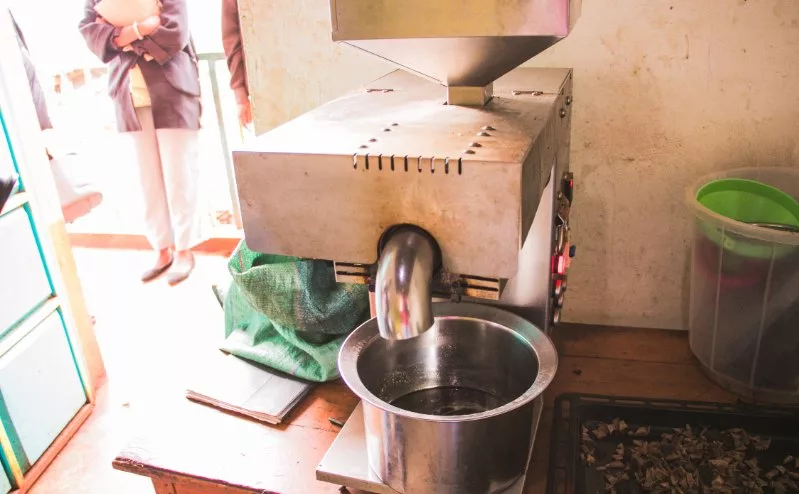 Avocado transformed to oil in Nyeri / HANDOUT
The AYuTe Africa Challenge is a flagship initiative of Heifer International, supporting agricultural innovators through funding, training, mentorship and links to financial and investment opportunities.
Patrick says the training has been particularly important as the business has moved from a small operation into an enterprise with ambitions to work with many more farmers.
“It helped us with the structures because we have received a lot of training from the facilitators who have helped us shape and have policies for our company,” he says.
The funding will also enable the company to invest in higher-capacity machinery and increase the amount of produce it can process.
“With the funding we won, we can procure and purchase higher-capacity machines, which is going to improve our production capacity, which translates to high impact and more farmers getting impact,” Patrick says.
At present, the company uses a solar dryer to dry avocados before processing them. Patrick wants to acquire a dehydrator and automate more of the process, reducing the time between receiving fresh fruit and converting it into oil.
“We are going to automate the process. So we can have the fresh avocados today, dry them today, process the oil today. That will be a game changer,” he says.
A business built around farmers
Mukurwe-ini Oil Enterprises currently works with about 150 farmers, but Patrick's ambition is to increase that number to more than 1,000.
Within the next year, he hopes to increase production capacity, employ more people and bring more farmers into the supply chain. By 2027, he wants the enterprise to be impacting more than 1,000 farmers.
The business has also created opportunities for women and young people. Six of its 10 permanent employees are women, while young people account for half of the workforce.
Among the farmers working with the company, about 70 per cent are women, many of whom are organised in chamas.