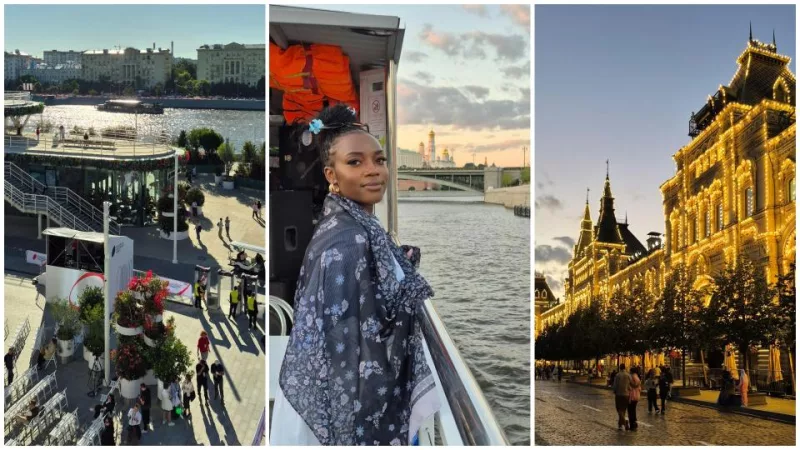
I was especially excited about travelling to Moscow in July for one reason: the summer season.
Coming from Kenya, where July is typically associated with cold mornings, grey skies and chilly evenings, the idea of experiencing summer in Europe felt almost magical.
As I prepared for the InteRussia Fellowship for journalists from sub-Saharan Africa, there was the usual anticipation that comes with travelling somewhere new.
My mind constantly thought about the documents, planning, airport logistics and perhaps most importantly, the packing. I filled my suitcase mostly with summer clothes, with a few layers added for good measure.
In my mind, I was preparing for long summer days, warm afternoons and the kind of weather that makes you want to spend hours outdoors.
What I had not quite prepared for was a Moscow summer that could change several times in a single afternoon.
If Moscow's summer had a personality, I would describe it as moody. One minute, the sun could be shining brightly enough to make you question why you had carried a jacket. Later on, the wind would pick up, the temperature would suddenly feel much cooler and before you had even figured out what was happening, heavy showers could arrive.
In the space of an hour, Moscow could give you hot weather, strong winds, chilly temperatures and rain.
To some extent, it felt like the city was playing a game with its visitors.
One time as we were taking a walk around the city centre together with the programmes manager for the InteRussia Fellowships, Liana Saakyants, we got into an interesting conversation.
Coming all the way from Nairobi, a city filled with so much slang and mostly humour in conversations, I had to bring some of it to Moscow.
“This Moscow weather is filled with so much inconsistency. It is just giving men,” I said as we quickly increased our pace to run away from the rain.
“No, this weather is like Moscow women. Beautiful but again very moody. You can be having a perfectly good day and then for the smallest thing, everything changes,” Liana said, laughing.
She went on to compare Moscow with St Petersburg, which she described as more masculine, slower-paced, calmer and seemingly in no hurry to prove anything to anyone.
Perhaps she had a point that Moscow’s weather had the same energy as a beautiful woman who walked into the room looking flawless, smiled at you and then changed her entire mood because you looked at her the wrong way.
“You could leave your accommodation dressed for sunshine and find yourself wishing you had brought something warmer, or step outside under a cloudy sky, only for the sun to appear later and completely change the atmosphere,” Liana said.
All this made getting dressed an exercise in prediction, constantly asking myself if I needed a jacket or if it was actually summer.
The answer, depending on the hour, could be all of the above, yet the unpredictability was part of what made the experience memorable.
There is just something fascinating about being in a city where the weather refuses to settle into one mood.
Moscow's changing skies became almost like a soundtrack to the experience, making it sometimes quiet and grey, sometimes dramatic and sometimes bright and inviting.
The city looked different with every change.
GREAT EXPECTATIONS
Before travelling, I had imagined summer in Europe largely through the images that dominate social media — blue skies, bright sunlight, outdoor cafés, colourful streets and people enjoying the warmth.
Moscow, however, offered a different picture. There were grey skies and wet streets as the rain fell heavily enough to send people searching for shelter. The wind could make an otherwise pleasant day feel distinctly chilly.
That said, the grey skies did not necessarily mean dull. In fact, some of my favourite visual impressions of Moscow came on those cloudy days.
The city's architecture seemed to take on a different character beneath dark skies.
Streets reflected the light after rainfall, buildings appeared more dramatic and the pace of the city seemed to shift slightly.
“Moscow is just as beautiful as the movies make it seem with its grand architecture, striking streets and unmistakable charm,” I said.
“The only plot twist is that the weather changes its mood almost every time you step outside.”
There was something cinematic about walking through Moscow when the sky was heavy with clouds.
It was not the stereotypical European summer I had imagined, but it was beautiful in its own way.
Perhaps, that is one of the things travel teaches you since expectations can sometimes limit what you are able to see.
It was tempting to spend the entire trip complaining about the weather. Instead, the unpredictability became something to observe.
There is also something particularly interesting about experiencing Russia in July as a Kenyan.
In Kenya, July carries a completely different emotional association.
“July in Kenya is one of those months when you instinctively reach for a sweater or jacket in the morning because the weather can be very chilly,” I explained to my Russian friends.
“The whole idea of travelling somewhere specifically because it is summer feels exciting, so when I thought about spending July in Moscow, I imagined a reversal of seasons.”
I was leaving a cold Kenyan July for a warm Russian summer, except that Moscow had its own interpretation of summer.
That contrast became one of the most amusing parts of the trip.
I had packed summer clothes with a few layers, thinking that would be enough, but Moscow quickly reminded me that weather does not care about your packing strategy.
I guess the bigger surprise was realising how little the word ‘summer’ tells you about what a place will actually feel like.
Summer is not one universal experience as it also depends on where you are, what you expect and what the city decides to give you.
The weather was only one part of a much bigger realisation.
FASHIONABLE FOLK
For many Africans, Russia can exist in the imagination as a place of extreme cold, snow, Soviet architecture and a distant culture that feels very different from our own.
That image is not completely invented because Russia does have famously cold winters, and its history and geography are unlike anything most of us experience in Africa.
Moscow in summer challenged some of those assumptions. The city felt modern, energetic and fashionable as people moved quickly through the streets and the metro.
Cafés and public spaces were busy as there was a sense of movement everywhere.
One of the things that caught my attention was how deliberately people dressed, even when the weather was unpredictable.
“Moscow’s fashion scene is another sight to admire,” I whispered to a friend as we got into the metro.
I found their oversized blazers effortlessly stylish, polished and surprisingly chic.
Summer did not necessarily mean everyone was walking around in shorts and sandals.
Layers were still useful, and people seemed accustomed to adapting to whatever the sky decided to do.
It was another reminder that Moscow could not easily be reduced to the Russia many of us had imagined from afar.
Eventually, I stopped trying to predict Moscow's weather and started learning to read it.
Before leaving my hotel, I would look outside and consider the possibilities.
METRO MAZE
Walking to the metro was another interesting experience.
One time, while on a call with my family, I remember telling them that the metro stations had me walking more than the Israelites who wandered for 40 years in the wilderness.
Honestly, I was only half joking, as the Moscow Metro can turn a simple trip into a full workout, with endless corridors, stairs and escalators that seem to stretch forever.
“At some point, I stopped asking for directions and started wondering whether I would ever make it out of the station,” I joked to my family.
However, beyond the walking, the metro itself was an experience, with stations so grand and beautifully designed that even getting lost felt like part of the adventure.
Looking back, moody Moscow feels less like a description of the weather and more like a description of the city itself.
Moscow seemed to have several personalities.
There was the fast-paced Moscow of the metro, where thousands of people moved through the city with purpose.
There was the elegant Moscow of grand buildings, cafés and carefully dressed pedestrians.
There was the quiet Moscow that appeared under grey skies and rain.
And then there was the bright, warm Moscow that would suddenly emerge when the sun broke through the clouds.
The weather simply made those different moods more visible.
Perhaps that is why the experience felt unexpected and unforgettable.
I had arrived excited to experience summer in Europe, where I had imagined warmth, sunshine and the familiar picture of what a European summer should be.
Instead, Moscow gave me something less predictable, with rain, wind, sunshine, chilly afternoons and surprisingly hot moments.
Travel is often sold to us through perfect images, whereby we see the destination before we experience it.
We often create expectations from photographs, videos, stories and social media posts, then we arrive and discover that the real place is much more complicated.
That is not necessarily a disappointment because sometimes, it is the best part.
Moscow did not give me the summer I had imagined, but it gave me a summer that demanded flexibility.
More importantly, it reminded me that a city should be experienced rather than simply imagined.
Perhaps that is what made it beautiful. Moscow did not simply show me what summer looks like.
It showed me that summer, like the city itself, can have many moods but still be unforgettable.