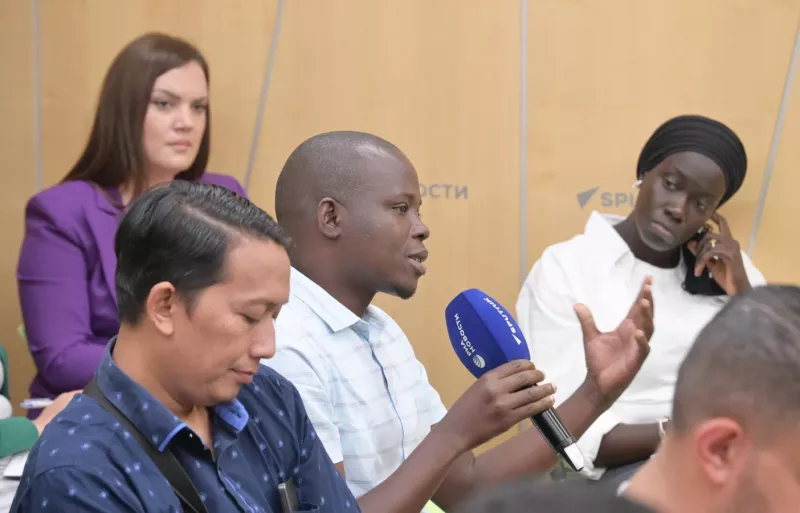
 The writer makes a presentation during the SputnikPro AI training programme in Moscow, Russia in June / SPUTNIK
After a five-hour overnight flight to Doha, Qatar, I arrived at the Hamad International Airport half-asleep and fatigued. Save for the bright sunlight that streamed through the giant-sized windows of the airport, casting sharp shadows on the walkways, I knew my fate was sealed. This is after a long delay in Nairobi made me miss my connecting flight to Sheremetyevo International Airport that was to depart at 7.45am for Moscow, Russia.
Marching in brisk steps with my black backpack in tow and thinking of Vladmir Putin’s Russia, a country famous for its classic literature, communist past and present entanglement with Ukraine, I arrived at the first information desk panting like a dog.
With my sky-blue East African passport and Qatar Airways boarding passes, I wanted to know what was the next step now that I had missed my flight.
“Sorry for the delayed flight, sir,” the Qatar Airways official quickly confirmed my fears. He asked for my passport and passes, studied them in silence, without looking at me, opened the passport, and scanned it on a box-shaped gadget that emitted green rays, then promptly returned it to me.
“Your new flight departs at 11.50pm. From here, go to the transfer desk in case you need hotel accommodation that will provide meals,” he said. “Any question, sir?”
I said no, reluctantly took the new boarding pass and started the long search for the transfer desk, which led me to endless escalators and elevators. Once there at last, the Qatar Airways official in charge tilted her head upon seeing my passport and glanced at me, then broke into Kiswahili. After greetings and niceties, she also studied my passport and the new boarding pass.
Since the 9/11 terror attacks, authorities worldwide have tightened airport security. Everyone is always a suspect. Inside the vast Hamad International Airport, I could imagine people walking with forged travel documents in their pockets, individuals with dark and malevolent intentions waiting to exploit the tiniest loophole in security to commit a crime so monstrous, so cruel, so brutal in the name of either ideology or religion.
And with giant cameras watching me everywhere, as I stood in front of the Kiswahili-speaking woman, I fully understood. It’s even more surreal to imagine that within the airport, one always sees oneself from the eyes of those watching him not physically but from air-conditioned surveillance rooms, where images are scrutinised round the clock, and any behaviour appearing abnormal triggers alarm bells. Beneath the air of measured conviviality and pleasant officials guiding passengers dragging suitcases to their boarding gates is an invisible security apparatus operating against constant suspicion and fear.
TRICK QUESTION
“Have you brought us any alcohol?” the official asked in disguised friendliness. I quickly knew it was a trap. Qatar being a devout Muslim nation, the consumption of liquor is prohibited. Thinking I would fall to her trap, I cheekily smiled at her.
“Not today,” I said. “But next time I will sure bring you some tots.”
She then told me to wait for my passport after 30 minutes. Half an hour gone, she returned, still insisting on speaking in Kiswahili with me, handed back my travel documents, and now, a yellow paper, indicating the hotel for my temporary accommodation.
Now, if you are at Hamad airport, the Royal Riviera Hotel is about 15 minutes away by shuttle bus. The windows of the bus are tinted black, and there is a warning against opening windows. One is, therefore, forced to become a witness to Qatar’s spectacular architecture and magnificent streets through darkened glasses that slightly distort the actual reality.
Upon arrival at the hotel, one steps out into reality, the blinding heat that stings the skin like a bee, with temperatures running up to 40 degrees Celsius amid desolate and empty streets, except for the occasional lone figure walking hurriedly, escaping the wrath of the afternoon sun.
Later on, from the eighth-floor window of my hotel, I scan the gleaming skyline of the city with a sense of wonder and astonishment: the dazzling skyscrapers, the round-shaped playground surrounded by green trees, blooming against the scorching earth, the elegant streets with large parking lots full of cars. From my vantage point, everything looks so tiny that the cars resemble toys. It’s like I am staring at urban art with all the colours and shapes, not at the city itself.
When the clock ticks exactly 9pm, it’s time to head back to the airport. Moscow is calling. This time it’s real. No delayed flights.
INSIDE RUSSIA
Let’s briefly flash back to Nairobi because it partly foreshadows things to come in Moscow.
“What’s your final destination?” the first Qatar Airways official, a Kenyan woman with heavy make-up, asks me at the Jomo Kenyatta International Airport.
“Moscow.”
“Boston?”
“Moscow.” I repeat.
Death. That’s the fate of travellers in the 2000 American horror movie ‘Final Destination’.
I suppose the ongoing conflict in Ukraine and the illegal recruitment of Kenyans brings this to her mind. Leafing through the pages of my passport, she summons her colleagues and briefly debates with them whether Kenyans are still allowed to travel to Russia. One says she is not sure. The other one says she needs to consult.
“What are you going to do in Russia?” she asks me.
“I am going for media training.”
“Can I see the documents?”
I nervously unzip my backpack, dip a long arm inside an A4 envelope and fish out printed copies of my travel documents, including the invitation by Russia’s media organisation, Sputnik.
It reads in part: “We are pleased to invite your correspondent [from Radio Africa Group] to attend the SputnikPro project in Moscow on June 21-27, 2026. The SputnikPro intensive programme includes the series of lectures and workshops led by top media experts with experience both in Russia and internationally.”
It adds, “The participants will have an opportunity to learn more about [the] Russian media landscape and exchange experience with foreign colleagues... This year, the programme is designed especially for journalists who wish to learn how to apply AI in their daily work.”
As she studiously skims through the invitation letter, I am hoping she can clearly see I am not going to the front line in Donetsk, or Crimea, or even Luhansk. I am simply a journalist – an editor, for that matter – who is going to share ideas with fellow media practitioners.
Later, when I arrive in Moscow, during an exclusive question and answer session with Maria Zakharova, the spokesperson for Russia’s Ministry of Foreign Affairs, I will ask about the fate of Kenyans being deceived to come to Russia under the guise of doing normal jobs, only to be dispatched to the kill zones in Ukraine. Zhakarova, visibly disturbed by the question, will vehemently deny the existence of such fraudulent military recruitment.
After what seems like a lifetime, the official presses a tiny green sticker at the back of my passport and motions me to the next queue.
MIXED FEELINGS
Memories of these fears and suspicions linger at the back of my mind even when, finally, the plane lands at Sheremetyevo International Airport in the early morning of June 22. It’s this same airport where Edward Snowden, the former National Security Agency intelligence contractor who leaked incriminating evidence of massive surveillance to the press, spent harrowing days, while seeking asylum in Russia. His request was finally granted.
After another long hour clearing with immigration, it’s time to have a taste and feel of Moscow from the airport to the Ibis Hotel on Kievskaya Street, which roughly takes 50 minutes. I arrive to a grey, chilly morning, one that would surely form a riveting backdrop to a play by Anton Chekhov or a long, winding, dystopian tale by Fyodor Dostoevsky.
I am instantly wowed by the wide roads and the clean streets and the lush green forests nestled between tall, shiny buildings. Moscow. I reckon silently in the backseat of a taxi. This is the house Comrade Joseph Stalin built. I will hear of his other astounding achievements, including the metro station constructed in 1935. But none will speak of the terrifying gulags and the torments of the great purges of the late 1930s that wrecked the country and disturbed such authors as Aleksandr Solzhenitsyn.
When I hop into the metro station on the third day of the tour after buying a three-day ticket, I not only relish my courage and curiosity but also become profoundly aware of the efficiency of Moscow’s transport system that operates on schedule and is fast and comfortable, save for the soft rattling of the rails.
One sunny afternoon, the training on the role of artificial intelligence comes even much more alive when a delivery robot, which looks like a giant insect with tall antennae, crawls past us (the participants), makes a momentary stop, then sprints down the street with fascinating precision.
I am both delighted and surprised. Delighted because a robot has replaced humans in performing a mundane task of doing deliveries, but equally surprised because of the transformative role of AI in changing how humanity views reality. Will robots become the new humans? And will humans turn into robots at the mercy of algorithms and big tech companies?
The delivery robot – a product of Russia’s technology company called Yandex – is a brief glimpse into a post-human reality. Will Homo sapiens win this time? Unfortunately, I leave Moscow without getting the answer.