The final whistle had barely sounded before Tanzania's players collapsed to the turf in celebration, while South Africa’s Banyana Banyana stood frozen in disbelief.
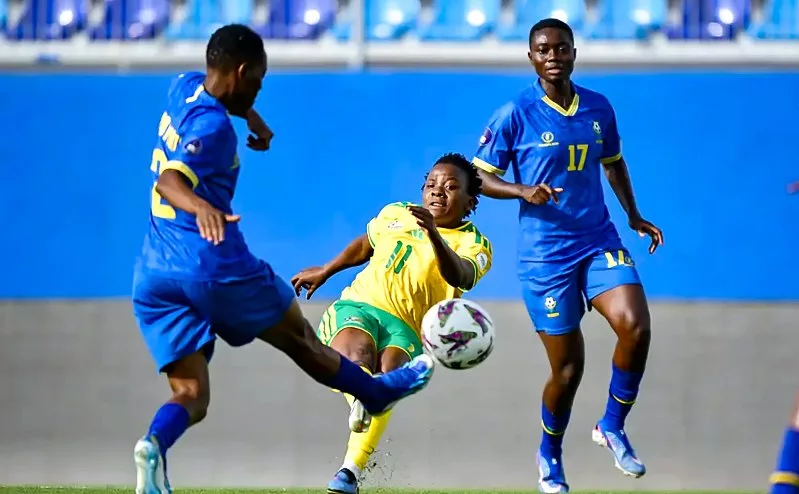
Under the floodlights of Casablanca’s Moulay Rachid Stadium, the Twiga Stars had produced one of the biggest upsets of the 2026 Women's Africa Cup of Nations, defeating South Africa 2-1 with an 86th-minute winner that sent their supporters into raptures.
It was a match played at relentless pace and with remarkable quality. Tanzania threatened early through captain Opa Tukumbuke. South Africa responded with wave after wave of attack, and after Diana Msewa's composed opener and Bambanani Mbane's equaliser on the stroke of half-time, substitute Hasnath Ubamba settled the contest with a cool finish four minutes from time.
More than a famous victory, it was another reminder that the competitive landscape of African women's football has fundamentally changed.
Even before kick-off, South Africa coach Desiree Ellis acknowledged that the traditional hierarchy in the women's game was disappearing.
"We have played Tanzania a few times now. We cannot take any team lightly. It shows that our football is evolving," she said.
“I don't think any game will be easy. Our games have always been tight against Tanzania. The dynamics have changed. There is no margin for error.”
The result captured the defining story of this year's Women's Africa Cup of Nations in Morocco.
COME OF AGE
African women's football is no longer simply a development project built on potential. It is becoming a more competitive, commercially attractive and professionally organised sport, driven by sustained investment from football federations, governments, broadcasters and sponsors.
This year’s tournament offers compelling evidence that those investments are beginning to reshape the game. Morocco 2026 is the first Women's Africa Cup of Nations to feature 16 teams instead of 12, bringing together a record 413 players from across the continent.
CAF has also doubled the champions' prize money to $2 million (Sh258 million), while increasing the overall prize fund to $5.8 million (Sh749 million), the largest financial commitment in the competition's history.
Beyond continental glory, the stakes are even higher, with the four semi-finalists securing automatic qualification for the 2027 FIFA Women's World Cup in Brazil.
The growth is visible not only in prize money but also in the quality and depth of competition. Tanzania's victory over South Africa illustrated how rapidly the traditional hierarchy is shifting.
Once considered outsiders, the Twiga Stars arrived in Morocco after years of steadily strengthening youth development, improving federation support and exposing players to more international competition. Their victory over the reigning champions was not a fortunate upset but the reward for a programme that has matured over several years.
Tanzania coach Bakari Shime said progress has come from exposing his players to stronger competitions across different levels of the game.
"We have benefitted a lot from different tournaments. Playing at the Cosafa U17, Cosafa senior championship and the inaugural FIFA Futsal Women's World Cup," Shime said before the match.
“All these major tournaments have continued to give us exposure. Last year, we registered one point against South Africa, and now we are going to play them again. We want maximum points from them. I hope we improve a lot.”
VETERANS AND NEWBIES
The changing profile of the players also reflects the evolution of the women's game. The tournament brings together remarkable experience and emerging talent in equal measure.
Cameroon's Gabrielle Onguéné is making a record eighth appearance at the Women's Africa Cup of Nations, while Mali's Fatoumata Diarra and Zambia's Racheal Nachula continue to compete at the highest level at the age of 40.
At the opposite end of the spectrum is Tanzania's Elizabeth Chenge, only 15 years old, who arrived in Morocco as the youngest player in the tournament. Burkina Faso's Deborah Guira, Côte d'Ivoire's N'Sira Safi Ouedraogo and Mali's Kadiatou Diarra, all born in 2008, represent another generation entering a sport with increasingly professional opportunities.
Nowhere is that transformation more visible than in Morocco. Long before hosting Wafcon, the North African nation embarked on an ambitious football strategy centred on world-class stadiums, elite academies, sports science, coaching education and youth development.
Those investments have already produced historic milestones, including the men's national team's run to the semi-finals of the 2022 FIFA World Cup and the Atlas Lionesses' qualification for the knockout stages of the 2023 Fifa Women's World Cup.
Hosting this year's tournament is another step in Morocco's broader sporting ambitions as it prepares to co-host the men's 2030 Fifa World Cup alongside Spain and Portugal.
From immaculate playing surfaces to packed stadiums and seamless tournament organisation, Morocco is demonstrating that African nations can deliver elite global sporting events while using football to drive tourism, infrastructure development and international visibility.
Yet Morocco is only one chapter in a wider continental story. Burkina Faso has returned for only its second Women's Africa Cup of Nations with a youthful squad built around emerging players and growing confidence after years of investment in grassroots football. Côte d'Ivoire is back on the continental stage after a 12-year absence with renewed ambitions under experienced coach Reynald Pedros.
Kenya has returned to the finals after a decade away, while Algeria has opened its campaign with an impressive victory over Senegal as more nations demonstrate they can compete at the highest level.
The progress is equally evident in Senegal, where the Lionesses have qualified for a third consecutive Wafcon as investment in the women's game continues to bear fruit.
"Qualifying for the third time in a row shows that our work is paying off. Everything we do every day, in training and in matches, brings results," Senegal forward Mama Diop said ahead of the tournament.
“This qualification proves that women's football in Senegal is growing and moving in the right direction.”
GLOBAL INTEREST
The growing competitiveness has been matched by expanding global interest.
Recognising rising international demand, CAF has significantly widened the tournament's broadcast footprint.
Alongside expanded television partnerships across Europe and Asia, CAF TV is streaming matches into markets including the United Kingdom, Spain, Portugal, Japan, China and several countries across Latin America.
Greater visibility is exposing African players to international audiences, while strengthening the commercial case for sponsors, broadcasters and professional clubs seeking emerging talent.
Many of the continent's leading footballers are already building successful careers abroad. Tanzania striker Opa Clement now plays in Spain, while several of Côte d'Ivoire's key players feature in leading European leagues. Those pathways are becoming increasingly common as scouts pay closer attention to African competitions and clubs invest more heavily in women's football.
The ripple effects extend beyond the professional game. Every full stadium strengthens the case for future investment. Every televised match encourages broadcasters to devote greater resources to women's competitions. Every successful tournament gives young girls across the continent visible role models whose careers demonstrate that football is no longer simply a dream but an increasingly viable profession.
That may prove to be Wafcon 2026's most enduring legacy.
Tanzania's dramatic victory over South Africa will be remembered as one of the tournament's defining results. Yet it also symbolised something much bigger than three points in Group B. It reflected a continent where investment is producing stronger national teams, deeper talent pools and fiercer competition than ever before.
The national teams participating in this year’s Women's Africa Cup of Nations comprised hosts Morocco, Algeria, Senegal and Kenya in Group A; South Africa, Tanzania, Côte d'Ivoire and Burkina Faso in Group B; record champions Nigeria alongside Zambia, Malawi and Egypt in Group C; and Ghana, Cameroon, Mali and Cape Verde in Group D. The expanded 16-team field is the largest in the tournament's history.
CAF president Patrice Motsepe believes the transformation is central to African football's future.
"Women's football is essential for the future of our continent. We must continue investing in our players, coaches and competitions because the future of African football depends on giving women the opportunities they deserve," he said ahead of the tournament.