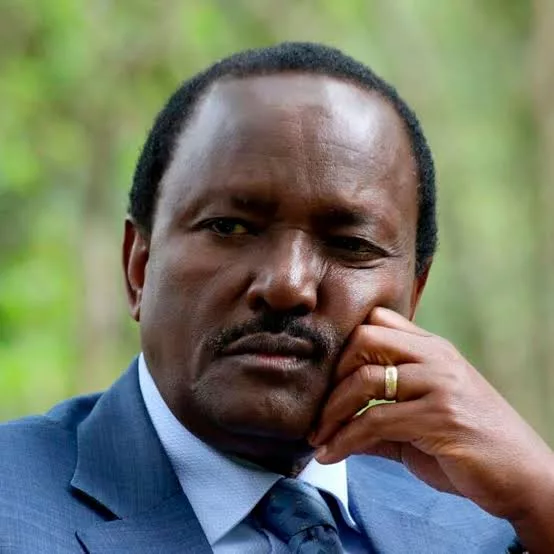
Wiper leader Kalonzo Musyoka's cautious approach to the 2027 presidential race has sparked growing debate within opposition circles and ruling coalition.
Critics are increasingly questioning whether the former vice-president expects to be handed the coalition's presidential flagbearer position rather than actively fight for it.
The debate has intensified in recent weeks following the rise of Nairobi Senator Edwin Sifuna, whose energetic nationwide campaigns and growing popularity have altered the dynamics of the race to lead the opposition into the 2027 general election.
Unlike Kalonzo, who has largely confined his activities to traditional opposition meetings and his support base in Ukambani, Sifuna has embarked on an aggressive mobilisation campaign, taking his message to various counties.
His rallies in Nyanza, including Kisumu, have been viewed as an attempt to build a national profile beyond Nairobi and position himself as a serious presidential contender.
The changing political landscape has also been reflected in opinion polls.
According to the late July national survey by Trends and Insights For Africa, Sifuna has overtaken Kalonzo in presidential popularity for the first time.
The survey placed the Nairobi senator at 15 per cent, ahead of Kalonzo's 13 per cent, making the Nairobi senator the most preferred opposition presidential candidate.
The findings have fuelled speculation that the opposition succession race is no longer Kalonzo's to lose, but an open contest that will require candidates to aggressively market themselves across the country.
Some political observers trace the former VP’s measured political style to the manner in which he rose through Kenya's political ranks.
Unlike many contemporary politicians who built their careers through years of grassroots mobilisation, Kalonzo was widely viewed as the political heir ofMulu Mutisya, one of the most influential leaders from Ukambani during the administrations of Presidents Jomo Kenyatta and Daniel arap Moi.
Mutisya served as his political mentor and godfather, introducing him into elective politics after backing him in the 1985 parliamentary by-election under Kanu.
The veteran politician gradually handed over the mantle of regional leadership to Kalonzo, whom he regarded as his political son.
Under Mutisya's mentorship, he steadily climbed the ranks within Kanu and later the national government, eventually becoming one of the country's leading politicians.
To date, Kalonzo frequently acknowledges Mutisya as the man who shaped his political career and regularly attends memorial events held in his honor.
That history has led some analysts to argue that the Wiper boss has often relied on political goodwill and negotiated settlements rather than aggressive campaigns to secure leadership positions.
Kalonzo's presidential ambitions have, however, remained remarkably consistent for more than two decades.
In 2002, he broke ranks with Kanu after Moi endorsed Uhuru Kenyatta as his preferred successor, bypassing senior figures including him, George Saitoti and Musalia Mudavadi.
Together with other disgruntled Kanu leaders, Kalonzo joined the Liberal Democratic Party, which later teamed up with Mwai Kibaki's National Rainbow Coalition to end Kanu's nearly four-decade grip on power.
Three years later, he was among the architects of ODM-K, which emerged after the successful "Orange" campaign during the 2005 constitutional referendum.
However, disagreements with Raila Odinga over the presidential ticket split ODM-K in 2007. Kalonzo retained the ODM-K name while Raila's faction registered ODM, setting the stage for one of Kenya's most consequential political rivalries.
Since then, Kalonzo has remained one of the country's perennial presidential hopefuls, although he has repeatedly shelved his ambitions in favour of coalition arrangements.
Despite Sifuna's growing popularity, political risk analyst Dismas Mokua believes the Wiper leader remains determined to contest the presidency.
"To think that Kalonzo Musyoka would sacrifice his presidential ambitions for any other candidate within the opposition, having done that under Raila Odinga and doing it under duress, is to dream," Mokua said.
He recalled the events preceding the 2022 general election when Kalonzo delayed announcing his political position before eventually backing Raila after intense negotiations.
"Remember the last time, he kept the nation waiting for hours on end, and it was because of arm-twisting by then President Uhuru Kenyatta that he accepted," Mokua said.
According to the analyst, withdrawing from the race again would severely damage Kalonzo's political standing.
"If Kalonzo in the next few days says that because of the love of the nation or public interest he will leave it for somebody else, he will immediately become a chapter in history books. He will lose his grip in his core base."
Mokua believes there is a strong likelihood that the former VP’s name will appear on the presidential ballot regardless of whether he secures the opposition's endorsement.
"You are unlikely to lose your money if you bet that Kalonzo will be on the race, Ruto will be on the race," he said.
However, Mokua argues that Kalonzo must become more visible if he hopes to convince Kenyans that he is ready to lead the country.
"Kalonzo, however, needs to come out and demonstrate his killer instincts-not to kill anybody-but to be president," he said.
Political analyst Joseph Mutua says Sifuna's rapid rise has exposed the Wiper leaders’ biggest political weakness, his reluctance to aggressively expand his support base.
"Kalonzo's decision to remain largely within his traditional support networks instead of actively seeking new alliances and supporters has weakened his visibility at a time when the opposition landscape is undergoing major realignments," Mutua said.
He argues that Sifuna's outspoken personality, regular media appearances and willingness to campaign beyond his comfort zone have elevated him into one of the opposition's most recognizable figures.
"Sifuna's growing national profile and frequent engagement with political debates have helped him emerge as a prominent opposition voice, creating the perception that he has eclipsed Kalonzo in the race to shape the future direction of the opposition," Mutua said.
While acknowledging Kalonzo's decades of political experience, Mutua says the former VP can no longer rely on his legacy alone.
"The changing political environment requires leaders to continuously mobilize support and communicate their vision to a wider electorate rather than rely solely on past influence," he added.
Saboti MP Caleb Amisi believes another challenge facing Kalonzo is former Deputy President Rigathi Gachagua, who has mounted an energetic political campaign while openly claiming to command a substantial voting bloc.
According to Amisi, Gachagua has consistently maintained that he starts with seven million votes and has been traversing the United States, the United Kingdom and other countries mobilising supporters and fundraising for his political activities.
"There is no single meeting Kalonzo has attended outside the borders of the country to raise resources and drum up support," the Saboti MP said.
He questioned why Gachagua would willingly surrender the opposition ticket after investing heavily in political mobilisation.
"If I have seven million votes, and I have raised resources, who tells you that I will give you the role?" Amisi said.
The MP argued that expecting the DCP leader to automatically back Kalonzo could prove politically unrealistic.
As uncertainty persists within the opposition, leaders allied to President William Ruto have intensified efforts to persuade Kalonzo to abandon the opposition altogether.
Mwala MP Vincent Kawaya recently claimed that discussions within the opposition suggest the coalition's presidential candidate would come from a community with a larger voter population, effectively locking out Ukambani.
"You have seen people in the opposition say that the person who will be made the flagbearer will be one whose community is populous.
“They have already indicated that Ukambani does not have the numbers. It means we have been officially locked out of the race on the opposition side," Kawaya said.
He urged Kalonzo to join Ruto's administration, arguing that cooperation with the government would enable the region to secure more development projects while cementing Kalonzo's political legacy.
Similarly, Kibwezi West MP Mwengi Mutuse warned the Wiper leader that his opposition allies could ultimately betray him.
"We have seen what is going to happen in the future and we want to ask our brother Kalonzo Musyoka to be visionary," Mutuse said.
"The people he is with are scheming against him. They want someone who has a lot of money to be their flagbearer and one who is not elderly."
He urged Kalonzo to join the government before political opportunities closed.
"We want to ask Kalonzo, before William Ruto's door is closed, come and join us. These people will betray you," he said.