

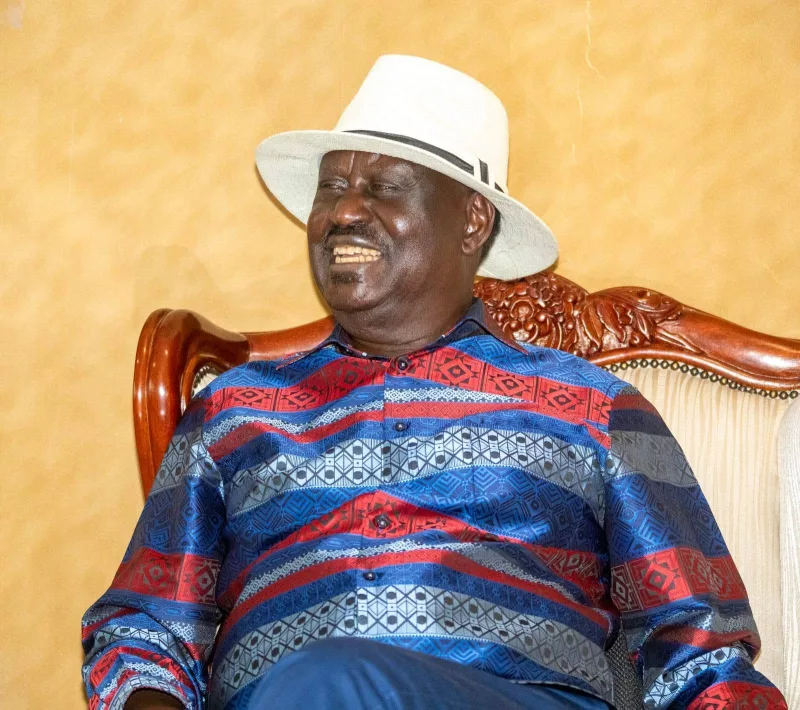
Some leaders are remembered for the offices they occupied. Others are remembered for the people who saw themselves in them. Former Prime Minister Raila Odinga belonged to the latter.
To millions of Kenyans, the apparent ‘Lord of Poverty’, was a title given to him by those who continuously get into politics for personal gain.
Yet he was more than a politician, he was a symbol of resistance, hope and the enduring belief that even the most forgotten citizen, those he represented, still deserved dignity.
Raila’s political journey was never a smooth road. It was marked by detention, persecution, political battles and years of struggle for democratic freedoms. And yet, through the turbulence, he remained a towering figure in Kenya’s fight for multiparty democracy and constitutional reform.
His life, through the lens of his quest to become the people’spresident, became intertwined with the aspirations of ordinary Kenyans who felt excluded and are still excluded, from the privileges of power.
So how did his title, ‘Lord of Poverty’, come about? Critics coined this nickname, suggesting that his politics thrived on the suffering of the poor. Granted, Raila and his family were never poor; in fact, he came from an almost aristocratic background and had multimillion-shilling businesses, but there is another way to understand that uncomfortable label.
At the very least, Raila represented people whose struggles rarely occupied the centre of power, mostly the unemployed youth who would show up at his rallies, listen to his well-crafted political satire and mostly listen to his message: the uplifting hope for change.
He also represented the struggling mother, the informal trader, the worker whose salary could barely sustain a family, and the citizen who felt that Kenya’s promise had passed them by. Perhaps the former ODM leader’s greatest political gift was his ability to make these people feel seen.
And, oh my, his presence was just enough to uplift, their frustrations found language through his satire and his abrupt songs and poetry. Even though he wasn’t the best public speaker, their grievances found a platform through rallies and other planned demonstrations, and their hopes found a champion, the downtrodden equally felt like champions; kweli, they were ‘Jeshi ya Baba’ (Baba’s Army).
Whether one agreed with his politics or not, it was difficult to ignore the emotional connection he forged with ordinary citizens, who make up the biggest percentage of the Kenyan population.
For many Kenyans, Raila was the man who could dare challenge any establishment, even when doing so came at a serious personal cost, meaning arrests, detention and personal political losses. His supporters saw in him a stubborn refusal to surrender the struggle for a fairer country.
His critics questioned his methods and political decisions, as they were entitled to do in a democracy. Raila revealed the constant sad struggle in this country over who gets heard, who gets opportunities and who gets to share in the nation’s prosperity, where access to opportunity is mostly reserved for a fortunate few and the now ‘Sharp Boys’ and ‘Sharp Girls’, new aliases of those in Kenya with unimaginable connections who have access to instant wealth accumulation through knowing the right people in government and pressing the ‘right’ buttons.
One can only imagine the biting satire, mischievous wit and perfectly timed punchlines Raila would have unleashed on today’s ‘Sharp Boys’ and ‘Sharp Girls,’ exposing the absurdity of a system where knowing the right people seems more profitable than working hard, and the quickest route to riches is sometimes simply knowing which buttons to press.
But Raila was human, too, and like every consequential leader, he had his flaws, made missteps and contradictions in the ‘right’ buttons he also pressed. In a poignant testament to the magnitude of his legacy and the depth of his loss on October 15 last year, President William Ruto posthumously conferred on his the Chief of the Order of the Golden Heart of Kenya. It was a recognition of a life that left an indelible mark on the nation.
Nevertheless, Raila’s legacy will always remain contested, as the legacies of consequential leaders often are. But history should remember not only the political battles he fought, but also the millions who found hope in his defiance. He was a voice in a country where too many people have always felt abandoned by the system, and have spent a lifetime unheard.
His representation mattered. As those who felt represented by him, and most of us, still try to cope with his exit from this world and from Kenya and Africa’s political and democratic space, I feel privileged to have shaken his hand, even briefly, and to have shared a moment with a man whose place in Kenya’s history will long outlive him.





