

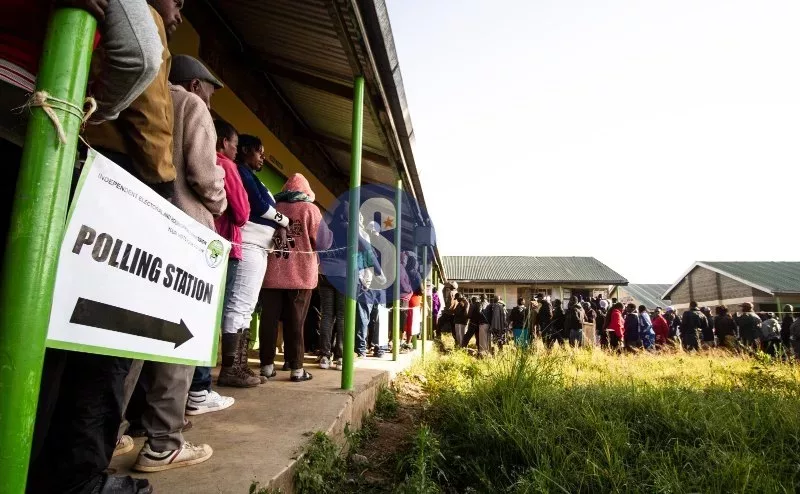
 Voters queue at one of the polling stations during Ol Kalou by-election in Nyandarua county on July 16, 2026
By the time you get to read this, the identity of the person who will represent Ol Kalou constituency, Nyandarua county, in the National Assembly will be clear.
Regardless of who it is, it will have been a hard-fought battle, with a combination of everything, from deep intrigues, violence, poisonous rhetoric and a cut-throat competition in which some egos will be deflated while some will swell like roadside mandazi.
First, the lack of creativity in President William Ruto’s regime shocks me quite a bit. As he is desperate to win a second term in 2027, I’ve always imagined that he and his ruling coalition would go out of their way to make a statement in Ol Kalou.
They apparently wanted to show that the government was willing to let electoral processes like the recent by-election proceed without the perception of state high-handedness. They are keeping their eye on the bigger prize than the local poll for MP.
In any case, Ol Kalou, before this by-election, was an opposition seat held by a Jubilee member. There would be, in my view, no net loss if the ruling UDA was beaten in this by-election.
It would help entrench a public belief, however weak, that the regime will not go out of its way to try and manipulate the more important 2027 general election.
If anything, the new MP will be sworn in and begin reelection campaigns immediately, making the remaining period largely inconsequential in the bigger legislative and political agenda on both sides of the divide.
The political war between President Ruto and his former deputy, Rigathi Gachagua, has been characterised by such hate rhetoric that the Ol Kalou contest boiled down to a fight between their egos.
Indeed, it was difficult to notice that the seat’s “defending champion’, the Jubilee party of former President Uhuru Kenyatta, had a candidate there too.
Elections in the region have recently taken up the format of those with Ruto versus those with Gachagua. The poisoned environment didn’t allow for a middle ground.
The country itself is almost exactly one year away from a potentially divisive and delicate election. The fierce ethnic and political rhetoric will most likely get worse, the closer we get to the election.
Which is why the country is in desperate need of statesmen and pacifiers to help tone down the rhetoric and heal ethnic divisions, to avert a large-scale rejection of the results of the 2027 general election.
And let’s face it, the existing leaders, from the President himself, are unable to walk back from the charged atmosphere and assure an anxious nation that all will be well.
The first sign of trouble is the rising goon culture in the country. Just last Sunday, there were two attacks, one targeting Nairobi Senator Edwin Sifuna and Siaya Governor James Orengo in a Kisumu church.
The other was the vicious disruption of a rally held by their Linda Mwananchi colleagues in Nyahururu. In both cases, the police were accused of either inaction or complicity in the attacks.
Truth be told, pro-government rallies never get disrupted anywhere in the country, so we can conclusively tell who is to blame for most of the attacks.
Regime propagandists would have you believe that opposition politicians organise attacks on their own rallies and spice it up by “kidnapping themselves to gain sympathy”.
We are obligated, however, to remain sensible and reject such foolish utterances, even if they come from high places.
If anything, the responsibility of the security establishment is to investigate and arrest perpetrators of criminal acts, regardless of how they are planned.
It is easy to see why the Ol Kalou by-election became such a do-or-die contest. For Gachagua, the perception that he has locked up the mountain and become the undisputed regional king is important for his own political survival.
Having his DCP’s maiden MP emerge from this process was always going to be more than just a mere contest.
As he fights in court to invalidate his impeachment and open the path onto the 2027 ballot for himself, he can’t afford other parties and interests staking a claim to the mountain pie.
For Ruto, the shrinking electoral map, in terms of his victorious 2022 support, places him in a delicate position, requiring him to maintain a semblance of influence in erstwhile bases such as Central.
Granted, there is a lot of disenchantment among sections of his previous supporters, but the President has an election to try and win in just a year.
He can’t afford the growing perception that a large part of this support is slipping like sand through his fingers.
The bigger picture, however, is how Ruto handles such tight contests, because Kenyans automatically interpret his posture and reactions to these by-elections as a pointer to how he will handle the 2027 election, especially if they don’t go his way.
In a recent pronouncement, the President declared that “the world won’t stop” if he loses the general election.
He urged Kenyans to stop focusing too much on “terms”, whether wantam or tutam, a reference to the divide between those oppose his reelection and those who want his reelection.
But if these words are to mean anything, state machinery must seem to align with them. It doesn’t augur well if armed, masked men in unmarked cars pop up along the roads during the campaigns, intimidating citizens.
Even worse and all too prevalent in Ol Kalou were the blatant acts of bribery and “development for votes” philosophy, whereby voters were enticed to vote for the ruling party candidate in exchange for promises of development projects.
Incidentally, this model unfolded in the exact same area way back in 1995, when the current Ol Kalou constituency was part of the larger Kipipiri constituency.
At that time, the death of the local MP, Laban Muchemi of Ford Asili, occasioned a by-election in which the ruling party, Kanu, audaciously attempted to win the seat.
Perhaps because Kenneth Matiba’s Ford Asili was in the fading-out stage, President Moi must have figured that his party stood a fair chance against Mwai Kibaki’s DP in the by-election.
State machinery descended on Kipipiri, with “development” and good old-fashioned bribes to sway voters.
Electricity poles landed in glory, as road construction equipment landed to start works. The constituency was on the cusp of bliss.
However, when the results were in, DP’s Mwangi Githiomi had won by a landslide. The state promptly responded by removing all development equipment it had taken to Kipipiri. It turned out that the “gifts” and “development” had been tied to the voters’ decision.
Elderly Ol Kalou voters no doubt remembered this, as the same method was deployed in the just concluded by-election. Whether this campaign template swayed voters this time is for the results to tell.
But if the uncompromising manner of the Ol Kalou contest reflects on the ultimate environment of the 2027 general election, then a few things will have emerged to worry well-meaning citizens.
To start with, the ethnic undertones around these campaigns need to tone down. Additionally, the use of state machinery to intimidate or bribe voters doesn’t sit well in such a charged atmosphere.
But of all players in this, the ability of the IEBC to deliver a credible election will have been tested in Ol Kalou, as a precursor to what we can expect in 2027.
I am truly hoping that the commission will internalise the lesson that in a country where elections are almost always disputed, restoring the ballot as a trusted transition process is crucial to national stability. That’s because we can’t bank on fraudulent elections forever.
Ol Kalou therefore gave the country the chance to test its electoral systems, view the “trailer” and proceed to correct areas that need correction, a year ahead of time. I hope we grab the opportunity.





