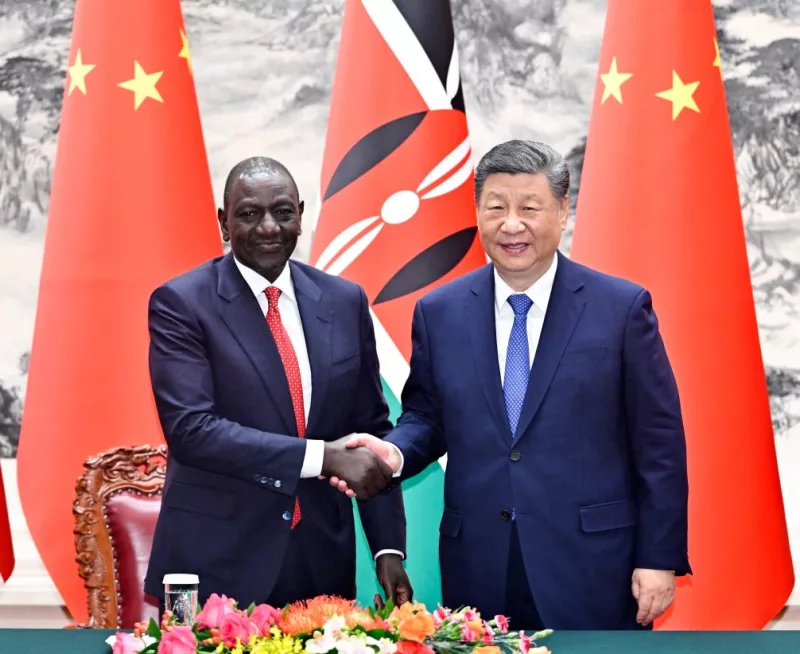
 China’s five-year plans have provided strategic continuity that transcends leadership changes, allowing the state to build an independent industrial system /STAR ILLUSTRATION
As the Communist Party of China marks its 105th anniversary, the world witnesses not just a celebration of survival, but a testament to visionary governance.
From a war-torn, agrarian society in 1949 to the world’s second-largest economy, China’s trajectory under the CPC is arguably the most significant development story of our era.
For Africa, a continent grappling
with many development challenges including infrastructure deficits, and the
urgent need for inclusive growth, this anniversary offers a blueprint for
modernisation.
The numbers are staggering. China has lifted more than 800 million people from extreme poverty, a feat unprecedented in human history.
Its GDP grew at an average annual rate of roughly 9.5 per cent for decades, transforming the country into a global leader in manufacturing, renewable energy and digital innovation.
But the statistics only tell half the story. The true strength of the CPC lies in its adaptability, its meritocratic governance and its unwavering people-centred philosophy.
For Kenya and the wider African continent, the question is not whether we can replicate China’s success, but whether we can adapt its core principles to our unique realities.
The answer lies in a disciplined reimagining of our political parties as catalysts for national transformation rather than mere vehicles for electoral competition.
One of the most striking features of China’s rise is its commitment to long-term planning. China’s five-year plans have provided strategic continuity that transcends leadership changes, allowing the state to build an independent industrial system, attract foreign investment and gradually integrate into the global economy.
Contrast this with the election-cycle thinking that too often defines African governance. Policies are fragmented, projects are abandoned and long-term infrastructure goals are sacrificed at the altar of short-term political expediency.
Africa already has the frameworks for success: Kenya’s Vision 2030 and the African Union’s Agenda 2063 are robust blueprints.
The missing ingredient is disciplined execution. Political parties must commit to these visions as national covenants, not partisan documents. We need leadership that prioritises industrialisation, human capital and infrastructure over populist gimmicks.
The CPC's cadre evaluation system, which emphasises performance, integrity and results, has created the world’s largest knowledge bureaucracy.
This is a direct challenge to the patronage networks and tribal loyalties that cripple African institutions. Corruption is not merely a moral failing; it is a direct obstacle to development.
The CPC’s relentless anti-corruption campaigns have strengthened public trust and institutional integrity. African parties must similarly invest in cadre development, ethical standards and accountability.
We need leaders chosen for competence, not connections; for vision, not ethnicity.
China’s Reform and Opening Up policy of 1978, coupled with the establishment of Special Economic Zones like Shenzhen, demonstrated that state direction and market dynamism are not mutually exclusive.
Kenya’s Standard Gauge Railway is a prime example of such a partnership, boosting connectivity and trade. But we must go further.
We must negotiate partnerships strategically, ensuring technology transfer, local content and long-term sustainability.
The China-Africa relationship, exemplified by the Forum on China-Africa Cooperation and the Belt and Road Initiative, represents a new model of South-South cooperation. This is not the paternalistic aid of the past, but a partnership based on mutual benefit.
Kenyan avocados now reach Chinese markets, while Chinese investment builds factories and creates jobs. African parties must engage these partnerships with strategic clarity, ensuring that we are not just consumers of foreign goods but active participants in global value chains.
China has shown that transformation is possible within decades. But it requires more than just economic policies; it requires a national psyche oriented toward progress, a commitment to merit and a relentless focus on the collective good.
Africa has the resources, the youthful population and the rising aspirations. What we need now is political will.
Let us build strong, innovative parties that unite our people, invest in our potential and partner wisely with friends like China.
Together, through enhanced cooperation in trade, infrastructure, technology and capacity building, we can realise an Africa that is prosperous, self-reliant and a vital pillar of global progress.
The writer is a scholar of international relations with a focus on China-Africa development cooperation. X: @Cavinceworld