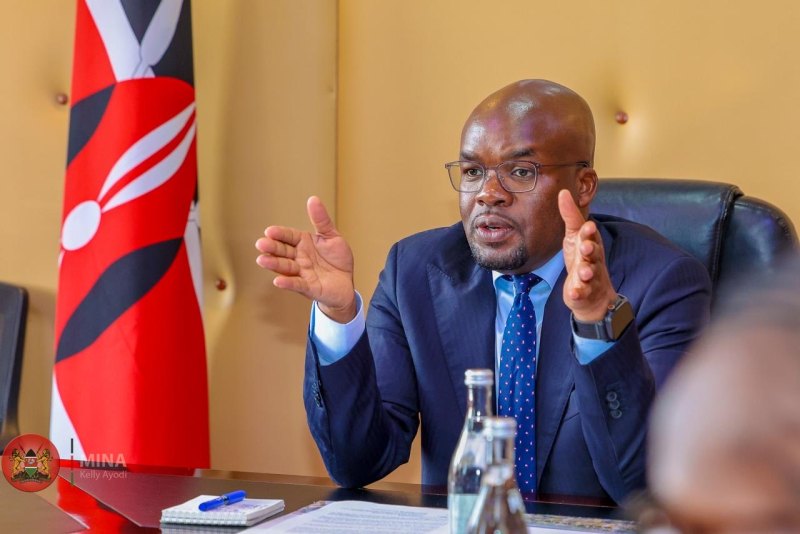
As Kenya's political landscape steadily shifts ahead of the 2027 general election, one government official has quietly emerged as one of the country's most influential public administrators.
While remaining largely removed from overt partisan political contests, Interior and National Administration Principal Secretary Raymond Omollo has steadily built a reputation that now stretches way beyond the corridors of Harambee House.
From overseeing key security and administrative reforms to spearheading government development programmes across the country, Omollo's expanding influence has positioned him among the most visible faces of the Kenya Kwanza administration.
His prominence is particularly evident in Luo Nyanza, where his growing role in coordinating national government projects, frequent development tours and close engagement with local leaders has earned him a reputation as President William Ruto's trusted point man.
Some political observers describe the quiet spoken PS as the government's "new sheriff" in Nyanza, a metaphor reflecting his expanding influence in a region that has historically been regarded as an opposition stronghold.
The other powerful civil servant to emerge from Luo Nyanza was Hezekiah Oyugi who interestingly held the same portfolio as Omollo. He was also from Homabay County, Rongo to be specific.
However unlike Omollo, he was a career civil servant who rose through the ranks from a district officer.
So powerful was Oyugi, that legend has is that provincial and district commissioners would stand at attention and repeatedly salute while on a telephone conversation with him.
The other powerful PS to emerge from Nyanza wasSimeon Nyachae who rose to become a Cabinet Minister and later contested the presidency in 2002.
Political commentator Joseph Mutua says Omollo's growing stature is closely tied to the confidence he appears to enjoy from the Head of State.
"While President William Ruto has never publicly singled out Raymond Omollo as one of his closest advisers, the Interior PS’s expanding portfolio, repeated presidential assignments and growing visibility in implementing government programmes have reinforced the perception among political observers that he enjoys the President's confidence," Mutua said.
"That perception has elevated his stature both within government and in his native Nyanza region."
Unlike politicians who built their influence through rallies and party structures, Omollo's rise has largely been anchored on public administration and policy implementation.
Since his appointment, he has frequently represented the President at major government functions, launched development initiatives and coordinated implementation of key state programmes.
Within government circles, he has become one of the administration's most dependable technocrats, often tasked with driving implementation of policies touching on national administration, security coordination and grassroots government operations.
His increasing presence in Luo Nyanza has equally transformed him into one of the Kenya Kwanza administration's most recognisable figures in the region.
As the government's chief mobiliser in Nyanza, Omollo has championed implementation of affordable housing projects, road construction, infrastructure development and programmes aimed at improving public service delivery.
Political observers credit him with helping narrow the historical gap between the region and the national government by encouraging closer collaboration between local leaders and the state.
His stewardship coincides with a noticeable increase in national government engagements across Luo Nyanza, reinforcing Ruto's strategy of expanding his political footprint beyond his traditional support bases.
Mutua argues that Omollo's emergence has introduced a fresh dynamic into Nyanza politics.
"ODM leaders are increasingly treating him as an emerging political force capable of expanding Kenya Kwanza's influence in one of the opposition's traditional strongholds," he said.
"Whether he eventually pursues elective politics or not, his growing administrative influence is already reshaping political calculations in the region."
His rise has attracted support from several leaders across Nyanza, many of whom view him as an effective bridge between the region and the national government.
Supporters argue that having a senior government official with direct access to the presidency has helped accelerate implementation of development projects and ensured that Nyanza remains part of the national development agenda.
Former MPs Nicholas Gumbo (Rarieda) and Omondi Anyanga (Nyatike) are among leaders who have publicly defended Omollo, saying persistent attacks against him are counterproductive and do not serve the region’s interests.
However, his growing influence has not been without controversy.
Within ODM, the PS has increasingly found himself at the centre of political disputes.
Some local leaders have accused him of attempting to build parallel political networks that could weaken the party's long-standing dominance in Luoland.
One of the most public disagreements involved Homa Bay Governor Gladys Wanga, who accused Omollo of undermining her leadership following the Kasipul parliamentary by-election.
The ODM chairperson claimed that the PS secretly backed independent candidate Philip Aroko against the ODM candidate, Boyd Were, who eventually won.
The allegations heightened tensions within the ODM, exposing internal divisions over how the party should respond to the Kenya Kwanza administration's growing presence in the region.
Even so, some senior partyfigures urged restraint. ODM leader Oburu Oginga publicly dismissed attempts by some leaders allied to Wanga to push for Omollo's removal from government, warning that sustained attacks against the PS could deepen divisions within the party.
Beyond regional politics, Omollo has also found himself under national scrutiny over the government's handling of insecurity, politically linked violence and alleged abductions.
In April, the Linda Mwananchi political outfit called for his arrest over rising incidents of politically linked goon attacks.
Siaya Governor James Orengo accused the government of failing to act decisively against perpetrators of political violence and alleged that investigators had failed to summon senior officials for questioning.
"We are extremely unsatisfied with how the investigations are going. We are seeing people who have not been summoned to record statements. The ring leader has not been summoned, PS Omollo has not been summoned," Orengo said.
Nairobi Senator Edwin Sifuna also alleged that elements within the security sector were responsible for deploying criminal gangs during political events.
Omollo has consistently dismissed the allegations, insisting that the government neither sponsors nor condones political violence.
"Criminal gangs and political goonism are a national challenge and will not be tolerated. Any individual or leader who engages in or facilitates such acts will be held accountable in accordance with the law," he said in April.
He has further argued that youth involvement in organised violence reflects deeper structural challenges affecting the country.
"There is always concern around young people and the issue of goonism, but it is important that we appreciate the broader context. This is largely a systemic and political challenge that Kenya has grappled with for many years," he said.
The PS has also faced criticism over allegations of enforced disappearances and abductions.
During public debates following the Gen Z protests, Omollo maintained that there were no government-sponsored abductions under Ruto's administration, with some alleged cases being stage-managed.
His remarks attracted sharp criticism from civil society.
Lawyer Willis Otieno argued that official denials alone were insufficient.
"Raymond Omollo owes Kenyans more than rehearsed denials. Every time the government is confronted with allegations of enforced disappearances and abductions, its first instinct is to deny, deflect and dismiss," Otieno said.
"The era when citizens accepted official statements without question is over. Kenyans demand the truth, accountability and justice."
Human rights activist Hussein Khalid also criticised the government's response during commemorations marking the second anniversary of the Gen Z protests, accusing officials of failing to acknowledge victims' concerns.
Despite the criticism, Omollo has continued to defend the government's security record, insisting that law enforcement agencies remain committed to protecting lives while upholding the rule of law.
Away from politics, Omollo's professional journey reflects a career built on academia, statistics and public administration.
Before joining the Interior Ministry, he served as managing director of the Lake Basin Development Authority, where he oversaw programmes covering 18 counties in the Lake Victoria basin.
Earlier, he worked at the Drugs for Neglected Diseases initiative Africa as head of data centre and statistician, contributing to research on neglected tropical diseases.
His résumé also includes service as a member of the board of directors of Consolidated Bank of Kenya, where he chaired both the credit and finance committee and the risk and compliance committee.
In academia, he served as a research fellow and adjunct lecturer at Strathmore University, mentoring students in statistics and applied research.
Born on December 27, 1979, in Homa Bay county, Omollo attended Muslim Primary School in Kisumu, Omolo Agar Primary and Rang'i Primary before joining Mbita High School.
He later earned a bachelor's degree in statistics and a master's degree in biometry from the University of Nairobi before completing a PhD in applied statistics at Maseno University.
As the clock ticks towards the 2027 election, Omollo will definitely be at the centre not only in Nyanza but equally coordinating national activities for President Ruto.