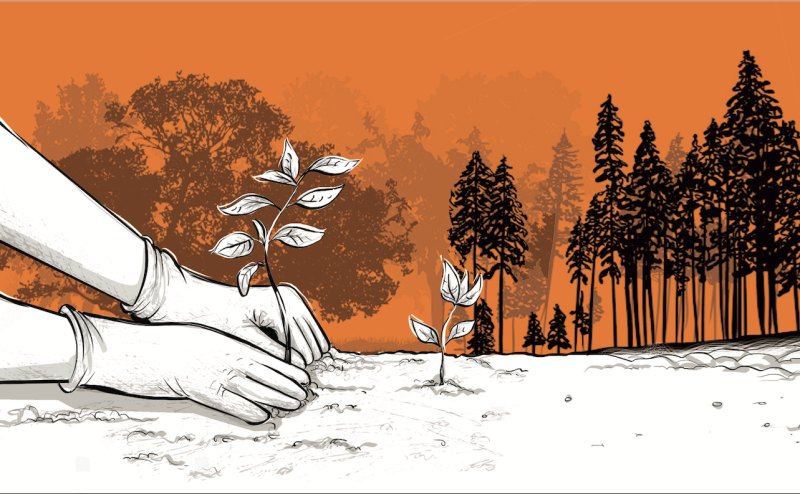
Conservation is often measured by the number of trees planted, hectares restored or protected areas established. These indicators are important, but they tell only part of the story.
The true measure of success lies in whether conservation improves the
lives of the people who live alongside these ecosystems. Where communities
derive tangible social and economic benefits from environmental stewardship,
conservation becomes self-sustaining. Where they do not, even the most
ambitious restoration programmes struggle to endure.
This understanding has increasingly shaped Kenya's approach to environmental management. The country's forests, water towers and biodiversity are not isolated ecological assets.
They underpin agriculture, energy production, water security, tourism and countless livelihoods. Protecting them is therefore not simply an environmental obligation; it is an economic and developmental imperative.
Kenya's commitment to grow 15 billion trees by 2032 reflects this broader vision. While increasing tree cover remains an important national target, the programme is equally about restoring degraded landscapes, protecting water catchments, strengthening resilience to climate change and creating opportunities for communities to improve their livelihoods through sustainable land use.
The success of this agenda depends on one fundamental principle: conservation must be owned by the people who live closest to our natural resources. Communities are not spectators in environmental protection. They are its first custodians.
They understand the forests, rivers and ecosystems that sustain them and they bear the greatest consequences when these resources are degraded. Their participation is therefore indispensable.
For many years, conservation was sometimes perceived as an undertaking driven primarily by government agencies and development partners. V
aluable as those efforts were, experience has shown that environmental restoration is most successful where communities become active partners rather than passive beneficiaries.
Lasting conservation is built on shared responsibility, mutual trust and the creation of sustainable economic opportunities that reinforce environmental stewardship.
This is the philosophy underpinning the Kaptagat Integrated Conservation Programme (KICP),one of Kenya's most successful examples of community-led ecosystem restoration.
Established in 2017, the programme has demonstrated that environmental conservation and economic development are not competing objectives but mutually reinforcing priorities.
Working across the Kaptagat, Sabor, Penon, Kipkabus and Kessup forest bloc, the programme has restored thousands of hectares of degraded forest while improving the livelihoods of communities living along the forest edge.
Instead of asking communities to choose between conservation and economic survival, KICP has created opportunities that make environmental protection economically rewarding.
Households have embraced high-yield dairy farming, zero-grazing systems, beekeeping, poultry production, biogas technology and high-value agroforestry enterprises, including avocado, coffee, macadamia and mango cultivation.
These initiatives generate income, improve household resilience and reduce dependence on unsustainable exploitation of forest resources.
The programme demonstrates that conservation succeeds when communities are empowered to become beneficiaries of the ecosystems they protect.
The environmental gains have been equally significant. Restored forests strengthen water catchments, improve biodiversity, enhance carbon sequestration and contribute to cleaner air and greater resilience against climate change.
These benefits extend well beyond the immediate communities, supporting agriculture, industry and domestic water supply across wider regions of the country.
The Kaptagat experience also offers valuable lessons for other restoration initiatives. It shows that successful conservation requires sustained collaboration between government, communities, development partners and the private sector.
Each brings unique strengths, but lasting success depends upon aligning these efforts around shared objectives.
Encouragingly, similar approaches are now emerging elsewhere across the country.
The recent restoration initiative at Chepkiep Forest on the Nandi escarpment illustrates how communities, professionals, government institutions and conservation partners can work together to restore degraded ecosystems while advancing national environmental priorities.
The planting of indigenous trees under the leadership of the Nandi Professionals Indigenous Tree Planting Initiative represents more than an environmental exercise. It demonstrates the growing recognition that ecological restoration is a shared responsibility that transcends institutions and generations.
Equally important is the initiative's emphasis on indigenous tree species. Indigenous forests support richer biodiversity, strengthen ecosystem resilience, improve water retention and better withstand local climatic conditions than many exotic species.
Their restoration therefore contributes not only to expanding tree
cover but also to rebuilding healthier and more resilient ecosystems.
The restoration of
the Nandi escarpment carries significance well beyond the immediate area. As one of
Kenya's important water catchments and biodiversity corridors, its health
directly influences downstream communities, agricultural productivity and water
availability. Protecting such ecosystems is therefore an investment in national
resilience as much as local environmental management.
The involvement of professionals in conservation also deserves recognition. Increasingly, Kenyans from diverse professional backgrounds are contributing their expertise, networks and resources to environmental restoration.
Such initiatives complement government efforts while strengthening public ownership of the national conservation agenda. They demonstrate that environmental stewardship is not the responsibility of foresters alone.
It belongs equally to educators, entrepreneurs, farmers, engineers, financial institutions and local communities.
The private sector has likewise become an increasingly important partner. Investments in tree growing, climate-smart agriculture, renewable energy and sustainable value chains not only support conservation but also create employment, stimulate enterprise and expand opportunities within the emerging green economy.
Environmental sustainability and economic competitiveness are no longer separate conversations; they are increasingly advancing together.
Looking ahead, Kenya's environmental ambitions will require continued investment in science, innovation and community partnerships. Restoration programmes must be supported by sound research, effective monitoring and long-term financing.
Equally, communities must continue to see conservation as a pathway to improved livelihoods rather than a limitation on economic opportunity. Where environmental stewardship creates jobs, strengthens food security and improves household incomes, communities become the strongest defenders of the ecosystems upon which they depend.
Ultimately, conservation is not simply about planting trees. It is about securing the ecological foundations upon which our economy, our communities and future generations depend.
It is about protecting the rivers that sustain our farms, the forests that regulate our climate, the biodiversity that enriches our natural heritage and the landscapes that define our national identity.
Kenya is demonstrating that conservation can achieve all these objectives when it is built upon partnership, community ownership and shared responsibility. KICP, together with initiatives such as the restoration of Chepkiep Forest, offers a compelling model for the future — one in which environmental restoration strengthens livelihoods, builds climate resilience and advances sustainable development.
That is the path Kenya must continue to pursue: one where conservation is not viewed as a cost to development, but as one of its strongest foundations.
Director of programmes, Office of the President