

Kenya’s greatest contradiction is not that we fail to recognise tribalism — it is that we recognise it perfectly well, but often only when it benefits or disadvantages us.
When jobs, contracts, scholarships, promotions, or public appointments appear to favour another community, we denounce tribalism with remarkable clarity and disgust.
Yet when the beneficiaries happen to come from our own community, many of you suddenly discover alternative explanations: they were simply the most qualified, the pattern of appointments is exaggerated, or “it has always been done this way”, and so on.
The principle quietly gives way to convenience. That selective outrage is what has allowed tribalism to survive as long as it has and rears its ugly head even more during every election cycle and without fail.
The only exception was in 2002 when the whole country rallied behind Mwai Kibaki and overwhelmingly elected him as president that year. However, as I have maintained ever since, what is often, if not always missed, is had Raila said in 2002 “(Simeon Nyachae) Tosha,” Uhuru Kenyatta would have become president in 2002, not 2013.
Today’s political landscape bears uncomfortable similarities to the 1992-1997 era far more than it resembles the unity moment of 2002.
Opposition figures today are refusing to acknowledge the obvious frontrunner best placed to beat the incumbent, there’s deep distrust amongcamps, the incumbent is quietly positioned to profit from every disagreement and the public is overwhelmingly hungry for change while leaders remain divided on how to deliver it.
Kenya today may have a more politically aware citizenry, a more assertive youth bloc and a clearer understanding that fragmentation guarantees defeat, but the opposition is flirting with the same mistakes that kept Daniel Moi in power for 24 years.
And on top of this is a new, dangerous narrative being sold to voters — the bogus notion that only a candidate from one of the so‑called ‘Big Five’ communities is suitable to be the united opposition candidate. This thinking is not just outdated; it is intellectually bankrupt.
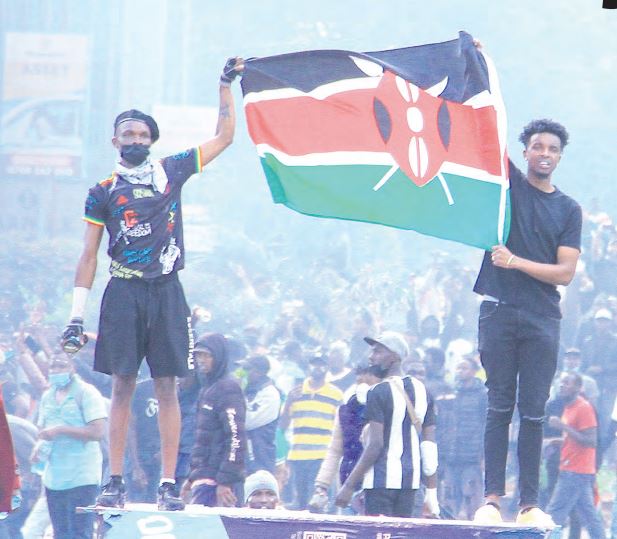
It reduces leadership to arithmetic rather than competence, integrity, or national appeal. It ignores the fact that Kenya’s most decisive political shifts — from 2002 to the Gen Z awakening of 2024 — were driven by tribalism. Voters must reject this lazy logic.
A united opposition requires a candidate who can command national confidence, mobilise the youth and articulate a credible alternative — not one chosen simply because their community has large numbers.
Across the world — and very much in Africa — there are countless examples of leaders from smaller ethnic communities who rose to national office and delivered exemplary, unifying leadership.
For example, Seretse Khama (1921-1980) of Botswana, from the relatively small Bamangwato community, built one of Africa’s most stable democracies.
In Tanzania, Ali Hassan Mwinyi (1925-2024), from the small Kwere community, presided over a critical liberalisation period that set the stage for long‑term stability.
These cases demonstrate a simple truth: excellence in leadership has never been the monopoly of large ethnic blocs and demographic size has no correlation with integrity, competence, or national appeal.
Once again, Kenya’s voters must reject this lazy, self‑serving argument that only candidates from large communities are viable opposition flagbearers. That logic is a political con like no other.
Again, what matters is the leader’s credibility, coalition‑building capacity and ability to inspire national trust—not the census numbers of their community.
For the avoidance of confusion, we must distinguish between tribalism or negative ethnicity and cultural pride, which is the celebration of one’s language, traditions, history and heritage while respecting the equal dignity of every other community.
A mature democracy should celebrate its cultural diversity while refusing to reward ethnic favouritism in any form.
In other words, tribalism and negative ethnicity must be rejected as Kenya approaches 2027. To be clear, negative ethnicity is the practice of distributing public appointments, business opportunities, or access to state resources on the basis of identity rather than merit.
Likewise, the promotion of prejudice, stereotypes, suspicion and hostility toward other communities must also be repudiated.
Weaponising ethnic identity for political gain has damaged this country for decades, and voters should refuse to be dragged back into that old script.
Kenya’s future depends on choosing leadership on the strength of ideas, integrity and national credibility, not on the outdated arithmetic of what’s his or her tribe.





