The Fourth Industrial
Revolution, Digital 2.0, that’s underway with artificial intelligence as its
leading invention is restructuring the global economic order that is, for the
first time in history, structurally advantageous for Africa. AI has the
potential to leapfrog the continent from developing to developed status.
Africa is currently at a crossroads with four structural shifts in demographics, AI, finance and energy — with the potential to redefine the continent's economic trajectory within a generation.
First, AI is redrawing the map of competitive advantage: AI is fast-replacing labour and capital as factors of production, while lowering production costs and reducing barriers to education and economic participation.
This is especially important for African youth who’ve previously been locked out or operating on the periphery of the global economic system.
What remains irreplaceable after AI deals with labour and capital are the two factors it cannot manufacture: land — the physical resource base from which all value ultimately derives, and entrepreneurship — the human capacity to identify meaningful problems and organise creative solutions.
These are precisely the factors that Africa holds in abundance, and are key resources in the AI era.
Second, the architecture of global finance is being redesigned: The paradigm is shifting — from aid to investment, and from charity to partnerships. Global capital is actively searching for new frontiers, and it is already moving South.
The surge of venture capital and private equity into African ventures is not a trend; it is the early signal of a structural capital reallocation. Besides, finance is being revolutionised through mobile money and decentralised, blockchain-based platforms enabling Africans to access financial products and create wealth in the process.
Third, the energy order is being remade: Fossil fuels are no longer a viable foundation for the next phase of global growth: economically, environmentally, or geopolitically.
The world is racing to build an entirely new energy architecture, and whoever controls the clean energy infrastructure of tomorrow will hold enormous strategic leverage over the global economy that will run on it.
Kenya is a frontrunner in this transition, already generating the majority of its electricity from geothermal, solar, wind, and hydro sources. It holds a clean energy profile that most developed nations are still struggling to achieve.
With the right strategic vision, it has the natural endowment and geographic positioning to become a net exporter of clean energy — and a key pillar in powering Africa's broader economic transformation.
Fourth, the West is plateauing: Ageing populations, shrinking workforces and declining domestic markets are eroding the economic dominance of WEIRD (Western, Educated, Industrialised, Rich and Democratic) nations that defined the last few centuries since the industrial revolution.
It relied heavily on human capital to power its growth. With this comes a renewed focus on emerging markets such as Africa — which holds the world’s largest youthful population.
The centres of the global economy are shifting, and the window for new powers to rise has never been more open.
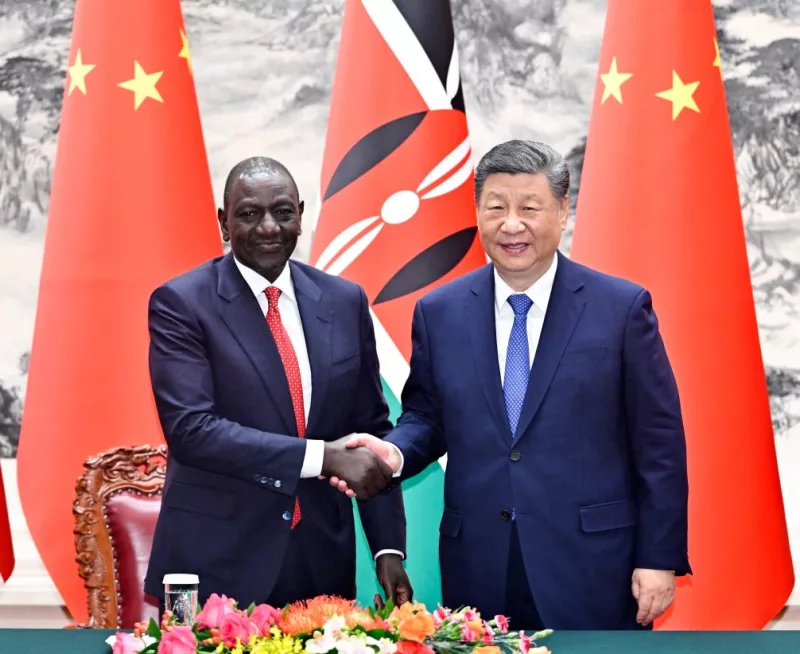
This reality was underscored by President William Ruto during the G7 Summit in France. Speaking on behalf of Africa, he urged the international community to recognise the continent's growing strategic importance.
The President argued that the future
of global growth will be shaped in Africa and that this future should be built
cumulatively, rather than individually.
What is obvious is that these remarks reinforce Kenya's growing role in amplifying African perspectives in international decision-making forums, such as the recently concluded Africa-Forward Summit in Nairobi.
What isn’t obvious is the fact that the invitation to the summit was more than a diplomatic courtesy. It was a reflection of the country’s and Africa's growing strategic importance in a rapidly changing world.
As partner and guest nations joined discussions on global economic imbalances, AI and regional security challenges, Kenya found herself at the table where the future of the global economy is being shaped.
This is the same privilege that Singapore, Japan and South Korea enjoyed during the Cold War. Their economic rise was shaped not only by effective governance and sound economic policies, but also by strategic backing and geopolitical favouritism from Western powers that viewed them as critical allies.
This partiality gave them preferential access to capital, export markets, security guarantees, foreign investment, and technology transfer.
The stars have aligned. The global order, tech innovations and even our public policy are all advancing in the same direction. Now, it’s our responsibility as African Gen Z to ensure we aren’t mere spectators but active participants in this economic revolution.
The writer is the founder and CEO of M-taji, a political and government service delivery platform empowering youth through political and public projects