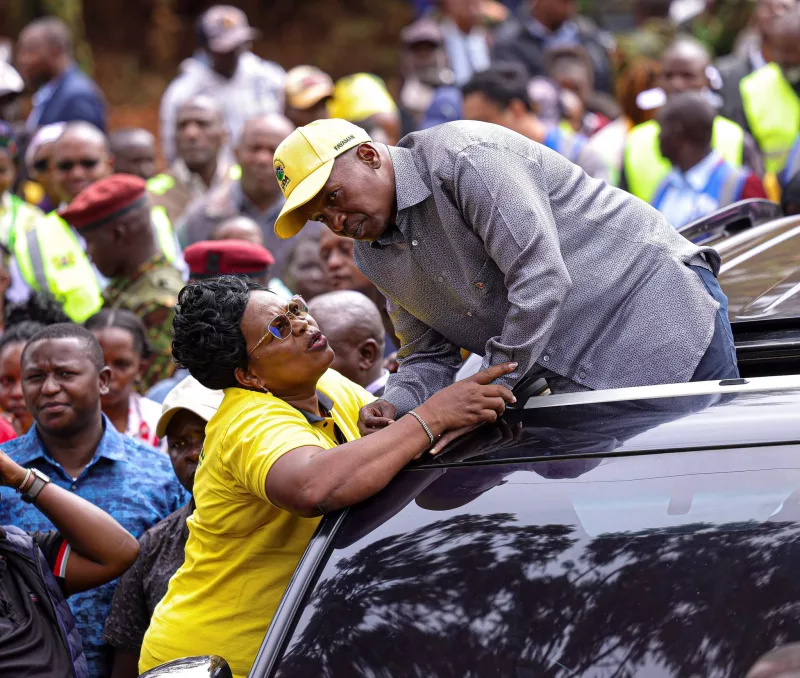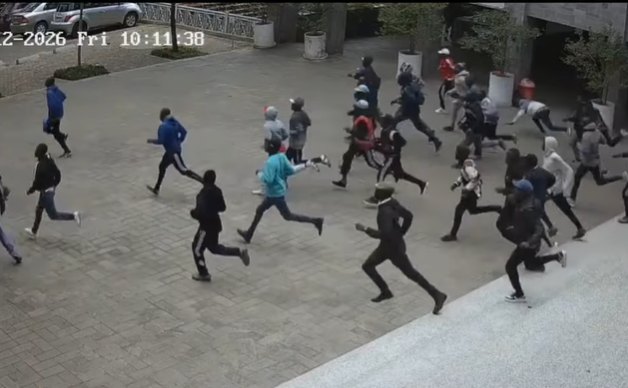
The country has recently witnessed increased involvement of gangs providing security to leaders. There is concern that as we approach the election next year, these groups of young people will engage in violent activities with reckless abandon.
They are mostly men with demonstrable body build showcasing strength, except recently a lady was spotted engaging the same violence in Migori. Their activities are generally outside the law and therefore criminal. Today the political parlance for them is goons.
However,
unbeknownst to many, the term goon gained currency and widespread use during
the last years of Sonu at the University of Nairobi. The student election of 2001 were a
watershed.
Unlike today when candidates mount campaigns running into millions of shillings, these young men and women still had faith in the intellectual capacity of their comrades.
Thus, public debates were organised across the seven campuses where each candidate was given the opportunity to sell his or her manifesto. However, outside campus political violence had been institutionalised with the ethnicisation of multiparty politics.
Intraparty and inter-party activities always turned violent and university students played an active role. The aspiring student leaders would promptly and conveniently import these tendencies to their campaigns. Candidates organised fellow students as security around themselves.
After the elections the groups remained largely idle and proceeded to harass others, mostly for extortion and event management.
The most prominent of this era was the Kosovo group. It comprised strata of goon leadership with the ruthless tendencies of the mafiosi.
Whatever assignment they undertook, whether on their own volition or for hire, the results were clinically delivered. Needless to say, these developments interfered with the smooth academic progress of some students.
It is this blend of political party youth violence modernised by Sonu that is practised today.
Early militias were state-controlled citizen groups, like the American Revolution's "Minutemen", requiring able-bodied men to serve and defend their communities swiftly.
As the United States developed a professional standing army, the necessity for independent militias faded.
The 1903 Efficiency in Militia Act formalised the state militias into the modern National Guard, which serves as a reserve component of the US Army.
Today, while historically composed of predominantly white males, the movement continues to fluctuate in response to various social, legal and political events.
The movement gained widespread notoriety after the 1995 Oklahoma City bombing, causing a spike in public concern over extremist paramilitary activity.
Militias use their armed presence to provide "protection" in exchange for fees or taxes, mimicking the extortion and protection models historically perfected by the Sicilian mafia. Corrupt governments may ally with local militias to maintain order while relying on mafia-style backroom deals to enrich political elites.
In these environments, the boundaries between political power, armed defence and organised crime are heavily blurred. When this happens, organised crime groups adopt military tactics, and militias act as criminal enterprises.
Militia groups in Kenya have grown in two primary forms: heavily armed pastoralist militias in the marginalised North Rift and politically affiliated, urban gang-turned-militia movements (such as the Mungiki).
The proliferation of illicit small arms, economic hardship and elite political patronage have fuelled their expansion. In North Rift, these groups have evolved from traditional cattle rustlers into heavily armed, tactical militias.
An estimated 650,000 illicit firearms were circulating in the region before the government crackdown almost eliminated the menace.
Originating in the late 1980s, Mungiki as an entirely ethnic sect, remains the most prominent and resilient urban militia. Banned in the early 2000s, it operates through an underground, cellular structure.
In Kisumu there existed the Baghdad Boys, while at the Coast, the Mombasa Republican Council was dominant.
History shows these groups are frequently co-opted by politicians
to intimidate rivals and secure territory during election cycles.
Unlike their Mungiki counterparts, the Kisumu and Mombasa militias were more politically and ideologically inclined than economically motivated.
They worked closely with opposition parties in their regions. With the harsh economic conditions taking a toll, however, they were imbued with some thrifty business ideas to exploit their controversial political skills.
Runaway unemployment has made militia enterprise a lucrative economic activity for the youth. Funny and ironically, some learned young people refuse to abandon the trade even if they get opportunities for gainful employment.
In previous regimes, they thrived more because the successive governments marginalised the regions dominated by the opposition parties. Political leaders from these regions doubted the neutrality of the security apparatus.
They thus resorted to relying on informal volunteer groups of young people. For small stipends, these groups would be in charge of security around the political leader during his engagements on the ground.
The same group occasionally was useful in causing mayhem and disrupting events and activities of rival leaders. Nepotism and tribalism also contributed significantly to the disillusionment of the youth.
This reinforced the bitterness by youth against the government and society in general. The propaganda and indoctrination by the regional leaders hastened the radicalisation of these young people. Elections provided the high season for the gangs to make hay.
During the low season, it became logical and natural for them to turn to crime for survival. It did not help matters that unscrupulous businessman cashed in on this enterprise to provide illicit liquor and narcotics.
The latest operation by goons was in the Kasipul constituency by-election in Homa Bay in November last year.
Both the top two candidates owned up to sponsoring standby security groups outside of the National Police Service and established state security agencies.
Allowing militias and goons to flourish normalises state-sponsored violence and risks destabilising a nation, breaking it up into ungovernable, warlord-led territories.
Armed with weapons and operating with impunity, goons often evolve into parallel police forces or localised militias. When left unchecked, these armed groups trigger severe consequences across democratic, economic and social systems.
As goon-for-hire networks expand, they pivot to extortion, racketeering and land grabbing, terrorising local communities and destroying private property. Leaders who sponsor, arm and finance these groups frequently lose control over them.
Once political utility fades, these disenfranchised, well-trained groups invariably turn their violence against the broader public and their former patrons. Fundamentally, the flourishing of militia and goonism erodes the benefits of democratic governance by subverting elections and consequently suppressing civic rights.
Hired gangs are frequently deployed to intimidate voters, disrupt rallies and violently alter election outcomes, fundamentally undermining the democratic process.
Freedom of assembly, and freedom of expression, together with peaceful gatherings and protests, are curtailed when citizens face targeted violence and abductions by armed groups.
Efforts to stem the entrenchment of mafia-style enforcement of interests and resolution of disputes must be supported.
The government is actively combating armed militias and political ‘goons’ through intelligence-led operations targeting gang leaders, strict enforcement by the NPS, and warnings to politicians who finance them.
The Ministry of Interior and Directorate of Criminal Investigations are mapping more than 100 organised gangs and targeting their financiers and organisers, rather than just street-level participants.
Politicians and leaders who mobilise, arm, or finance these groups to disrupt political rallies or civil protests must be called out and held to account.
Local authorities should take initiatives, such as the directive by Kisumu county to outlaw private security personnel during political rallies, requiring event organisers to rely strictly on NPS officers.