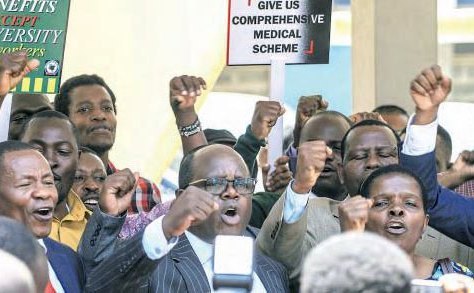
The results of the 2026 University Academic Staff Union (UASU) national elections are out. Seats were retained by Dr Constantine Wasonga (secretary general), Wakili Grace Nyongesa (chairperson), Cyprian Ombati (vice chairperson), Dr Janepha Kumba (treasurer), Don Weldon Keter (assistant national treasurer) and Dr Jane Michael (trustee).
The new entrants are Dr Grace Kibue (deputy secretary general), Eng Jacob Musembi (organising secretary) Prof Josiah Odalo and Dr Florence Guantai (Trustees).
Of all these, only Eng Musembi was elected from the camp opposed to the Wasonga-Nyongesa axis, christened the “Liberty Team”.
UASU is not just another labour body. It is the institutional voice of university lecturers, researchers and scholars working in a higher education system battered by chronic underfunding, delayed salaries, unimplemented collective bargaining agreements, governance instability and a state that increasingly appears to want world-class universities on a bargain-basement budget.
To lead UASU, therefore, is not merely to occupy office. It is to inherit a frontline political role in the battle over the future of public university education in Kenya.
Now, to understand the significance of the result, one must begin with the fact that the 2026 UASU elections were shaped by a crisis of succession, legitimacy and constitutional control.
For months, UASU had been wrestling with the fallout of legal and internal disputes over constitutional amendments, including the politically explosive issue of term limits for top officials.
Once the courts effectively blocked attempts to alter the constitutional order under which the union would vote, the election stopped being a routine transition exercise and turned into something much bigger: a battle over whether the outgoing power centre would retain influence or whether an anti-establishment coalition would break it.
That is why the UASU vote was so closely watched in union circles. It was not simply about filling offices. It was about answering a far more strategic question:
Could the current leadership architecture survive the term-limit storm by reorganising itself around loyalists, allies and carefully chosen successors—or would the crisis create enough momentum for an anti-establishment wave? The answer is now clear. The establishment survived.
Publicly, the campaigns may have sounded like they were about service, welfare and the future of lecturers. And of course, they were partly about those things. But internally, the contest was sharper. It revolved around two broad camps.
The Wasonga-Nyongesa establishment axis: This was the continuity bloc — the network of branch delegates, national office loyalists, experienced operatives and incumbent-aligned actors who believed the union should not be handed over to an untested coalition at a time of sectoral crisis.
Its central argument was straightforward: UASU is in the middle of a bruising confrontation with the state over funding, salaries, CBAs and the general erosion of public university education.
In such a moment, the union requires institutional memory, negotiating experience, and a leadership that already understands the bureaucracy of labour relations, state engagement and branch management.
But behind that public argument was a more hard-edged political calculation: if the establishment lost this election, it risked not only losing office but also losing the ability to shape the narrative of its own legacy.
The alliance between Nyongesa at the chairperson level and Wasonga at the secretariat level is what gave this bloc its backbone.
The chairperson’s office offers political legitimacy and public face; the secretary general’s office is the union’s operational engine room. Retaining both effectively means keeping the union’s symbolic and administrative centres within the same broad camp.
The anti-establishment insurgency: On the other side was a loser but emotionally potent coalition of delegates and branch actors who believed UASU needed a reset.
This camp drew energy from several grievances: that the union had become too concentrated around a familiar leadership circle; that constitutional controversies had damaged UASU’s moral standing; that branches were often treated as voting reservoirs rather than real centres of power; and that members had not felt sufficient material benefit from the union’s loud national posture on welfare matters.
Its weakness, however, appears to have been organisational. Reformist sentiment may have been real, but sentiment alone does not win delegate elections.
To defeat an entrenched union establishment, one needs coherent slates, branch discipline, national coordination, and a compelling alternative centre of gravity. There is little evidence that the anti-establishment side managed to build that kind of machine at the national level.
The Wasonga-Nyongesa UASU leadership has won control, but not immunity. This is the central point. The new UASU team has captured the top offices. It has not captured peace. Nor has it captured patience.
The same delegates who have retained the establishment will be watching closely to see whether the victory produces results or simply reproduces old habits under refreshed packaging.
The Wasonga-Nyongesa axis must read the result more intelligently: as a conditional mandate, it should stabilise the union, restore trust, broaden inclusion, and deliver tangible gains for dons.