The Democracy for Citizens Party, associated with former Deputy President Rigathi Gachagua, is emerging as one of the political formations facing early tests of cohesion as defections, nomination disputes and public disagreements begin to surface ahead of the 2027.
In recent months, the party has attracted growing scrutiny following the exit of key allies, complaints over internal decision-making and a series of accusations that have exposed emerging rifts within its leadership.
While Gachagua has dismissed claims of an internal crisis and insisted that the reports are politically-driven, analysts say the developments reflect early signs of strain that are often seen in young parties as they attempt to transition into national political movements.
At the centre of the latest internal debate is a growing conversation around discipline, influence and communication among senior officials, with deputy party leader Cleophas Malala facing criticism from a section of leaders allied to Gachagua in Mt Kenya.
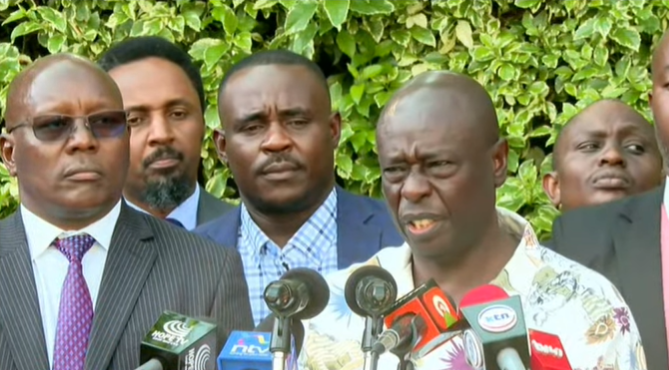
Kirinyaga Senator Kamau Murango, during an interview with a local TV station this week, openly accused the former Kakamega senator of conduct he said was damaging the party’s image and fuelling divisions within its ranks.
“You cannot be at the party while your work is to go collecting money and tainting the image of the party,” Murango said.
He further claimed that Malala had fallen out with a significant section of the party leadership and was contributing to rising tensions.
His remarks came months after Kirinyaga Woman Representative Njeri Maina, another close ally of Gachagua, accused Malala of secretly meeting a section of Kirinyaga MCAs allied to Governor Anne Waiguru.
“@Cleophasmalala, I am aware that … you met a section of MCAs allied to Governor Anne Waiguru from Kirinyaga county at Golden Palm Kenol. I’m also aware that the agenda was to create a splinter group to fight Rigathi Gachagua’s foot soldiers in that county.
“You facilitated the MCAs in attendance with Sh20,000; monies you obtained from persons who seek to derail the agenda of the people and the united alternative government,” Maina claimed.
While these accusations have fuelled speculation of widening cracks within the party, Malala has repeatedly dismissed them, insisting that there is no fallout and pointing instead to what he termed political propaganda linked to the Kenya Kwanza administration.
Speaking at a burial ceremony, he said reports suggesting a rift between him and Gachagua were part of a broader campaign aimed at weakening the opposition.
"Since the Ruto administration knows it will go home, today it has sponsored propaganda that Rigathi Gachagua and I have differed. I want to tell those people spreading such propaganda that Gachagua and I are very much united," Malala said.
His remarks came amid growing speculation, partly triggered by his absence from several opposition events.
In an apparent effort to calm the speculation, Malala on Wednesday posted a photo of himself with Gachagua ahead of the opposition’s Western Kenya tour.
"Having a chit-chat with my party leader ahead of the Western tour," he posted on social media.
Mwangi Ng’ang’a, a lecturer at Jomo Kenyatta University of Science and Technology and a former MCA, told the Star that despite the public show of unity, recent defections, leadership changes and emerging disagreements suggest that DCP is still in the process of defining its internal structure and authority.
“What is unfolding in DCP reflects the early tensions of political consolidation rather than outright collapse. When a party begins to expand rapidly, differences over nominations, communication and regional influence become more visible.
“The real test is whether those disagreements are managed internally or allowed to spill into the public arena,” he said.
Mwangi added that the debate around Malala is only one part of a wider set of challenges facing DCP as it expands its national footprint alongside other emerging political parties.
In recent months, the political outfit has experienced a series of setbacks linked to nominations, defections and dissatisfaction among some of its members, raising fresh questions about internal cohesion.
Beyond the disputes involving Malala, political observers say the bigger concern for DCP is the growing list of leaders who have either exited the party or publicly expressed dissatisfaction with its internal processes.
Among those who have since left or distanced themselves from the party are Githunguri MP Gathoni Wamuchomba, former Nyeri Town MP Ngunjiri Wambugu, Kimani Ngunjiri (Bahati) and Juja MP George Koimburi.
In a widely shared social media post, Wambugu appeared to mock attempts to target Malala, remarking that "Malala must be fought; viciously" and suggesting that more criticism was on the way.
“Murango has just thrown the first shot. There’s more to come,” he said in a statement that drew mixed reactions online.
Meru politician Kobia Koome says the exits of figures such as Paul Waiganjo, Wamuchomba, Wambugu and Koimburi have raised questions about whether the party is managing to retain key allies as it expands its political base.
“Every defection is not just a loss of a leader, it is a signal problem within the party. It tells you there is dissatisfaction somewhere in the chain of command,” he said.
Koome added that defections in political parties often act as early warning signs of internal strain, where members begin questioning leadership direction, fairness and inclusion.
“In Kenyan politics, elections are not what break parties. It is contested nominations that expose internal fault lines and test loyalty,” he added.
While DCP insiders maintain that the departures are normal political realignments, critics say they point to deeper challenges.
About two weeks ago, the party suffered another setback after former Ol Kalou MP aspirant Paul Waiganjo defected following a disputed nomination exercise.
Waiganjo accused the party of failing to conduct a free and fair nomination process, saying the exercise did not reflect the expectations of aspirants.
“Three weeks ago, I was contesting for the DCP ticket in the Ol Kalou MP by-election. The reality is that we encountered numerous challenges, and what we had anticipated did not materialise.
“We had hoped the nomination process would be free and fair, but unfortunately, that was not the case,” he said.
He has since aligned himself with the Kenya Kwanza administration and was later appointed to a government position.
Political analysts say his exit marked an early test of DCP’s ability to manage internal competition, especially in high-stakes nomination contests.
Political analyst and MCA aspirant Edwin Mwangi says the developments within DCP reflect the typical trajectory of young political parties that expand quickly but struggle to manage competing interests.
“Once a party gains influence, internal competition is inevitable as leaders seek visibility and future opportunities. The real test is whether the leadership can manage those ambitions without letting them fuel divisions,” he said.
He added that DCP’s key challenge lies in balancing regional expectations with its ambition of becoming a national political force.
“A party built around a strong political figure must ensure members feel included and valued. If that perception is lost, mistrust, competing centres of influence and public disagreements can quickly emerge,” he added.