Kenyan politics is entering a period that legendary Manchester United manager would have called “squeaky bum time”. In real sense, we shouldn’t be there yet, given that there are still 14 months to the next general election.
But in a country where politics is the dominant occupation, and competition for power is a daily endeavour, no one is going to be patient enough to await the official campaign period.
Central to the next general election is the quest by the joint opposition, which loves to refer to itself by the rather fancy phrase “joint alternative government”, to field a single candidate.
At every stop in their rallies, the opposition luminaries have reiterated the message that they’ll back one person on their ticket. For context, the general opposition grouping now associates with the Linda Mwananchi faction of ODM rebel leaders.
The search for a single opposition candidate in this country is the most hilarious and frustrating thing in Kenyan politics, dating right back to the restoration of multiparty democracy in 1991.
The then powerful Ford, which brought together the most talented cast of Kenyan liberation and justice heroes, found out soon enough that they could be united by the desire to remove President Moi and end the long Kanu rule, but when it came to the choice of presidential candidate, things were never so rosy.
The infamous Section 13 of the original Ford constitution became a sticking point over the mode of identification of presidential candidate, with Jaramogi Oginga Odinga favouring a collegiate system while Kenneth Matiba, buoyed by perceived larger numbers, insisted on the “let the people decide” universal suffrage method. This divide was allegedly fuelled in no small measure by the Special Branch.
Even though there were deep seated ethnic and political issues within Ford that ultimately broke it up, it was easy for the media to run with the easier narrative blaming the dispute over mode of picking the flagbearer as the central cause.
However, in all subsequent elections, the most difficult campaign season issue has been the opposition’s desire to identify and pick a single flagbearer.
Last week, the leader of the People’s Liberation Party leader and former presidential running mate, Martha Karua, was quoted in the media stating that only science would be an acceptable way to identify the joint candidate who would attempt to unseat President Ruto.
Before you see this as a very revolutionary idea, let me rain on your parade by telling you that in Kenya, “science” is purely in the mind of the politician. If it doesn’t favour them, then it is not science!
However, it is also important to mention that the declaration that they will back one candidate, or indeed the manner of selecting that person, make up the easy part. When the rubber meets the road, the opposition luminaries will discover that it is a whole different ball game altogether.
There will be kinsmen serving tribal interests who will be whispering things in their ears, lionising them in an attempt to stop any compromises, as well as intelligence operatives pushing everyone to run.
Besides, the first question at the negotiating table will be “who stands the best chance of dislodging President Ruto?” This question might never get answered in the negotiating room.
But Wiper leader, Kalonzo Musyoka, who backed Raila Odinga’s presidential bids in three consecutive elections, will know that the “science” behind this is often centred around political perceptions rather than anything remarkable.
For instance, when President Uhuru Kenyatta practically arm-twisted Kalonzo to back down from his presidential ambitions and back Raila in 2022, the overriding philosophy was that “only Raila can beat Ruto”.
This view was informed by Raila’s obvious appeal to a large cross section of the country, as compared to Kalonzo’s acknowledged hold of his Ukambani backyard but not much influence beyond Lower Eastern.
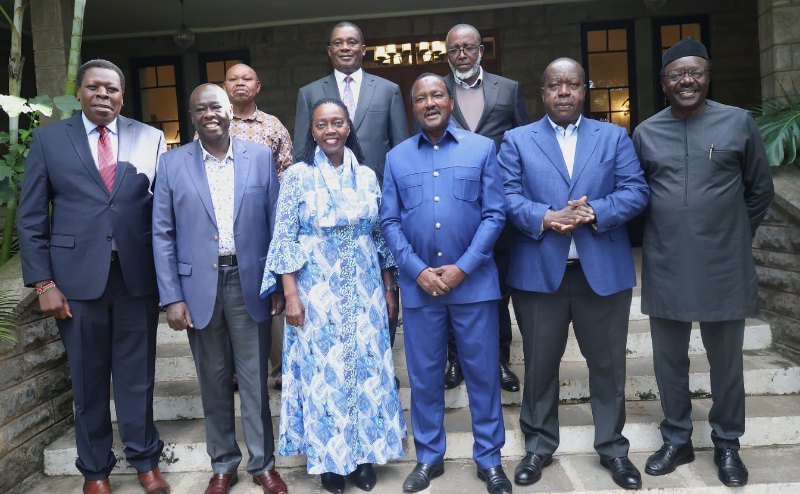
This question will be a key “scientific” conversation in the 2027 electoral cycle too. Of the opposition luminaries now lining up to be picked as the joint candidate, only Nairobi Senator, Edwin Sifuna, so far appears to transcend regional-ethnic prisms and gain support across the country, especially driven by hordes of young people seeking a break from the old order.
The others, chiefly former DP Rigathi Gachagua, Kalonzo, Karua and former CS Fred Matiang’i, in all fairness, still largely resonate only in their regions.
In conversations with sections of the opposition, another key talking point has emerged. Which is that the desired candidate must not only be one who can garner support across the country, but whose “vote protection credentials” are reliable.
This is euphemism for a candidate who will not rush into a handshake after losing in a process that is perceived to be fraudulent. In other words, a large part of the opposition desires a strong uncompromising joint candidate rather than a weak one.
Nevertheless, when the real negotiations for a joint candidate hit a crescendo in the coming months, a major problem will be if those who step down from the race and back someone else can still guarantee support in their backyards.
Apart from Kalonzo, who has consistently delivered Ukambani to Raila, the big question is if Gachagua, Matiang’i and Karua can get their regions to line up neatly behind the pick if they are not in the race themselves.
The secondary part of this question, which the chosen flagbearer must grapple with, will be the demands made by opposition luminaries steeping aside for the ultimate choice.
This is what accelerated the fallout between President Ruto and his then deputy, Gachagua, when the latter perennially demanded more and more government largesse and slots for his ethnic base, to the exclusion of the rest of the nation. It became untenable to keep working together.
Yet even today, Gachagua’s politics still holds much of that belief in the ethnic supremacy of his region. If he isn’t the pick, the chosen one will have to contend with 50-50 demand for government “shares”, which is not practical in a multi-ethnic coalition forming or desiring to form government.
If the joint opposition, by their own admission, believes that defeating Ruto in the next general election is the most compelling task for their generation, then they must remain cohesive in the competition for the ticket, but most importantly, be ready to back anyone and any scientific method that arrives at the candidate, even where it doesn’t favour specific individuals.
One of the best things about the 2010 Constitution is that a presidential candidate and his running mate do not get to contest any other seat in the same election, a far cry from the past, when presidential candidates simultaneously ran for Parliament.
It helped breed the culture of jokers and weak politicians on the presidential ballot, hoping to use that to enhance their influence and win at least the parliamentary seat.
In the new constitution, a losing presidential candidate and his running mate face five years in the cold. In fact, even the Nadco proposal for an Office of Official Opposition Leader, which currently lies in limbo, only gives solace to the runners up in the election.
The net effect is that a search for a joint opposition candidate will be aided by reality check, when weaker candidates opt to run for lower seats instead of risking five years after a vain attempt.
Science will come in handy, if opposition leaders decide to go that way, but the most effective “science” will be a combination of history, reality and the level of change-driven conviction domiciled among opposition luminaries.
We have a few months left to witness the intensity of squeaky bum time.