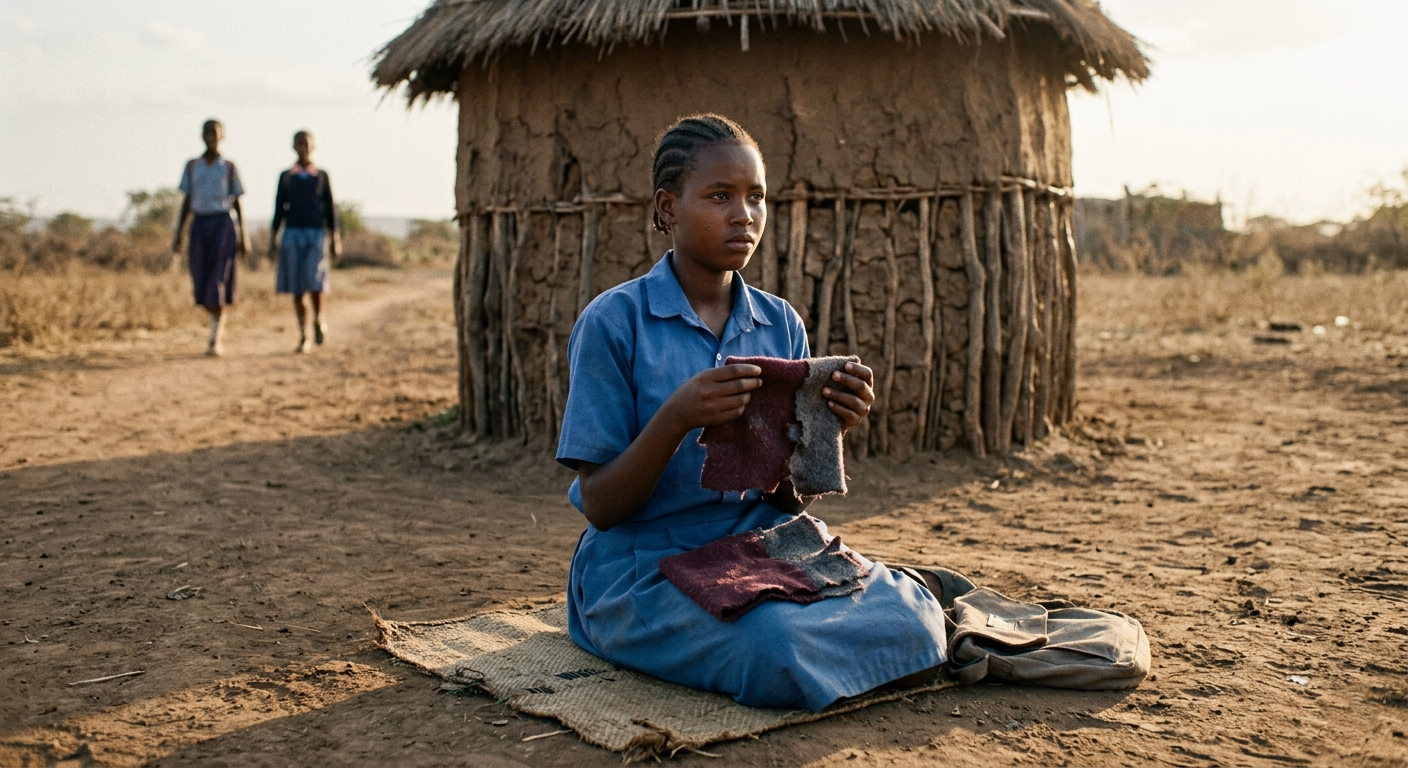
 AI-GENERATED IMAGE
For many girls, using a sanitary pad is a routine part of life.
But for 13-year-old “Somoe Abdullahi” (not her real name) from Marsabit county, it remains a luxury she can only dream of.
Unable to afford sanitary towels, Somoe cuts pieces from an old blanket and uses them during her monthly periods. While the makeshift solution helps contain the flow, it does little to ease her anxiety.
Every month, she lives in fear of staining her school uniform.
“When I am on my period during school days, I stay at home,” she says. “I don’t want to embarrass myself.”
Her fear stems from experience. After once staining her skirt at school, classmates ridiculed her relentlessly. Since then, she has chosen to miss classes whenever she menstruates.
Somoe considers herself fortunate. Some of her peers, she says, use pieces of old mattresses as sanitary pads.
Hundreds of kilometres away in Kisumu county, “Sally Atieno” (not her real name) shares a similar story.
An orphan living with her aunt, Atieno began menstruating at the age of 10. Though she had some basic knowledge about periods, she felt too young and too embarrassed to ask for help.
Accessing sanitary towels seemed impossible.
For two years, Atieno collected discarded pieces of mattress foam, washed them and used them as pads, placing them between two pairs of underwear.
One day, a classmate noticed the foam she carried and innocently asked why she always brought pieces of mattress to school to clean the blackboard.
“I just smiled,” Atieno recalls. “I had nothing to say.”
Behind that smile was the shame of a young girl struggling with a natural biological process without the basic products needed to manage it.
For girls and women living with visual impairment, the challenges are even greater.
Angeline Akai says wearing a sanitary pad independently was once difficult because she could not easily differentiate textures or determine the correct positioning.
As a result, she had to rely on friends for assistance, sacrificing her privacy in the process.
“If menstrual health awareness programmes were more inclusive, many visually impaired girls and women would manage their periods independently,” she says.
Akai says accessible menstrual health education would reduce dependence on sighted guides and help restore dignity to visually impaired women and girls.
For Arbe Godana from Marsabit county, menstruation came as a complete surprise.
“No one told me about it at home,” she says.
She was in Form 1 when she experienced her first period. Confused and unprepared, she did not know how to explain what was happening or how to ask for money to buy sanitary towels.
Fortunately, a friend gave her cotton wool to manage the situation.
Later, she used money meant for back-to-school shopping to buy sanitary pads.
“I never told my family because they never asked,” she says.
But what troubled Arbe most was witnessing the struggles of other girls.
Some used pieces of mattresses as sanitary pads. Others isolated themselves indoors whenever they menstruated.
Among pastoralist communities, where families frequently migrate in search of pasture and water, managing menstruation becomes even more difficult.
For many older women, Arbe says, sanitary pads remain unfamiliar. Some simply allow menstrual blood to flow freely because they have never had access to menstrual products or information on menstrual hygiene.
“To them, it has become normal,” she explains.
These experiences pushed Arbe to take action.
Four years ago, she founded NUTOKUMA Community-Based Organisation, whose name means “We Are One”.
Through the initiative, Arbe has supported more than 500 girls with sanitary pads and underwear, enabling them to remain in school during their periods.
She believes awareness creation is just as important as the distribution of sanitary products.
“Communities need to understand that menstruation is normal,” she says.
Arbe argues that boys should also be included in menstrual health education, as they are often responsible for teasing and stigmatising girls who stain their clothes.
She further calls for expanded distribution of free sanitary pads to girls from vulnerable households so that no child misses school because of menstruation.
According to gynaecologist Dr Victor Wanjohi, menstrual hygiene is not defined by the type of product a woman uses.
“It is a misconception that proper menstrual hygiene requires specific menstrual products,” he says.
While cloth materials can be used safely, he stresses that they must be thoroughly cleaned and dried before reuse.
Dr Wanjohi recommends changing sanitary products every four to six hours and cautions against excessive washing or douching during menstruation, noting that this may disrupt the natural balance of bacteria and increase the risk of infections.
He also emphasises the importance of understanding the menstrual cycle.
A normal period, he says, lasts between two and seven days, while the menstrual cycle typically ranges from 21 to 35 days.
“Periods should not be a taboo topic,” he says. “The more we normalise conversations around menstruation, the easier it becomes for women and girls to seek support and manage their health with confidence.”
He also warns manufacturers against the use of harmful chemicals in menstrual products, saying prolonged exposure may be linked to allergies, fertility complications and other health concerns.
According to Kilifi County Woman Representative Getrude Mbeyu, duplication of efforts among organisations distributing sanitary towels has contributed to uneven coverage.
She argues that while her office and the Ministry of Gender focus on school-going girls, other partners should target girls who are out of school to ensure no one is left behind.
Although Kenya introduced free sanitary pad programmes in public schools, supply shortages and affordability challenges continue to affect many girls.
It is estimated that more than one million Kenyan girls miss between three and four school days every month due to lack of access to sanitary products.
Poor sanitation facilities, inadequate water supply and limited access to emergency menstrual products in schools further worsen the situation.
Research by UNESCO indicates that one in every 10 girls in Sub-Saharan Africa misses school during menstruation due to inadequate menstrual products, poor sanitation facilities, stigma or lack of menstrual health support.
For girls like Somoe and Atieno, menstruation is not just a monthly biological process. It is a recurring struggle that determines whether they attend school, participate confidently in public life or retreat into silence and shame.
Until menstrual products become accessible, affordable and stigma-free, thousands of girls will continue paying for their periods through missed opportunities and interrupted education.
INSTANT ANALYSIS
Despite government initiatives, supply gaps, stigma and poverty still force many girls to miss school or use unsafe alternatives, affecting their learning and confidence. The situation is worse in marginalised and pastoralist communities, where awareness and resources are limited. While community-led interventions and advocacy are emerging, sustainable solutions require stronger policy coordination, a consistent supply of free sanitary products and inclusive menstrual health education targeting both boys and girls to eliminate stigma.