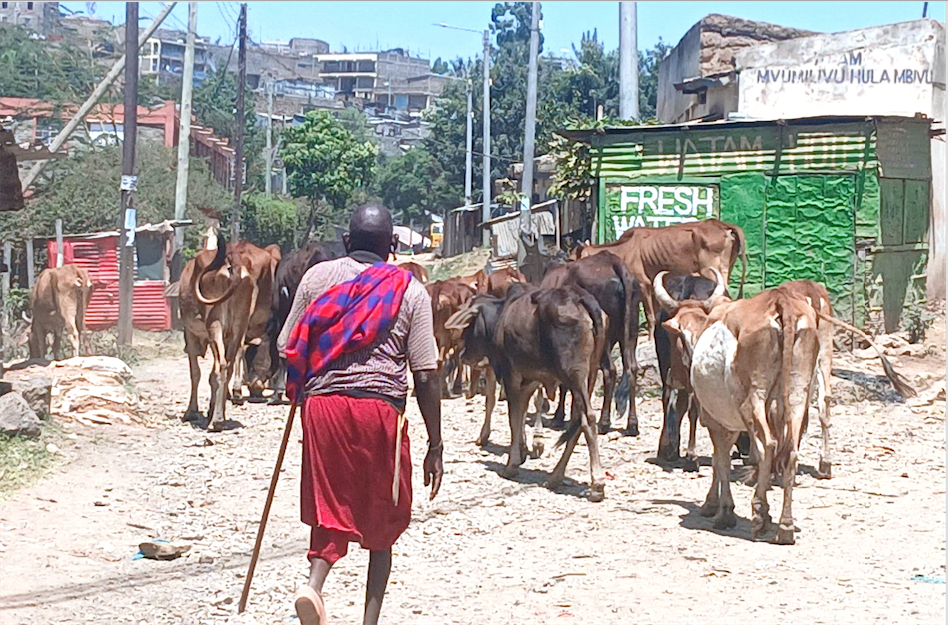
 A Maasai herder drives cattle on Crystal Rivers-Whistling Moran road through Yeyani Resort in search of water and pasture in Athi River, Machakos county, on January 10 /GEORGE OWITI
Livestock farmers in Kenya’s Arid and Semi-Arid Lands counties are facing significant challenges due to climate change.
Rising temperatures, prolonged droughts and erratic rainfall patterns are threatening traditional livestock-dependent livelihoods, worsening food insecurity and economic instability.
The struggles that these communities face include water and pasture scarcity, increased livestock diseases and conflicts.
Drought has led to water shortages, affecting livestock and human consumption. Consequently, climate change has reduced grazing land, leading to malnutrition and livestock deaths. It has equally increased the spread of diseases, thereby further threatening livestock health. Competition for scarce resources like water and pasture has led to conflicts among communities.
To cope with these challenges, the majority of farmers are adopting various strategies, including moving livestock to areas with better pasture and water. This traditional way of beating climate change among livestock farmers is common among many communities.
The Star in January embarked on a fact-finding mission on the impact of drought on livestock farmers, especially pastoralists from ASAL counties.
This reporter noted increased movements of cattle from counties like Kajiado, Narok and Laikipia to parts of Machakos and Makueni counties in search of water and pasture. This prompted the decision to identify possible solutions to the drought affecting pastoralist communities.
Namanga subcounty police commander Hassan Elema said the drought had led to increased cross-border movements of livestock between Kenya and Tanzania.
“We have in the recent past witnessed a lot of livestock moving from Tanzania into the country and vice versa, owing to the drought in parts of the two countries. The porous borders are majorly on the Oloitoktok side,” he said.
The police boss noted that climate change had equally proven to be a challenge to the government’s efforts in ensuring 100 per cent learners’ transition in schools.
This is despite the interventions by President William Ruto’s administration to ensure that all children enjoy their right to education as enshrined in the constitution. The most affected children are those from arid and semi-arid areas.
The government has been working towards achieving 100 per cent transition of learners from primary to secondary school. As of January 2026, the country had, according to the Ministry of Education, achieved a 97 per cent transition rate, with 61 per cent of eligible learners already registered in Senior Secondary School.
The government has implemented various initiatives to support this effort, including door-to-door tracing and household mapping, community sensitisation forums and bursaries for vulnerable learners.
“Some of the children who are yet to join school are those from the pastoral communities. This is due to the fact that many children, especially male ones, have moved from their homes in the company of their fathers and guardians in search of pasture for their livestock. A situation prompted by the drought that has already hit their homes and neighbourhoods, forcing them to move their livestock to other areas, some far-flung, in search of water and pasture,” Elema said.
INTERVENTION
Ausquest Farm, privately owned and located in Kyumbi, Machakos county, has been a ‘blessing in disguise’ to some of the pastoralists in ASAL regions.
The farm produces silage, which farmers from the affected counties purchase to feed their livestock. This has reduced livestock movements in the counties. The model farm, situated on approximately 3,000 hectares (7,413 acres), was founded by Stuart Barden in 2012.
“I have come to purchase silage for my cows because we didn’t get enough rainfall. This has led to a shortage of grass, forcing us to move to different areas away from our homes in Kajiado county in search of water and pasture,” said William Leposo, a resident of Mashuru in Kajiado county.
He spoke to the Star when this reporter bumped into him while he was purchasing silage at the farm.
Leposo said he had moved his livestock to various areas, including Kambu, Kiboko and Masimba in the neighbouring Makueni county. He was left with a few of the animals, especially cows, which produce milk.
“We rely on silage from this farm to feed the cows. At Ausquest Farm, livestock feeding is treated not as a routine task but as a strategic decision. Every ration, ingredient and feeding schedule is carefully considered, recognising that feed is the single most influential factor in animal health and productivity. This is why I, together with many other livestock farmers, chose it as our silage provider,” he said.
Joseph Olengatunyi said the drought was ravaging most parts of Kajiado county and the Lower Eastern region.
He said the silage supplements the little forage they had for their livestock, noting that they would not be able to meet their basic needs, including raising school fees for their children, if they fail to do so.
“Now that schools are open and our cattle have lost weight, we have to sell them at low prices. The cows, which were selling between Sh60,000 and Sh70,000, now cost Sh35,000. It’s a serious challenge. I am left with only 50 cows,” he said.
Samson Mutuku, one of the workers at Ausquest Farm, said the silage is grown from sorghum.
“The sorghum we grow here and use to make the silage has been developed through advanced research. It is rich in proteins, with 15 per cent carbohydrates, which makes the animals add weight faster. It goes through a long process to be ready for livestock consumption,” he said.
Mutuku said silage increases milk production and helps the animals add weight.
He said cattle can either feed on silage alone, since it’s healthy. The silage can also be mixed with other feeds.
Mutuku said a cow can consume up to 600 kg of silage in a month. Each kilogramme costs Sh15, while a bale weighs between 500 and 700 kg.
CATTLE BOMA
The investor, through his Ausafrica Fencing Limited company, also supplies livestock farmers with modern cattle bomas made of stainless steel to help in disease and pest control, livestock theft reduction and increased production.
“Ausafrica Fencing Limited deals with cow sheds and fences. Here, we have cattle bomas. We have different components and tools, and every tool has its purpose for a farmer who is rearing livestock: cows, goats and horses. The cattle boma is built using durable materials and for anchoring to ensure the Boma withstands weather, pressure from livestock and long-term use,” Mutuku said.
He said the cattle boma is easy to relocate. Unlike permanent concrete structures, the boma is designed with flexibility, allowing it to be moved from one location to another.
The structure is built using modular fencing panels that can be dismantled and reassembled without heavy machinery. Posts are firmly anchored for stability but can be removed without damaging the land, making the system ideal for rotational grazing and seasonal farm planning.
The ability to relocate the cattle boma has turned infrastructure into a flexible management tool. It reflects a broader approach to farming where the system adapts to the land and livestock, not the other way round.
As Kenyan farmers face rising costs and unpredictable weather, success increasingly depends on informed early decisions. At Ausquest Farm, certified seeds from Pure Seeds Limited, strategic livestock feeding and smart infrastructure by Ausafrica Fencing Limited show how planning reduces risk and improves productivity.
Beyond the farm’s gate, the impact reaches national priorities: food security, rural incomes and sustainable land management. As climate change challenges intensify, farms that invest in smart systems rather than short-term fixes may define the future of Kenyan agriculture.
As climate pressures and production costs continue to rise, farms like Ausquest point to a different future for agriculture, one built not on chance but planning. Here, the fence, the seed and the feed come together to show that invisible decisions can shape visible progress.
CLIMATE-SMART SEEDS IN A CHANGING ENVIRONMENT
Ausquest Farm’s crop success owes much to its partnership with Pure Seeds E A Limited. Here, the invisible work begins long before a seed touches the soil.
Pure Seeds varieties, including the Nyota bean, are grown at Ausquest Farm under full dry-land conditions. No irrigation, no special treatment and no selective harvesting.
Through Pure Seeds, the farm produces certified, research-backed varieties tailored to local weather conditions. These seeds are chosen not only for yield potential, but also for resilience to pests, diseases and shifting weather patterns.
“Nyota bean seeds are early-maturing and drought-tolerant. Traits that are more important as planting windows shorten and rainfall becomes unpredictable. If you look at the Nyota beans keenly, they look like any other bean in the field, though they have undergone advanced research. We discovered that a farmer can get high yields compared to others. Nyota beans can yield eight to 12 bags if you preserve them well in your farm,” says Fidel Bradley, one of the workers at the farm.
Fidel adds that Nyota bean is rich in iron and micronutrients, which support blood formation and help reduce fatigue. It also contains high fibre that aids in digestion, helps prevent constipation and supports a healthy gut. Pregnant mothers and children need these beans for their health since they help boost the immune system.
The Nyota bean seed is a result of extensive research, field trials and farmer feedback. Its strength lies not just in yield but in consistency. In areas where rainfall patterns have become increasingly unpredictable, Nyota has shown an ability to perform under varying conditions, giving farmers a level of confidence that traditional varieties often fail to provide.
They grow so fast and uniformly that they can be harvested within 75–80 days, a key advantage to farmers working within short and unpredictable rainy seasons. The rapid growth is not accidental but a result of deliberate breeding and careful seed selection by Pure Seeds.
“They cook so fast. As you can see, there is a shortage of firewood in this region. Getting charcoal is also a problem. So it’s an advantage to use these beans because they take a short period of time to cook. The Pure Seeds are packaged in 1kg, 2kg and 5kg packets and the company does deliveries straight to the farmer’s doorstep, or they can get them from an agrovet or order online through their website www.pureseeds.ke," Fidel said.