“Quiet night of quiet stars…” she begins, swaying as she croons the lyrics of Antônio Jobim’s 1960 bossa nova classic ‘Corcovado’. Her melodious voice blows you away. You savour it long after the music ends on the YouTube video.
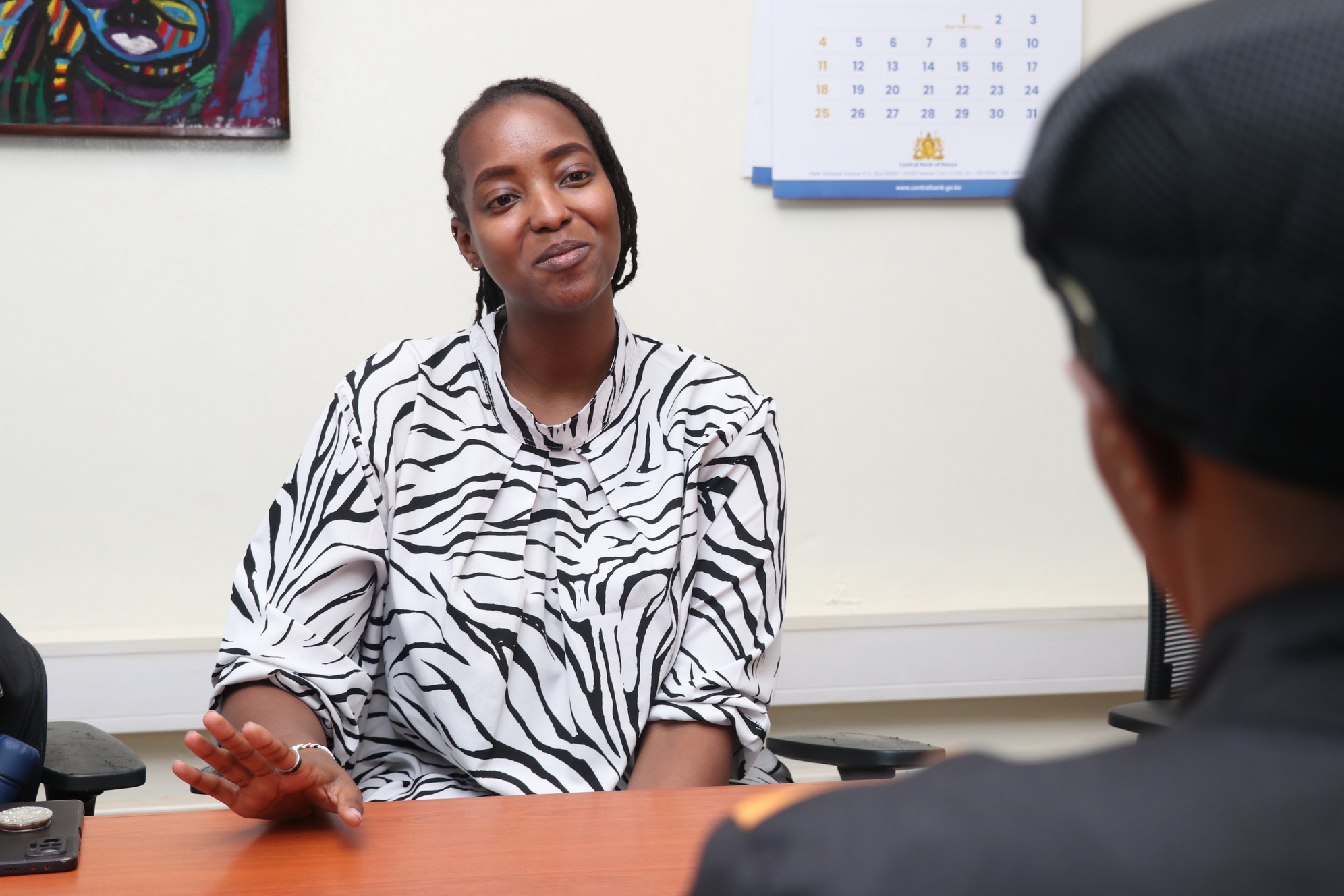
How did this Kenyan in a sea of white faces get here? In an exclusive interview with the Star in Nairobi on Friday, Macharia revisited the journey and her quest to establish herself as an artiste in her own right.
She turns up in a zebra pattern tunic top and jeans, long braids and a white beaded bracelet with diagonal stripes of the Kenyan flag’s colours. Tall and chocolate-skinned, she’s chatty and charming.
Macharia is temporarily home after two intense years in the United Kingdom. She is in Kenya on a grant from Arts Council England to research and develop her creative practice. Her mission boils down to a question that has come to define her life and her music: “Why did I have to leave my country to love my country?”
Macharia, who performs under the name Macharia Music, completed her Master’s degree in Music Performance at the University of Manchester, with a special focus on vocal performance.
She began the programme in October 2023, finished coursework in September 2024 and graduated in December that year. Since then, she has been working in the UK arts sector while grounding herself again in Kenya.
“When I was here, all I wanted was to go abroad,” she says. “But the minute I left, everything changed.” Distance, she says, sharpened her sense of loss. Kenyan music filled her playlists. Kenyan films and television became her comfort viewing. Cultural details she once overlooked — language, rhythm, communal life — suddenly mattered deeply. What she is researching now is not abstract. It is personal, rooted in longing and return.
DISORIENTING TRANSITION
The phrase she keeps coming back to — having to leave Kenya to love it — was not part of a formal assignment. It emerged organically from her experience of isolation abroad.
Manchester offered opportunity, but it was also lonely. She arrived without family, without a ready-made support system, and had to learn how to exist, work and create on her own. Seeing someone with a Kenyan bracelet was a rare and treasured moment of reconnection with the homeland.
Her solitude forced a reckoning with identity, particularly race. In Kenya, she says, blackness is not something you have to think about. It is not a lens through which every interaction is filtered. In the UK, it became unavoidable. She was the only African in the Music Department.
The difference was not overt or hostile, but it was present. “You walk into a room and everyone else is white,” she says. “You stand out even when you don’t want to.”
With that visibility came questions she had never needed to ask before. When opportunities did not materialise, was it about skill, or was race a factor? When doors opened, was she being seen for her work or as a symbol of diversity?
These thoughts, she says, were not constant, but they existed in the background, adding an extra layer of mental labour. At home, rejection felt straightforward: you were not ready, or not good enough yet. Abroad, the reasons were harder to untangle.
Paradoxically, that discomfort also clarified what she missed most about Kenya. There was a freedom in being unremarkable, in blending in, in expressing herself without carrying the weight of representation. There was also language. Macharia grew up in an English-speaking household, a choice her parents made deliberately, believing it would give their children an advantage. It did. Her fluency helped her adapt quickly in the UK. But it also meant she never fully learned Kikuyu, her mother tongue.
Being away stirred a hunger for that lost fluency. She asked her parents to speak to her only in Kikuyu. They text in it now. She is relearning, slowly, deliberately, absorbing as much as she can while she is home. “I’m tired of English,” she says plainly. “That’s all you hear over there. I wanted something that felt like home.”
MUSIC INSPIRATION
Home, for Macharia, has always been supportive. Her parents encouraged her musical interests even when it went against conventional expectations. She grew up in a musical household: her mother sang often, her father took the family to watch stage musicals, and long car rides were filled with music, from country songs to Michael Jackson. The arts were not treated as a distraction but as a legitimate part of life.
The moment she realised music was more than a hobby came early. Visiting a family friend as a child, she encountered a grand piano and guitars. She and her older brother improvised a ‘concert’, making noise rather than music, but feeling a joy that stayed with her. She asked for piano lessons soon after and began formal training at around six or seven years old.
Her brother, who is older, moved into music sooner, taking it as a subject in high school. Macharia followed, learning piano and later guitar, picking up skills from older students at school and choosing guitar as her Western instrument in exams.
High school choir was formative. It was there that performance became routine rather than intimidating, and where teachers played a crucial role.
One music teacher in particular, Edward Omulupi, saw her potential early and encouraged it. Another, Abbey Chokera, then a doctoral student in music, opened her eyes to the possibility of studying music at university.
Until then, she had assumed her strength in mathematics and physics would lead her into engineering, with music remaining a side interest. Learning that music could be pursued academically, even to doctoral level, changed everything.
She enrolled at Kenyatta University in 2018 and completed a Bachelor’s degree in Music in 2020. Alongside her studies, she immersed herself in performance, particularly through involvement with a performing arts production company called Khweva.
She began as a singer then expanded into dance and ensemble work, before moving into leadership roles. By 2021 and 2022, she was assisting with direction and music supervision. In 2023, she served as music director for a full musical production, composing and arranging the score and leading the band.
By the time she left for the UK in October 2023, Macharia was not a beginner. She was an emerging artiste with practical experience across performance, composition and direction.
Manchester refined that foundation. Her master’s programme focused on vocal performance, including opera and jazz, stretching her technically and stylistically.
EARLY ACHIEVEMENTS
Outside university, Macharia sought out work and community. She taught music in a youth centre, working with children in a space that combined recreation and creativity.
Later, she joined the Contact Theatre in Manchester as engagement and agency alumni coordinator, splitting her time between running the music department and community engagement.
Performance opportunities followed. She sang at established venues, collaborated with institutional ensembles and took part in festivals. She was selected for an artiste residency as Soundcheck Artiste for the Manchester Jazz Festival, and participated in projects that addressed the realities facing grassroots musicians.
Some of these opportunities placed her in spaces she never imagined as a student in Kenya: singing with accomplished musicians, recording professionally and being evaluated purely on her ability.
Macharia sees herself as a “daughter of the earth” paving the way for other artistes, something that would make her mum’s father proud if he was still alive.
“Like in that YouTube video, I don’t think he could imagine one of his offspring would one day be in a space where she’s the only Black person and there are white people behind her, supporting her,” she recalled her mum saying.
“He would be so, so proud.”

CAREER, INDUSTRY CHALLENGES
Despite international exposure, Macharia is still finding her feet as an artiste. Her music cannot be boxed into a single genre. It draws from Kenyan folk traditions, contemporary Kenyan sounds, jazz, opera and choral textures learned in high school.
Language is layered intentionally. English, Kiswahili and Kikuyu coexist, sometimes within the same song, chosen for feeling as much as meaning.
She has not yet released original recorded music publicly, but the work exists, waiting for resources and the right moment. She is aware of the headache many artistes face over rights and royalties but has not faced any major dispute herself, in part because she’s worked within clear contractual frameworks.
Collaboration is part of her vision. She looks up to the likes of Xenia, Serro and Barbara Wangui, artistes she hopes to learn from and one day work alongside.
Macharia is currently independent, funding her projects herself while applying for competitive grants. Her next major work is an EP shaped directly by her research. It traces a narrative arc: isolation abroad, the ache of missing something unnamed, the search for roots and eventual acceptance of a hybrid identity.
As part of her grant, she is required to present a performance in Kenya. Securing an affordable, accessible venue was not easy. Many spaces prioritise artistes who already have recorded releases or established promotional campaigns. Others are costly once technical requirements are factored in. For an independent artiste still in the process of recording, the barriers are real.
She is careful not to frame this as blame. Rather, she sees it as a structural gap, particularly for grassroots musicians who are still developing their work.
In the UK, she says, open mics and jam sessions are abundant. They provide low-stakes spaces where beginners and seasoned professionals share a stage, test ideas and learn from each other.
That ecosystem, she believes, is something Kenya could adopt. She imagines building such a space herself one day, once she is more established.
PARENTAL, PUBLIC SUPPORT
Macharia sees progress in how songwriting, production and performance are valued in Kenya. She says young artistes need to be equipped with skills, discipline and honesty about the challenges ahead.
“The reality, even in the UK, is that music is not the most lucrative business, especially at the grassroots level, which is why I have a job in a theatre,” Macharia says.
“But as we continue to support each other, as we continue to support the arts, the important thing is not giving up too soon. Because the opportunities that come to you are, number one, when you least expect it, but also when you keep going.”
Fans play a key role in motivation. “If someone has a show and no one’s showing up, then how are we supposed to aspire and continue to do this thing that we love?” Macharia asks.
She also urges young artistes to be resourceful. Platforms like YouTube and TikTok have opened doors for many. Opportunity does not always arrive through traditional channels.
Nonetheless, the fear of not making money from music makes many parents baulk at the idea of their children pursuing it as a career. They would rather you become a doctor, lawyer or engineer. Macharia acknowledges this, and it pains her.
“Maybe Kenyan parents need to understand that when your child really craves music, it’s not just them trying to be defiant,” she says. “If your child wants to be a doctor, then support them. If your child wants to be a musician, then support them in the best way.”
Speaking to the youngsters in this predicament, Macharia is full of encouragement.
“Your dreams are so, so valid!” she says. “It’s not just a thing in your head. It’s not just a phase that will pass. And even if it is, let it pass. My brother did music for a year and then decided, ‘This isn’t for me, let me go to IT now.’”
For Macharia, the journey is still unfolding. She is visiting Kenya for now, listening closely, relearning, composing. Next month, she will return to the UK to continue building her career. Wherever she is, the question of belonging travels with her. She left Kenya to master her talent. She came back to ground it.
Call it bravado, but Macharia is dreaming big. And if her dreams materialise, then you could call it prophecy. “Five years from now, I’ll be winning Grammys.”
Macharia Music will be performing at 6pm on Saturday at the Rooftop Gallery in Village Market, Nairobi. Entry is free.
Tom Jalio is the features editor of the Star and producer of the Jalio Tales YouTube channel