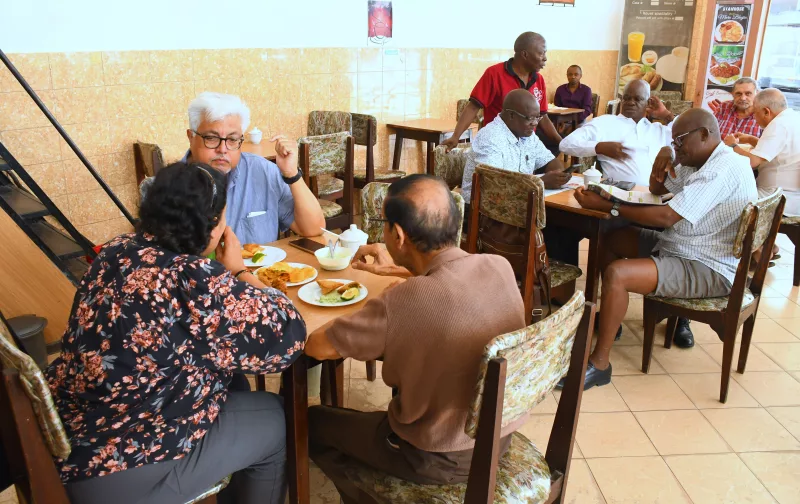

When Japanese fisheries economist Prof Haruko Yamashita ordered fish at a Nairobi hotel during her recent visit to Kenya, she noticed something that surprised her. The fish she was served was imported.
For a country with access to the Indian Ocean, major freshwater lakes such as Lake Victoria, and expansive rivers, the imported fish struck her as an indication of what is not working in Kenya’s much-touted blue economy.
“It is sad that local hotels can’t buy domestically caught fish. This is probably an area you need to work on to offer your fish to tourists,” Prof Yamashita told the Star in an interview on Monday.
Recent figures indicate fish imports of around 9,960 tonnes in 2024, a decrease from the prior year. The imports are mainly from Tanzania (65 per cent), China (12 per cent) and South Korea (4 per cent).
The academic was in the country to give a lecture themed: "Advancing the Free and Open Indo-Pacific through Promotion of the Blue Economy in Fisheries". From Prof Yamashita’s perspective, Kenya’s fisheries challenge is not primarily about the absence of fish but about how the sector is structured, governed and connected to markets.
A professor at Daito Bunka University and a former adviser to Japan’s Prime Minister’s Office on Ocean Policy, Yamashita has spent more than three decades researching fisheries management in Japan, Southeast Asia, the Pacific Islands and parts of Africa.
From the onset, she acknowledged that fisheries is among the most politically and socially complex sectors to reform.
She described the problem as an “aporia” — a structural dilemma that cannot be solved by a single policy intervention. In Kenya, she argues, the sector is crowded with people who depend on fishing informally for survival, yet the state lacks clear data on who qualifies as a fisher and who does not.
Without strong fisher associations, she said, regulation becomes nearly impossible. But excluding people from fishing without offering alternatives risks destroying livelihoods, especially in remote coastal and lakeside communities with limited access to education or alternative employment.
“How do you incentivise the fishermen to diversify to other sectors, given some of these fishing areas are quite remote, and some fisherfolk might not have enough education to work in cities? But that is outside fisheries because it is something the Ministry of Education should be doing,” she said.
“These fisherfolk should also have better access to the fishing areas but don’t have proper vessels to do that. They also need training to operate these vessels.”
This governance issue, Prof Yamashita suggests, explains why the blue economy often promises more than it delivers in terms of jobs and income.
Expansion without structure leads to overexploitation, declining returns and social tension.
LEARNING FROM JAPAN
Japan’s own experience offers a lesson to Kenya, which is prioritising the blue economy. In 2009, a government survey found that when consumers bought fish at retail prices, only about 25 per cent of the value reached the fisher.
Policy reforms then shifted focus toward processing, cold storage and direct market access. By 2017, the fisher’s share had risen to 31 per cent — a modest gain, but one achieved through deliberate restructuring of the value chain rather than increased catch volumes.
The academic painted a picture of the importance of investing not just in harvesting fish but also in cold-chain infrastructure, processing and links to tourism and domestic markets.
Without these, even abundant water resources will continue to generate limited income for those who depend on them.
Climate change further complicates the picture as rising lake levels in the Rift Valley and warming waters threaten already fragile livelihoods. Yamashita notes that the phenomenon has affected Japan, and globally, governments and universities are increasingly investing in aquaculture and climate-resilient species.
In Japan’s case, the government provided loans for fishing vessels and new technologies to increase productivity and incomes as a foundational stage in 1958.
The second stage followed during the period of rapid economic growth in the 1960s and 1970s, when many young people left fishing villages for factory jobs in cities.
While this reduced overpopulation in villages, income disparities widened. Across countries, common concerns remain: ensuring domestic seafood supply and creating employment.
The professor noted that while there are many things Kenya could do to support the fisheries sector, the priority should be the cold chain. This is the temperature-controlled supply system, crucial from catch to consumer, using ice or refrigeration to slow spoilage, maintain quality (taste, texture and safety) and extend shelf life.
“The supply of ice is not a big headache, and its provision would be of great help to local fisherfolk by increasing their income,” she said.
While approaches differ, the shared objective is to increase incomes by diversifying livelihoods and making effective use of domestic resources, she noted. Below are excerpts from the interview with Prof Yamashita.
Why do you think the blue economy, particularly fisheries, is becoming central to Japan’s Free and Open Indo-Pacific vision?
We don’t have the notion of the blue economy. What we have is marine industry, which became national policy in 2022, although the industry has existed for the last 40 years. But the promotion of the blue economy is very important because in some countries, the fisheries are overexploited, while in others, the sector is underexploited. We thus need some mitigation or common goals to fully but sustainably utilise this resource.
What key lessons can Kenya learn from Japan in managing and growing its fisheries sector sustainably?
I can describe this as aporia, a problem that cannot be solved easily. You need to dig down to the roots of the problem; otherwise, you can’t solve it.
From my research, I think we are facing the same “aporia” problems in the two countries. If you want to solve this problem, for example, overpopulation of coastal fishermen, and you don’t know who are the fisherfolk and who isn’t, you first need to have the fishermen association and sort of exclude those who are not.
But then again, how can you exclude some of those who fish for their living?
That is outside fisheries because it is something the Ministry of Education should be doing.
These fisherfolk should also have better access to the fishing areas but they don’t have proper vessels to do that. They also need training to operate these vessels.
But we cannot stop improving the situation even if it is bad. We should start some projects in parallel. For example, have these fisherfolk form the association, train them and research on this resource, which is very scientific and widespread.
That is something the government, not necessarily the people, need to do because it requires a lot of money and involves water resources that are shared with other countries.
From Japan’s experience, how can the Kenyan government sustainably expand the blue economy sector while protecting small-scale fishers in Kisumu, Lake Turkana and the Coast, for instance?
We are just starting the mariculture, and we only export very little. But people have started this salmon culture. So there is also an opportunity for Kenya to start its own with expertise from Japan or major aquaculture countries, such as Norway, Denmark and southeast Asian countries like Thailand and Malaysia, who are very good at aquaculture.
Kenya is suffering the challenge of rising waters in the lakes located in the Great Rift Valley, a climate-change linked phenomenon that has disrupted the little fishing that was happening there. How can Kenya respond to this challenge?
This kind of research is being conducted across the world. There was a particular natural salmon that would come from Aleutian Islands every winter to Japanese rivers in the north. But it decreased so much, an issue attributed to global warming. The water became too hot. For aquaculture, some researchers are breeding certain species resistant to the higher temperature. This is with the support of the governments and universities.
In regards to international relations, do you see Kenya as an emerging Indo-Pacific partner despite its position on the western edge of the Indian Ocean?
This is certainly one of the reasons countries are cooperating in this. We need a reason to cooperate, for instance, with Kenya. Kenya is in a stable political and economic situation. It is developing and it is a good country to cooperate with as a gateway to East Africa. For fisheries exports, we have a very good relationship with Mauritania and Morocco. We import their octopus.