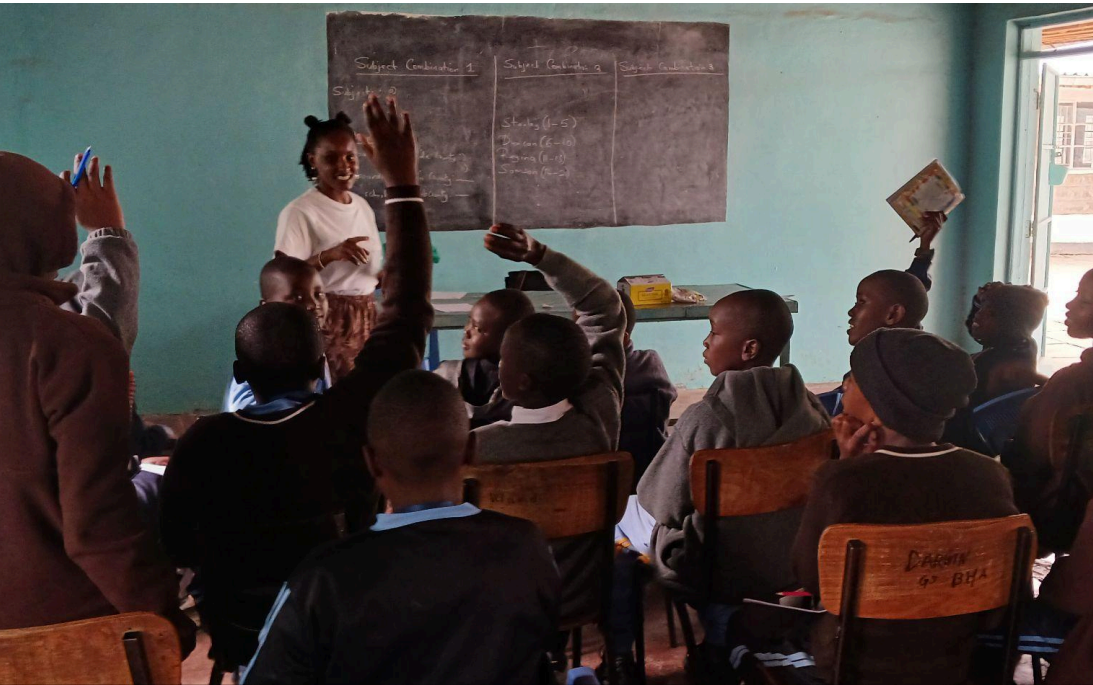
 Children write letters to their future selves, discovering that their voices and feelings truly matter.
When Ashitha first came to Kenya four years ago, she was driven by a simple but bold idea. Inequality, exclusion, and silence could be challenged through storytelling. Not polished narratives, but real stories. Stories that allow people to see themselves in others.
Today, that idea is alive in select Kenyan classrooms, where Lighthouse trains children in emotional literacy and mental well-being, teaching them that their feelings are valid and their voices matter.
Ashitha’s journey into this work began early in life. She traces it back to childhood curiosity about difference and belonging.
“Growing up as an only child with working parents, if I wanted to play or learn, I needed to make friends wherever I could, in the neighborhood, at school, in extracurricular spaces. Very early, I noticed something fundamental about human behavior: people tend to gravitate toward those who are like them and resist those who are different.”
While many retreat from difference, she leaned into it.
“Yet, I realized I approached the differences differently. I was naturally curious about it. ‘If someone is very different from me,’ I remember thinking as a child, ‘then there’s something to explore here, and not something to resist.’ That mindset shaped my friendships, the projects I gravitated toward, and the people I felt compelled to work with.”
That curiosity turned into action at just 18. Ashitha launched Unchaining Gender, a project connecting LGBTQ+ youth across countries. It created space for vulnerability and shared reflection, and revealed something that would later define Lighthouse.
“Through this project, I saw firsthand that the emotional and experiential core of human life is strikingly similar across cultures and geographies. Despite different social contexts, our participants shared remarkably resonant feelings, fear, hope, joy, and moments of self-doubt that transcended borders.”
As she grew older, this insight deepened into a worldview. She began to notice how societies often cling to familiarity and exclude what feels unfamiliar, even when doing so causes harm.
“In a world that was becoming increasingly interconnected yet fragmented, curiosity toward difference felt more necessary than ever.”
Her travels between 2019 and 2020 reinforced this belief. From Chile to Germany, Ghana to India, she saw the same emotions surface again and again.
“I remember walking through a park in Berlin and watching children chatting, laughing, and worrying about grades, and their future. I had seen the same emotions mirrored in Mumbai, Santiago, and Accra.”
Then came the pandemic. In 2021, a conversation with a Chilean journalist helped sharpen the question that would define Lighthouse.
“I realized that while news and social media provide facts or headlines, they rarely capture the intimate, lived experiences of everyday people across the world. I thought, How can someone in Mumbai truly connect with the hopes, fears, and daily life of a peer in Mexico?”
The answer lay in a concept called symbolic mobility.
“Symbolic mobility refers to the ability to traverse cultural symbols, languages, and identities, not physically, but emotionally and cognitively.”
Lighthouse was built to make that possible, using storytelling as both method and message.
The platform’s impact became clear during its pilot campaign, Stories of Kisumu. The project focused on a settlement in Kisumu County, where gender-based violence had surged during the Covid-19 period. According to the Kenya National Crime and Research Centre, 53 per cent of women and girls aged 15–49 in Kisumu County reported experiencing gender-based violence.
Working with local journalists and facilitators, Lighthouse created a safe space for survivors to speak.
“One participant, Amina*, recounted her experiences of navigating abuse, societal stigma, and the fear of being silenced.”
When these stories reached audiences in India, Germany, Chile, and the US, something powerful happened. People who had never set foot in Kenya recognised themselves in the stories.
“This campaign underscored the importance of intersectionality: each story was not just about gender or geography, but also about age, socio-economic and community pressures.”
That ethical approach now guides all Lighthouse work. Ashitha describes these spaces not as safe, but brave.
“I approach safe, or rather ‘brave spaces’ for storytelling as a combination of ethical design, participant agency, and culturally responsive facilitation.”
The ongoing Unmentioned campaign applies this thinking to mental health. Participants share deeply personal stories, many for the first time, challenging silence around emotional pain.
“A fundamental framework our work is based on, is that of ‘Narrative Agency’, which emphasizes that people are not merely subjects of observation but active participants in shaping the meaning of their experiences.”
Across campaigns in Africa, South Asia, and beyond, Lighthouse uses structured storytelling to explore justice, peace, identity, and belonging. Data supports the impact, with over 75 per cent of participants reporting increased emotional clarity and connection.
One story from Unmentioned continues to resonate.
“One story that lingers comes from a 19-year-old participant in Mumbai… Across the world, the Mexican participant shared her own ritual of emotional expression, emphasizing family ties and friendship as protective spaces.”
For Ashitha, leadership itself has been reshaped by these stories.
“Listening to the resilience and vulnerability of so many people has taught me that transformation is reciprocal.”
It is a lesson now being passed quietly, steadily, to Kenyan children learning that their stories matter.