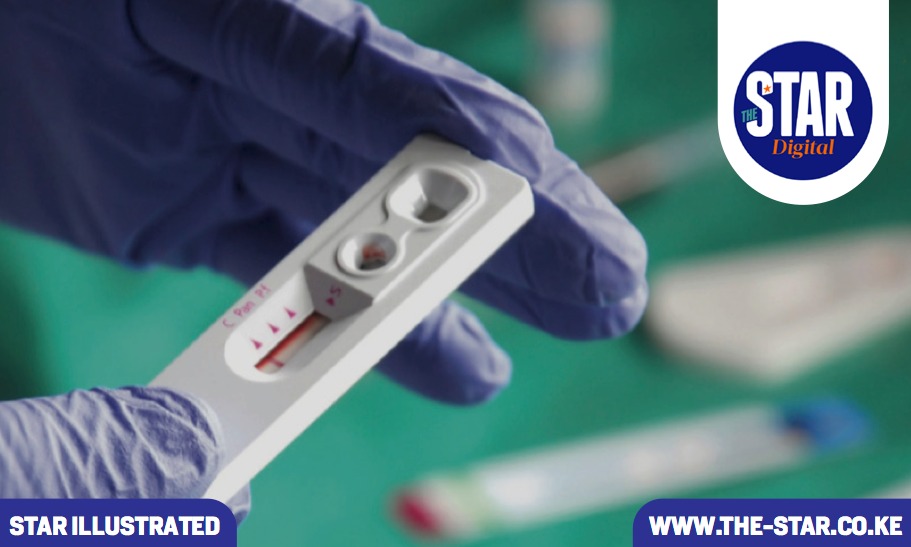
 HIV test. Kenya has more than 1.3 million people living with the virus./HANDOUT
The trial, announced by the global research organisation IAVI, has started giving first doses to healthy adult volunteers.
Researchers said they are testing a new vaccine approach to train the immune system to make special antibodies that can recognise many different strains of HIV.
Kenya has more than 1.3 million people living with the virus, and 19,991 new infections were recorded in 2024, the National Syndemic Diseases Control Council data shows.
IAVI described the trial (code-named G004) and what researchers hope it will achieve:
“The hypothesis being tested is that highly specialised vaccine immunogens, delivered in a specific sequence, can target certain B cells within the immune system and coach them toward the production of broadly neutralizing antibodies against HIV. Scientists widely believe that a vaccine inducing broadly neutralizing antibodies (bnAbs) could provide broad protection against many strains of HIV,” the organisation said in a statement.
Although the trial is taking place in Soweto, South Africa, its findings matter to Kenya because HIV affects the region in similar ways, and future vaccine studies are often expanded to neighbouring countries once early safety tests succeed.
If the G004 trial shows promising immune responses, it could pave the way for larger studies that include Kenya.
This trial involves 96 healthy adults living without HIV and will test different vaccine doses to find the safest amount that triggers an immune response without harmful side effects.
The vaccine parts being studied were developed by scientific teams at IAVI and Scripps Research, and delivered using the same mRNA technology that underlies some Covid-19 vaccines.
“Even with the advent of highly efficacious long-acting antiretroviral drugs for pre-exposure prophylaxis (PrEP), the availability of an efficacious HIV vaccine will likely be required to sustainably control and eventually end the Aids pandemic,” Iavi explained.
Kenya has made strong progress in reducing deaths and new infections over the past decade, with AIDS-related deaths down by more than two-thirds and new infections declining.
Yet the virus still infects far too many people and remains a major public health issue, especially in high-burden counties.
Kenyans currently rely on prevention tools that include daily PrEP pills and long-acting injectables.
Developing an HIV vaccine remains extremely challenging mainly because HIV mutates rapidly, creating many different versions of itself that are hard for the immune system to recognise.
It also hides inside immune cells and changes the outer proteins that vaccines usually target, helping it escape immune responses.
This is why past HIV vaccine trials have often failed to show strong protection, even when they appeared safe.
In Kenya, scientists and volunteers have been part of earlier HIV research that tests how willing people are to take part in vaccine studies.
Last year, researchers at Kemri Kericho received an award of $45.6 Million (Sh6.6 billion) for the advancement and development of an African-led HIV Vaccine Candidate based on the circulating HIV viruses within the continent.
The programme brings together Kemri and Walter Reed Project (WRP) Clinical Researchers who are part of a consortium led by the South African Medical Research Council.
The collaboration is part of a five-year USAID award plan titled BRILLIANT (BRinging Innovation to Clinical and Laboratory Research to end HIV In Africa through New vaccine Technology).
Acting director general Prof Elijah Songok said, “This award will support African scientists and institutions that design and test HIV vaccine candidates, including Kemri Kericho scientists, to improve and advance the most promising HIV vaccine candidates toward clinical trials. It is also a notable transition towards localized research and development of generating solutions that reflect the diversity of our region.”
The team will focus on leveraging existing capacity, scientific expertise, and investments made in community engagement in sub-Saharan Africa to advance an HIV vaccine from discovery through clinical trials.
Kenyan scientists will join forces with research colleagues from Mozambique, Nigeria, South Africa, Tanzania, Uganda, Zambia, and Zimbabwe.
The programme lead and director Kemri Kericho, Dr Fredrick Sawe, said: “This is a major boost that will strengthen the vaccine development process, potentially leading to the creation of a more suitable and effective vaccine Clinical Trials.”