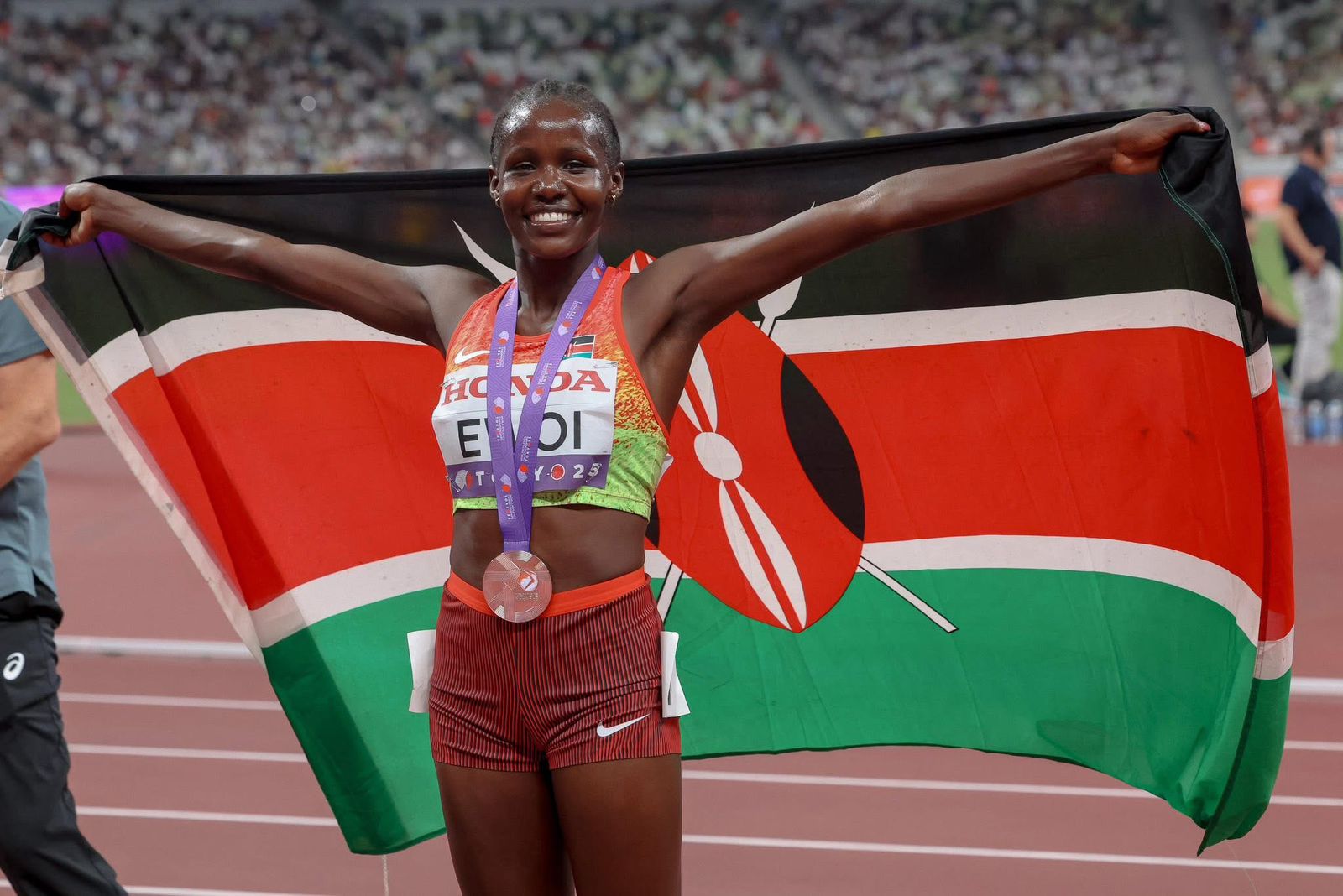
 Dorcas Ewoi at the Tokyo World Championships/ FILE
The United States of America is fast turning into a breeding ground for Kenya’s next generation of athletic greats, with an increasing number of stars packing their spikes and heading west to harness the world-class training facilities and academic opportunities available there.
National sprints coach Stephen Mwaniki believes this migration wave could be the key to unlocking the nation’s future champions. “America is much more developed in terms of facilities compared to us. Most of our athletes take advantage of the lucrative deals and scholarships offered by American colleges,” Mwaniki told The Star.
The seasoned tactician says the trend is not only beneficial to individual athletes but also pivotal for Kenya’s long-term global competitiveness. “This is a very good thing because they are helping us develop our athletes. All of us cannot be here in Kenya,” he added.
One such success story is Dorcas Ewoi, the Tokyo World Championships breakout star who stormed to silver in the 1,500m, clocking 3:54.92 behind four-time world champion Faith Kipyegon (3:52.15) and Australia’s Jessica Hull (3:55.16).
“Ewoi is one of the stars who have taken advantage of being in the US. She hasn’t been there long, but you can already see how fast she is growing. If you compare her to our world Champion Lilian Odira, she took a shorter time to claim a global medal,” Mwaniki observed. Ewoi’s journey began at South Plains College in Texas (2018–2020) before joining the Campbell Fighting Camels track and field program.
She finished fifth at the 2023 NCAA Division I Outdoor Championships before turning professional with Puma. In 2024, she stunned the world by defeating Olympic champion Athing Mu to win the Holloway Pro Classic, a World Athletics Continental Tour Silver event.
Apart from Ewoi, Tokyo also had a number of top-class athletes based in the US. Another rising sensation is Ishmael Kipkurui, who finished fourth in the 10,000m at the Tokyo World Championships.
The young prodigy, formerly of Sinonin Secondary School, joined the University of New Mexico in January 2025, where he broke the NCAA record in the 10,000m at The TEN meet, clocking 26:50.21.
In June, he clinched the NCAA 10,000m crown and added to his growing resume that already includes gold at the 2023 World Cross Country Championships in Bathurst, Australia.
The women’s steeplechase team in Tokyo also showcased the growing American influence. Doris Lemngole, a University of Alabama standout and reigning NCAA steeplechase and 5,000m indoor champion, narrowly missed the podium, placing fifth in 9:02.39.
Her teammate, Pamela Kosgei, who joined the University of New Mexico in 2024, entered the Championships as the 2025 NCAA 5,000m and 10,000m double champion.
Before heading to the US, Kosgei had already announced herself with bronze at the 2023 World Cross Country Championships and won gold in the 3,000m steeplechase at the African U-20 Championships in Ndola.
Distance maestro Edwin Kurgat, who represented Kenya at the Paris Olympics (5,000m) and Tokyo Worlds (10,000m), also polished his craft in the US.
A product of St. Patrick’s High School, Iten, Kurgat moved to America to join the University of Tennessee, later transferring to Iowa State in 2018.
Another key member of Kenya’s Tokyo squad, Susan Ejore, also honed her middle-distance prowess in the US before donning national colours in the 1,500m in Paris 2024 and Tokyo.
Interestingly, the migration trend appears to favour female athletes, a fact Mwaniki attributes to several factors. “Our female athletes moving to the US are more compared to their male counterparts. It’s easier to bring women to the level you want them to be or teach them.”
“Another factor is that maturity in athletics for women takes a shorter time than for men. Also, not everyone can fit in the US system, the recruiters look at education background,” Mwaniki explained.
Among the latest movers are 2019 African 400m hurdles champion Vanice Kerubo, 1,500m prospect Mary Nyaboke and 800m hopeful Dorcas Isoe. They join a powerful list of Kenyan women already thriving on American soil.
Leading the charge is two-time world champion and marathon powerhouse Hellen Obiri, who relocated to Boulder, Colorado, in 2022 to join the On Athletics Club (OAC).
Seeking better coaching and training partners for her marathon career, Obiri has since reaped massive rewards. In 2023, she completed a stunning Boston–New York double, winning in 2:21:38 and 2:27:23, respectively.
She defended her Boston title in 2024 (2:22:37) and placed second in New York behind Sheila Chepkirui (2:24:35). At the Paris Olympics, Obiri clinched bronze in 2:23:10 behind Sifan Hassan and Tigst Assefa, and earlier this year, she clocked 2:17:41 for second in Boston, just behind Sharon Lokedi (2:17:22).
Lokedi, another Kenyan success story, relocated to the US in 2015 after graduating from Kapkenda Girls High School, pursuing nursing and business at the University of Kansas.
A 10-time All-American and 12-time Big 12 champion, she won the NCAA 10,000m title in 2018 before conquering the global road stage. Her stellar resume includes the 2022 New York Marathon title, Boston victory this year, second place in Boston 2024 (2:22:45), and third in New York 2023 (2:27:33).
Back home, Townhall Athletics Club in Iten is helping identify and prepare athletes for these US opportunities. Director Albert Kirwa revealed that nearly 35 student-athletes have already moved to America in 2025 alone.
“Townhall was established in 2021, and we conduct trials once a month to send athletes to various colleges and universities in America,” Kirwa said. “An athlete must have completed Form Four with at least a D+ and be under 24 years. We test in 5,000m, 3,000m, 1,500m, and 800m events, with specific qualifying standards.”
The women’s 5,000m standard is 16:59 (14:09 for men), 3,000m is 9:59 (8:09 for men), 1,500m is 4:27 (3:47 for men), and 800m is 2:10 (1:59 for men). Once qualified, athletes submit their credentials and passports for placement, with colleges or well-wishers covering travel costs.
“Once the athlete meets qualifications, we take their information, where they need to have a passport and their KCSE certificate. From there, the college that is interested in the athletes caters for travel, and those who don’t, we have well-wishers who help them.”
As the athletes prepare for their journey to the US, they pitch camp at the Townhall camp in Iten. "Before going to the US, the selected athletes stay in our camp where they are trained nd guided by our coaches Willy Bitok and Benson Mateka."
Kirwa pointed to some of the top athletes who have passed through the Townhall trials. “We have had some big names who have come through Townhall, including Ishmael, Pamela and Evans Korir, who showed remarkable talents that landed them scholarships.”
Mwaniki notes that this phenomenon isn’t new; Kenya’s athletics legacy in America runs deep. “This is not the first time Kenyan stars have gone on to shine internationally after studying in the US. We have Paul Ereng and the late Henry Rono who flew the nation’s flag proudly,” he said.
Ereng relocated to the US to join the University of Virginia in early 1988, where he took up the 800m. He won Olympic gold for Kenya in Seoul 1988, as well as back-to-back world titles in Budapest 1989 and Seville 1991.
Rono, meanwhile he attended college in the US at Washington State University in Pullman in 1976.
His career saw him claim double gold at the 1978 Edmonton Commonwealth Games in the 5,000m and 3,000m steeplechase, as well as another pair of gold in the 10,000m and steeplechase at the 1978 African Games in Algiers.
Mwaniki also credited Barnaba Korir, Athletics Kenya’s chair of youth development and the National Olympic Committee of Kenya (NOCK) first vice President, for translating his American experience into administrative success.
“Korir learned a lot about management while in the US during his athletic career, and he has brought that knowledge to help uplift our athletics,” Mwaniki remarked.
Korir attended Iowa State University, where he holds a Bachelor of Finance. He was further inducted into the Iowa State University Athletics Hall of Fame in 2019.
Between 1987 and 1988, he was a six-time Big Eight champion while at Iowa University, winning the 10,000m, 5,000m, One Mile, Cross Country, Distance Medley relay and 4 x1,600m. He is also a three-time All-American champion in the 5,000m and cross country.
Mwaniki also revealed that soon, Kenya may have more sprinters relocate to America. “There is a belief that Kenya is not a sprinting nation; they know we are only long-distance athletes. But with the way our sprints are coming up, it is very promising.”
“At the Tokyo championships, some of our sprinters were actually approached to join the American collegiate. They are just waiting for visas. This shows that in future we may have many sprinters based in America.”
"The facilities in the US will prove to be highly beneficial for our sprinters if we are to dominate not only the continent but the globe."