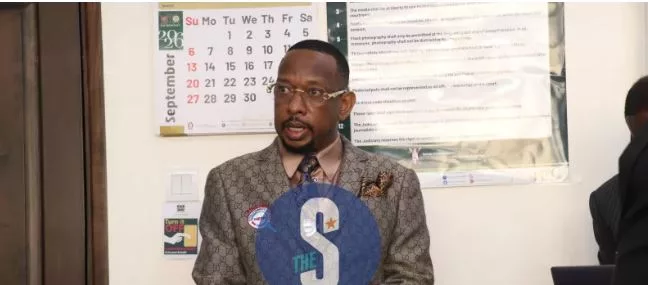
 Nairobi Governor Johnson Sakaja before the Senate Committee on Roads, Transport and Housing on Tuesday /HANDOUT
Governor Johnson Sakaja’s ambitious revenue collection in Nairobi hassuffered a major setback after the High Court struck down his administration’sFinance Act for 2023.
The court nullified the law late last week, citingfailure to meet legal requirements of pricing transparency and public consultation.
Finance Acts are updated each year.
The 2023 law is still in effect because the Sakaja administration withdrewits 2024 Finance Bill, following President William Ruto’s withdrawal of thenational Finance Bill due to Gen Z protests against higher taxes.
The court decision will be reflected in the Finance Bill, 2025, which is being considered by thecity county assembly. A new bill is expected to be introduced.
The county’s 2023 Act had introduced sweeping increases in levies and fees. Itraised the reserved parking fee from Sh1,000 to Sh1,500 per day and increasedthe annual loading zone fee from Sh220,000 to Sh250,000. The annual display fee forvehicles on road reserves was also increased from Sh10,000 to Sh15,000 per squaremetre.
Alcohol licensing costs were sharply increased; general retail licence feessurged from Sh25,000 to Sh100,000. Small and medium-sized nightclubs facedhigher charges. Large transport companies were hit with a Sh40,000 increase intheir annual trade licence fees.
Taxi-hailing companies were also hit. The application fee forpassenger pick-up and drop-off was increased from Sh1,000 to Sh5,000.
Parking fees in the Central Business District also rose. Sedan cars in non-automated zones increased from Sh200 to Sh300 per day, while pickups andvans were charged Sh500.
Due to the 2023 Finance Act, the county has been doing well in raising own sourcerevenue.
In the 2023-24 financial year, Nairobi county collected a record Sh12.8 billion,marking the highest own-source revenue among the 47 counties.
Justice Bahati Mwamuye ruled, however, that the county government had violatedboth the constitution and the County Governments Act by introducing new feesand levies without first formulating a clear tariff and pricing policy.
Heemphasised that without a guiding structure, the county had no legal basis tocharge residents and businesses for these services.
“The petitioner’s uncontroverted evidence shows that Nairobi City County didnot develop, adopt, publish, or implement any tariffs and pricing policy beforeenacting the impugned Finance Act, 2023. Public participation involvedpresenting schedules of proposed fees without underlying policy or costanalysis,” the judge said.
The case was filed by Nairobi resident Jared Ngisa Nyabuto, who argued thecounty government had implemented illegal revenue measures that financiallyburdened the public. He sued the county assembly, its speaker, and the countyexecutive. None of them responded to or challenged the petition in court.
Justice Mwamuye ruled that all new charges introduced under the 2023Finance Act were unlawful. He ordered the county to revert to the fees and leviesin effect under the previous Finance Act of 2022, or any earlier applicable law.
“Accordingly, the levies, rates, and fees imposed by law and in force immediatelybefore enactment of the Nairobi City County Finance Act, 2023, which hasbeen quashed, being those under the City County Finance Act of 2022 orearlier, shall now continue to apply and shall be paid by all affectedpersons, pending the enactment of a new Finance Act,” the judge said.
He said the county must comply with all constitutional and statutory requirements,including public engagement and clear pricing structures, before imposing any future financialobligations on residents or businesses.