And that romantic hour’s gone After another poet’s born Speak when there’s someone Where there’s none refrain — Khainga O’Okwemba.
This little poem above is one I wrote for Pheroze Nowrojee. It is published in my poetry anthology, Smiles in Pathos and Other Poems.
It appears among poems I created on my pilgrimage to the shrines of great African literary minds, to invoke their names as inspiration as I embarked on a literary journey.
Pheroze was both a renowned writer and legal mind, and, therefore, an obvious target for the pilgrim.
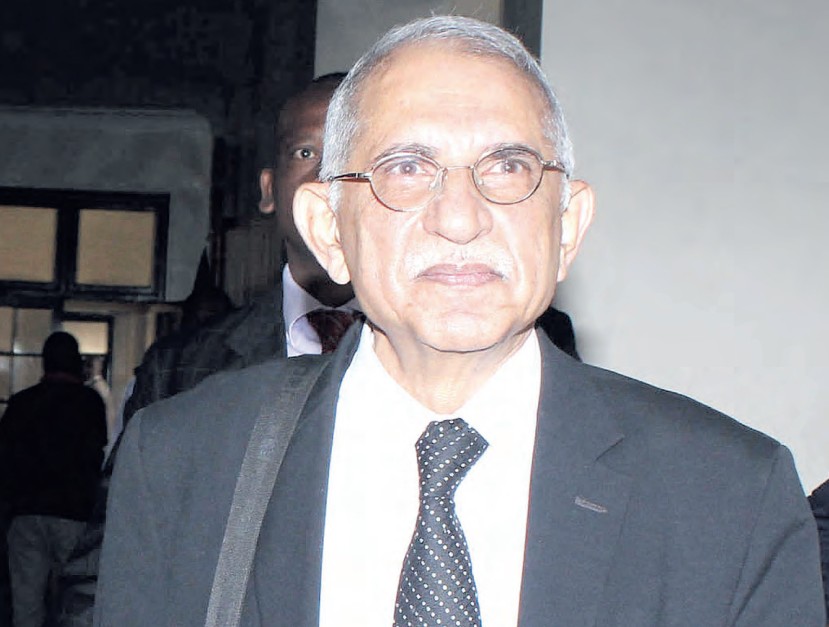
It was the prolific Kenyan writer, painter, fine art scholar and leading art and cultural promoter Prof Elizabeth Orchardson-Mazrui who called me to break the sad news about the sudden departure, in full flight, of my friend and mentor Pheroze at the age of 84.
I say “sudden” because not long ago, I was with Pheroze at the literary memorial of journalist Rasna Warah at the Kenya National Museum. Pheroze was jovial, sharp of mind, lucid if you will, thought-provoking and caring, as was typical of his character and conduct.
I first met Pheroze at KICC during the now defunct National Youth Council annual meet-up. At the time, I was an almost permanent fixture among an emergent new breed of Kenyan writers, whose arrival on the national scene coincided with the sweeping into power of the grand coalition that was Narc.
Pheroze was a keynote speaker, and on this occasion, he reminded the young Kenyans overflowing in the amphitheatre that when you pick a text on Kenyan history, you need must read it with a pinch of salt.
I have carried those words in my mind as though Pheroze Nowrojee is lisping them as he lies in repose. After his address, Pheroze stayed for a few more minutes and then made to leave.
I went to Pheroze; to me, he was a phenomenon. When he saw me, he burst out, “People’s Poet,” and I cried, “Mwalimu!” as we walked to his small Peugeot.
We were friends and together, we would share a platform as newspaper columnists in the Star.
Am I running ahead of myself? I am not good at remembering dates, but I recall occasions, people, places and activities with the magic of a finicky scribe.
For I recall meeting Pheroze Nowrojee alongside Prof Chris Wanjala, Prof Taban lo Liyong, writers Marjory Oludhe-Macgoye and Philo Ikonya at the Legacy Bookshop at the KICC, when PEN Kenya Centre organised a literary event in memory of the great Palestinian poet Mahamoud Darwish.
Between these two events, I don’t know which one came first, but Pheroze, ever with his delighting literary finesse, was present at both.
KENYAN JOURNEY
Pheroze Nowrojee was an intellectual, searing, fearless. A celebrated human rights lawyer and one of Kenya’s most formidable, but little spoken about, writers.
A poet, an essayist, a journalist, a short story writer and a biographer.
When he published the biography of his great-grand uncle, Motabhoy Darabshaw, the first to arrive in Kenya, as A Kenyan Journey, tracing his family’s roots, and the short story collection, Dukawalla, about the Asian community in Kenya, I invited him to The Books Café.
It was during the programme that Pheroze, perhaps the most perceptive writer Kenya has had, defined for us the role of the writer: “The writer is seeking to see what is hidden, what is not disclosed. And so the writer seeks, by his writing, to bring to the surface not just a narrative, not an anecdote. A story is not only an anecdote. A story is disclosure, it is opening up something that the reader has not seen. The reader seeks material that is known to him and familiar to him so that he’s comfortable in it. But at the same time, the reader is seeking revelation, surprise, a point of view,” Pheroze told me.
After the programme, this largerthan-life yet self-effacing Kenyan treated me to a meal and a tete-atete at the Norfolk Hotel.
Echoing that day, faraway, at an eating parlour on the Red Sea, when the late Somali scholar and writer-friend Dr Maxamed Afrax took me from the cloisters of a conference hall in Djibouti to treat me to lunch as we talked Africa and literature.
Chinua Achebe was engulfed in the same situation when Unesco awarded him an open travel fellowship, and he decided he would go to the United States of America and Brazil, for the simple reason of what the black population in these two countries represents.
When the venerated African American poet Langston Hughes heard that Achebe was in the States, he extended “a gesture of friendship” by inviting him for a meal and to “a seat of honour” beside himself at a performance of the opera Street Scene, which Langston had written.
LITFESTS PATRON
Pheroze was ever present at literary events. In 2018, Prof Orchardson-Mazrui, who had long started a programme of honouring distinguished Kenyans in the arts and literature, organised a celebration in honour of Tanzanian immigrant Elimo Njau, the legendary painter and founder of the famous Paa Ya Paa Arts Gallery, on his 84th birthday.
The guest speaker at this celebration was Pheroze, and he did not just give an address, he read the five poems he wrote and which were inspired by Elimo’s extraordinary paintings in the interior walls of the Anglican Church, the Saint James and All Martyrs Cathedral in Murang’a.
Pheroze says when he heard about this stunning art, he went to Murang’a and over the years, since the late 1960s, he and wife Villoo became pilgrims.
These poems and the paintings have been published in Harold Miller’s book, The Murang’a Murals. Here is an extract from Pheroze’s poem about the mural on The Last Supper: Someone is about to make — or has made —
An after-dinner speech But it does not appear to be one of thanks One does not know if, to treason Bad manners accrete For Judas’ departure is abrupt And there is no acknowledgement To those who brought the yams…. Only a few can see That the landscape to our right Promises little And no one notices the owl
MISSED OPPORTUNITY
Pheroze and I would walk together to and from Broadcasting House, whereupon Pheroze stopped, pulled me by holding my hand and burst out, “Khainga, I want you to write a book about your encounters with writers. Your memories with the many writers you have interviewed.”
And he gave me the assurance that he would extend his help in putting the book together. It was on this occasion that I suggested to Pheroze that we launch the books I mentioned above at the Goethe-Institut, which we did.
The Kenya Broadcasting Corporation recorded this literary jamboree and aired it on its flagship writers’ programme The Books Café on KBC English Service.
Pheroze was a person I hugely admired. He was an inspirational figure. When I last met him, we spoke quite a bit and agreed to do another programme with him focusing on his new book, The Station Master.
Well, it is that interview on The Books Café I will never have. But the book he was prodding me to write, about my encounters and recollections with writers, will have, like the fine strokes of a painter’s brush, a historical personage who was a celebrated Kenyan writer, called Pheroze Nowrojee.
Khainga O’Okwemba is the presenter and producer of ‘The Books Café’ on KBC English Service