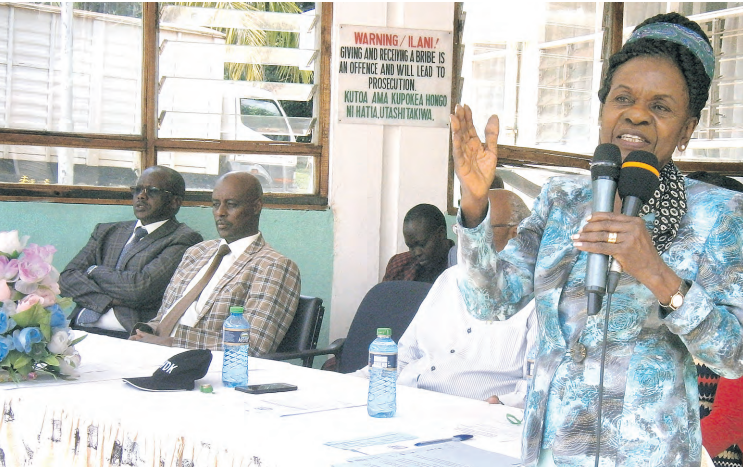
ENTRY INTO POLITICS
Determined to excel, she pushed through every challenge and made her way to Alliance Girls and then to Harvard University — an extraordinary achievement at the time.
“Many of the girls I grew up with were still stuck in the same cycle of early marriage and domestic life,” she says.
“I had travelled the world, but back home, nothing had changed for them. That realisation hit me hard.” After excelling in academia, she became the first female lecturer at the University of Nairobi.
“I loved teaching. I was in the lab 24 hours a day, working with medical students, education students — everyone. I never imagined leaving that life.” But fate had other plans. Her entry into politics was unexpected.
“I never thought about politics. Never learned it, never trained for it,” she admits.
“But one day, elders from my village called a meeting and told me, ‘We need you to lead." She hesitated. “I was a researcher. I had a stable career. Why would I leave all that for politics?” The elders were insistent.
“They told me, ‘We will teach you the language of politics. Just like you learned in books, you will learn from us.’”
Eventually, she accepted the challenge, not because she wanted power, but because she wanted to uplift her people.
“My goal was never to get a political position. It was to help my community.” Running for office as a woman in a male-dominated field was no easy task. Her opponent was a seasoned politician, well-funded and deeply entrenched in the system.
“I had only Sh70,000 to my name,” she recalls. “I bought a small Datsun 1100CC with it and hit the road.
Meanwhile, my opponent had all the resources, vehicles, youth groups and even government security.”
Her biggest supporters were women, young people and the elderly.
“They had no money, but they gave what they could, a meal, a place to rest, moral support.” But as Election Day neared, the campaign turned violent.
“My opponent started using brutal tactics. His supporters carried pangas and axes. They would cut off ears to instil fear.”
Her own husband was a victim of the brutality. “On election day, he was attacked. They chopped his vehicle with pangas and cut off part of his ear. It was terrifying.” Despite the dangers, she remained undeterred.
“Fear was not an option,” she says. “If I backed down, I would be letting down all the people who believed in me.”
Despite the threats, intimidation and violence, she won. She had done the impossible, defeated a political giant as an underdog with no wealth or connections.
“The day I was announced the winner, my people wept,” she says. “The elders, the women, the youth, they had risked their lives for this moment.”
But even in victory, the challenges did not end. “When I went to collect my retirement benefits from the University of Nairobi, they told me there was nothing for me,” she said.
“At the time, there were no proper retirement schemes. I had left everything behind for politics.” Even the President, who was also the chancellor of the university, had tried to dissuade her.
“He told me, ‘If you leave, don’t come back. I won’t employ you anywhere in government.’”
She had risked it all and won.
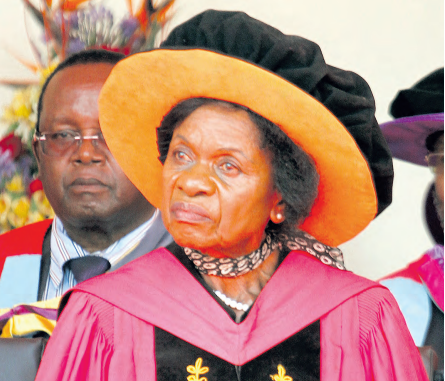
GREAT EXPECTATIONS
As Kenya’s first female Assistant Minister, she understood the weight of her position. “I wasn’t just representing myself.
I was representing every woman who had been told she wasn’t good enough.” Her focus remained on development and education.
“I knew that the key to real change was knowledge. I wanted to make sure no girl in my village ever had to fight just to get an education.”
She championed policies that prioritised women’s education, maternal health and rural development. “I believed that when you empower a woman, you empower an entire generation,” she says.
Her leadership also brought international recognition. She represented Kenya in numerous global forums, advocating for women’s rights and policy changes that would benefit future generations. Despite not being very active in politics, Prof Julia Ojiambo continues to mentor young leaders.
“Leadership is not about the title. It is about the impact,” she says. “I may no longer be in government, but my duty to the people does not end.”
She remains active in community work, supporting scholarships for young girls and championing causes that uplift marginalised groups. Looking back, she sees her journey as one of purpose.
“It wasn’t easy. But if I had given up at any point, what message would that have sent to the next generation?” Her story is one of triumph over adversity, of breaking barriers and inspiring future leaders.
From a young girl who travelled on a train for education to a woman who stood her ground against a political powerhouse, she embodies resilience, courage and the power of belief.
“If you believe in something, fight for it,” she says. “No matter how hard it gets, no matter how many people say you can’t do it. Because if I did it, so can you.”