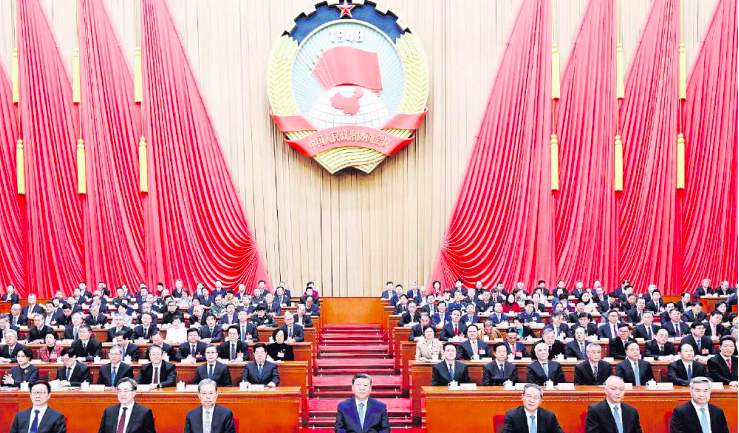
CHINA’S parliament cuts a unique characteristic with its members meeting only once a year to debate and approve the government agenda.
It has elected representatives who sit at the National People’s Congress and a group of consultants who checkmate the government.
The top political advisory body is the National Committee of the Chinese People’s Political Consultative Conference.
The meetings of the CPPCC and NPC – bodies that serve a five –year term, run parallel and take place at the same time, hence the name ‘two sessions’.
The current 14th National People’s Congress has nearly 3,000 deputies, while the 14th CPPCC National Committee has over 2,000 members.
Under the concept of whole people’s democracy, masons, farmers, taxi drivers, doctors and top business magnates have been elected to the NPC.
None of them draw a monthly salary from the government. They are only facilitated for travel and accommodation during their stay in the capital for the ‘two sessions’.
They have the power to elect national leaders, approve government budgets and national development plans, among others.
The political consultative conference is a specialist consultative body whose members advise on major national policies and key issues.
They review government work reports from the perspectives of economic, political, cultural, social and ecological development. This year, the sessions of the NPC and the CPPCC National Committee began on March 4 and concluded yesterday.
GOODIES FOR KENYA
In the just-concluded session, China assured its friends abroad, including Kenya, and Africa by extension, of better times ahead. In a statement by Chinese Premier Li Qiang, the government assured it would “strive for solid progress in pursuing high-quality Belt and Road cooperation.”
“We will advance both major signature projects and small but beautiful public well-being projects, and produce a number of exemplary cooperative project deliverables,” Qiang said.
China also assured Africa and its cooperating partners of deeper multilateral and bilateral and regional economic cooperation.
“We will continue to expand our globally oriented network of high standard free trade areas,” the PM assured, restating that China would promote shared development. Lou Qinjian, a spokesperson of the National People’s Congress, said
“China will always be a participant and advocate of South-South cooperation.”
“China has prioritised its support for the development of the Global South under the global development initiative,” Lou said.
China has provided aid to over 160 countries and announced zero percent tariff treatment for more than 40 least developed countries.
“China is committed to promoting a community of shared future for humanity,” Lou said.
The assurances stand to calm the nerves of African nations, which have been fretting about aid cuts implemented by US President Donald Trump’s administration.
Ahead of the meeting, leaders, among them Prime Cabinet Secretary and Foreign Affairs CS Musalia Mudavadi, said they were hopeful Chinese MPs would work towards more engagements under the BRI.
In an interview with CGTN, he said the BRI is important and dear to Africa.
“Trade works with enhanced connectivity. If you are talking of railway, road and internet, this is an important agenda for Africa,” Mudavadi said.
He expressed hope that the Chinese MPs would position themselves to help Africa, even more, when it came to the Belt and Road initiatives.
Africa, Mudavadi said, is hoping for China’s support in its quest for a permanent seat at the United Nations Security Council. “China’s voice is very strong and we hope that they (MPs) can amplify it to support Africa,” he said.
KENYA-CHINA EXCHANGES
China and Kenya relations straddle more than 60 years, with leaders assuring that it was headed for the best in the near future. On parliamentary affairs, China and Kenya are currently executing an exchange programme that has seen CPC and UDA compare notes on governance.
A recent meeting between UDA top guns led by secretary general Hassan Omar and China’s new ambassador to Kenya Guo Haiyan highlighted the ties.
The talks focused on ways to “further strengthen ties between UDA and the CPC, as well as broader areas of bilateral cooperation between Kenya and China.”
“The party aims to foster a strong, cordial relationship with the Communist Party of China based on shared beliefs and mutual interests,” Omar said.
Youths are targeted in the exchanges, with a view to having them learn China’s best practices and identify areas of improvement in governance. The aim is to have the young people understand, deeply, each of the sides’ social structures.
“There is a desire to redefine engagements and promote South-South cooperation, emphasising the importance of people-centred policies and collaborative efforts,” Omar said.
CHINA WAY
It is, however, the efficiency at which the Asian powerhouse’s parliament works that has attracted attention. “It is the epitome of public participation in governance. It brings together delegates from all walks of life and hence a perfect model of all people’s democracy,” Cavince Adhere, a scholar and expert on Chinese affairs, told the Star.
“NPC has worthy lessons for Africa on governance, being a platform for domestic and foreign policies. The decision they make have serious implications on China cooperation,” Adhere said.
The sessions have been held at a time many leading economies are looking inwards, cutting aid to foreign partners. Coming a few months after the FOCAC summit, eyes are cast on how the sessions would give life to the resolutions of the grand meeting, which President Ruto also attended.
The African Union has also had a change of leadership, staging the possibility of renewed focus on the priorities of the continent, especially under the BRI. Under BRI, China has helped Africa build more than 100,000 kilometres of both roads and railways, and also improved a number of sea ports.
“Two sessions is where all the decisions are made. We expect China to step in, not fully, but see a way to collaborate with Africa to spur development in the continent,” Adhere said.
During the sessions, the government unveiled its ‘work report’ of the year – a review of past achievements and development priorities.
Among the new spending plan is a package for climate change response, restoring Africa’s hope for more climate financing.
As per the work report, China targets an economic growth of around five per cent in 2025, with 12 million new urban jobs.
China aims to set aside a Sh12 trillion budget for the next financial year, part of which Africa stands to benefit. During the recent Forum on China-Africa Cooperation summit in Beijing, China promised Sh6.4 trillion support for Africa.
The funding is aimed at tackling unemployment, climate change and helping Africa advance technologically, especially in the field of AI.
ELECTIONS
Chinese MPs are elected through people’s congresses from 35 electoral units – which are formed from the lowest level at the county. CPC is the ruling party, while the other parties provide political consultancy, including ideas on how to make laws. The consultants don’t represent regions.
The deputies, as the MPs are referred to, present the suggestions of the people. NPC deputies are subject to supervision by their electoral units, which also have the right to recall any deputies they have elected.
After each election, the NPC deputies elect from among themselves a 175-member Standing Committee, which serves as the de facto legislature during the 350 days when the NPC is not in session. A special sitting could also be called when supported by a fifth of the deputies – about 596 deputies.