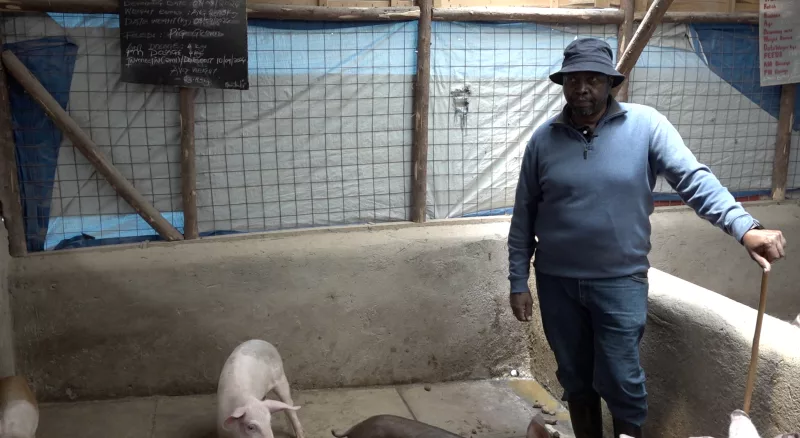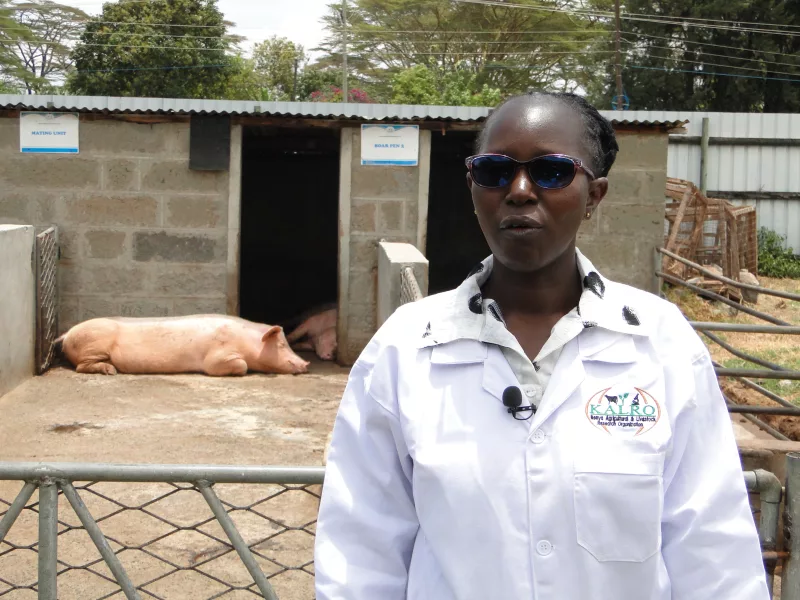
For Mwanya Migadde, pig farming began as a small experiment. He started with two sows at his farm in Kinamba, Naivasha. Within a year, the herd had grown to about 80 pigs.
The rapid expansion convinced him that pig farming could become a serious enterprise. But it also exposed him to the costs and risks that come with putting more animals into the system.
“It’s been a journey. It hasn’t been easy,” he says.
Feed, disease, access to expertise and finding reliable markets are among his biggest challenges. Feed, in particular, can quickly determine whether a farmer makes a profit or loses money.
“Cheap is expensive at the end of the day,” Migadde says.
He now makes some of his own feeds, sourcing ingredients such as maize germ, pollard, omena and soya beans and combining them to meet the nutritional needs of his pigs.
At another farm in Buffalo View, Naivasha, Damaris Njoroge knows the same struggle.
“I once kept nearly 400 pigs. The herd has since fallen to about 82,” she says. “I’m facing three challenges: Feeding, the market and diseases.”
Their experiences mirror challenges across a pig value chain that is gradually becoming more commercial.
Kalro estimates Kenya's pig population at close to 981,000 animals. Annual pork production ranges between 23,000 and 40,000 tonnes, against estimated demand of 38,500 tonnes in 2025. The resulting supplies gap points to room for expansion.
The sector is also projected to grow rapidly, with pork demand expected to increase by 125 per cent by 2030. Smallholder farmers raise about 80 per cent of Kenya’s pigs.
But increasing the number of pigs alone will not make the industry more productive.
For researchers at the Kalro Non-Ruminant Research Centre in Naivasha, the science begins with genetics, feeding, animal health and management.
BREED CHOICE
Research scientist Benedict Olale says success starts with choosing animals suited to the farmer’s objective.
The centre keeps Large White, Landrace, Duroc and Hampshire pigs, as well as their crosses.
Large White and Landrace are important in breeding programmes, particularly for developing productive breeding females. Duroc and Hampshire are valued for growth and meat-production characteristics and can be used as terminal lines in crossbreeding programmes.
“If it’s a farmer who is interested in slaughter stock, then we will sell them the crosses of Duroc and Hampshire,” Olale says.
Njoroge keeps Duroc, Landrace and Large White and favours crossbreeding.
“I prefer Duroc because of the weight gain,” she says.
The choice matters because pigs of different genetic backgrounds vary in growth, feed efficiency, reproductive performance and carcass characteristics.
But good genetics alone cannot guarantee a profitable pig enterprise.
THE FEED EQUATION
At the Kalro Dairy Research Institute feed mill, Victor Opiyo oversees the formulation of feeds for different classes of animals.
For pigs, the mill produces creep, starter, lactator, grower, weaner and finisher feeds.
He says the process starts long before the ingredients enter the mixer.
“A feed can only be as good as the quality of the raw materials used to make it,” Opiyo says.
Raw materials are first taken to a laboratory for proximate analysis to establish their nutritional composition. The results are then entered into a computerised formulation system before the ingredients are mixed.
The finished feed is tested again.
“We check the protein, energy and other nutritional parameters. If the feed meets the required specifications, it is dispatched.”
At the Kalro feed mill, a 1.5-tonne mixer is used and ingredients are mixed for about 20 minutes to ensure they are evenly distributed.
Opiyo says a balanced ration must account for energy, protein, minerals and amino acids.
“You cannot formulate a feed simply by looking at energy or protein alone,” he says.
That matters because feed is the biggest cost in pig production. Kalro puts it at more than 70 per cent of production costs in its feeding guidelines.
The wider value-chain assessment puts the cost at about 60 to 70 per cent, while also identifying inadequate and expensive feed as one of the sector's major constraints.
The cost pressure is particularly important for smallholders. Kalro estimates available feed resources for pigs at 382,022 tonnes a year against demand of 868,232 tonnes — a deficit of 56 per cent.
Opiyo says protein can come from sunflower meal and soya De-Oiled Cake, while energy sources include maize, maize germ, wheat bran and wheat pollard.
The formulation also requires amino acids, such as lysine and methionine, as well as minerals including calcium and phosphorus.
For a sow, he gives an example of a ration containing about 15 to17 per cent protein and 2,800–3,100 kilocalories of energy, depending on the animal's production stage and formulation.
Different stages require different feeds.
Creep feed gives piglets a nutritional start. Starter feed supports the transition to solid feed. Grower feed promotes rapid development, while finisher feed is designed to help achieve the desired carcass and lean-meat production.
Kalro's feeding guidelines similarly distinguish nutritional requirements by production stage, with weaners requiring about 18 per cent crude protein and growers and finishers about 14 to 16 per cent.
For farmers, however, the challenge is balancing nutrition with cost.
Njoroge says some feed can cost about Sh70 a kilogramme.
Researchers are therefore looking at alternative protein sources, including black soldier fly and other locally available ingredients, as part of efforts to reduce dependence on expensive conventional sources.
CONTAMINATION AND DISEASES
Feed quality does not end at the feed mill.
Opiyo says toxins such as aflatoxins can compromise raw materials. Storage can also affect the finished product.
Feed should be kept in a well-ventilated store, raised on pallets and protected against rodents and moisture. Packaging must also protect it from environmental conditions during transport and storage.
“You can do everything correctly during sourcing and processing and still compromise the quality of the feed during storage or transportation,” he says.
Water is another essential part of production. Olale says pigs need adequate clean water throughout the day.
At the Kalro centre, nipple drinkers are used because open troughs can easily become contaminated.
For Kalro veterinary officer Dr Irene Ogali, good feeding must be matched by disease prevention.
“Biosecurity entails keeping germs out of the pig farm,” she says.
She advises farmers to clean and disinfect pig housing regularly and to clean equipment such as wheelbarrows, forks and feeding utensils.
New animals should not immediately be introduced into an established herd. Ogali recommends isolating them for about two to three weeks while they are examined for signs of disease.
Farmers should also restrict unnecessary visitors, use footbaths and protective clothing and source breeding stock from reputable farms.
Daily observation is equally important.
A farmer who knows how his pigs normally behave can detect changes in appetite, body condition, breathing and temperature or general behaviour.
“You should not delay because there are diseases where, if you miss the early clinical signs, you can have mortality of even up to 100 per cent of your pigs,” Ogali says.
African swine fever remains one of the biggest threats. Kalro's value-chain assessment describes it as highly contagious and notes that there is no cure or vaccine, making prevention and biosecurity particularly important.
Njoroge knows the consequences. She lost about 18 pigs in April.
“We have a lot of outbreaks. After recovery, another one follows,” she says.
MARKET WOES
Even healthy, well-fed pigs still need a buyer. Njoroge previously had buyers from Limuru but no longer has access to that market. She now relies largely on local buyers who come to the farm.
“They don’t take them according to breed. It’s only the weight,” she says.
Migadde initially sold pigs through friends and relatives but found that prices sometimes failed to reflect what he had invested in feed and management.
Kalro's assessment identifies market access as a major constraint, noting that farmers face inconsistent pricing and limited access to reliable market information.
The processing side presents another bottleneck. The source document estimates that existing slaughter facilities have capacity for about 560 pigs a day, or 145,600 pigs a year, against an estimated 907,425 slaughter pigs. That leaves a processing capacity deficit of 761,825 pigs.
The industry, therefore, needs more than farmers producing more animals. It needs better genetics, affordable and safe feed, disease prevention, reliable markets, processing infrastructure and stronger links between research and farmers.
Kalro's national strategy identifies four broad priorities: increasing production and profitability; strengthening research and extension; expanding access to profitable markets through value addition; and improving institutional coordination and regulation.
For farmers such as Migadde, the journey is already underway. The two sows he started with have become about 80 pigs.
“The uptake has been good. At least we are slowly and surely getting there,” he says.
But he knows that expansion requires more than increasing the number of animals.
“This was basically a test run,” he says. “We are expanding and venturing into bigger markets.”
For the scientists at Kalro, the lesson is that successful pig farming is not simply about keeping pigs. It is about understanding what they need, when they need it and how every part of the production system — from genetics and feed to hygiene and markets — affects the final return.