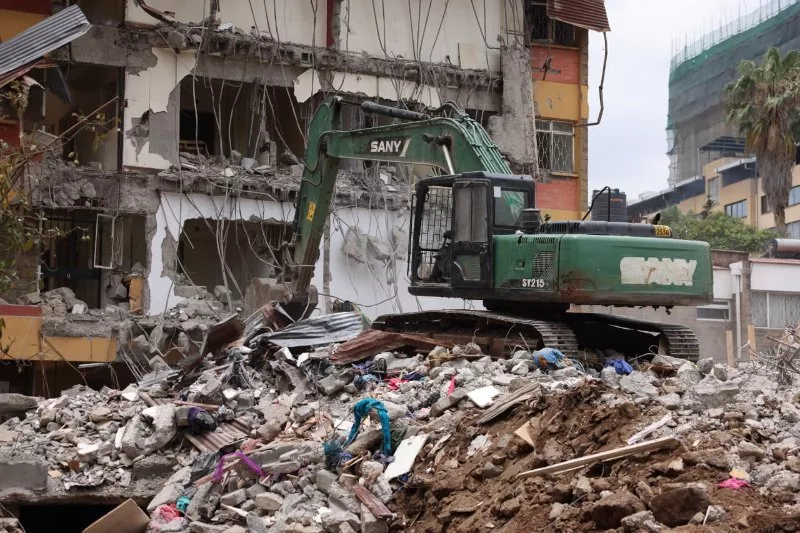
The government has stepped up its crackdown on riparian encroachment in Parklands, with demolitions targeting properties along Nairobi’s river channels as authorities prepare for anticipated heavy rains.
The operation is part of a wider Nairobi River Basin regeneration programme aimed at reclaiming riparian reserves, restoring blocked waterways and reducing flood risks.
The ongoing enforcement has targeted land in First Parklands, including property identified as Ahmed Ndovu land.
The Nairobi Rivers Regeneration multi-agency team, led by the Nairobi Rivers Commission (NRC), is also engaging property owners and institutions along Kibagare River to facilitate the restoration of the waterway.
Last week, the team met the Oshwal Religious Centre Committee, led by its chairman Samir Chandaria, and the centre’s consultant to discuss opening up and restoring the section of Kibagare River that passes through the centre’s Parklands site.
The commission said the meeting reviewed a proposal to restore the river, which is currently canalised through the centre and reclaim the riparian land for rehabilitation as a public park.
“Both parties agreed on a programme to finalise the restoration plan by this week,” the commission said in a statement.
The religious centre committed to supporting the restoration of Kibagare River and the government’s broader efforts to regenerate Nairobi’s rivers.
The engagement comes amid enforcement operations in Parklands to reopen river channels and remove structures that authorities consider illegal because they occupy waterways or riparian reserves.
Over the past six months, the multi-agency team has engaged residents along Kibagare River, including those in Parklands, Brookside Drive and Grevillea Grove, in what the commission describes as a lawful, consultative and transparent restoration process.
The crackdown is taking place alongside preparations at Nairobi Dam, where authorities have opened the emergency spillway to improve readiness for the anticipated El Niño rains.
Nairobi Rivers Commission chief executive Brigadier (retired) Joseph Muracia said water was now flowing through the spillway as part of planned safety interventions and the wider dam regeneration programme.
“The exercise forms part of a multi-agency approach to mitigating flood risks and restoring Nairobi’s river ecosystems,” Muracia said.
He urged residents living downstream to remain calm but vigilant, warning them to keep away from flowing water and river channels and to follow official safety advisories.
The commission cautioned that water levels and flow conditions could change depending on rainfall and other factors. It urged residents to heed instructions from relevant agencies.
Opening the spillway is part of preparations to address safety concerns ahead of heavy rainfall, as authorities work to lower water levels and restore the dam.
The government hopes to transform Nairobi Dam from an environmental and public safety concern into a recreational attraction for city residents within a year.
The commission says the dam, last maintained in 1998, could regain its recreational value if persistent problems, including pollution, encroachment and damaged sewer infrastructure, are addressed.
Built in 1953 along the Ngong River, the dam was intended to help control flooding while providing a recreational space for Nairobi residents.
Decades of neglect have left it burdened with solid waste, while parts of the surrounding area have been encroached on by people who have erected temporary iron-sheet structures.
Authorities have also reported farming in the area, including the cultivation of arrowroots for sale to Nairobi residents.
Public safety remains an immediate priority as the dam’s water levels are lowered in anticipation of heavy rains.
Previous warnings have highlighted the risk of flooding in downstream neighbourhoods, including Kibera, Nyayo Highrise, Dam estate, Lang’ata, Nairobi West and Madaraka.
The restoration programme seeks to address the combined threats of encroachment, pollution and flooding while recovering the river corridors and dam for public use.
INSTANT ANALYSIS
Nairobi’s river restoration drive is testing the government’s resolve to reclaim riparian land, enforce planning laws and protect residents from flooding.
Demolitions in Parklands and the opening of Nairobi Dam’s emergency spillway signal a push to address years of encroachment and neglect. However, success will depend on consistent enforcement, functional drainage and sewer systems and transparent engagement with affected communities beyond emergency preparations ahead of heavy rains.