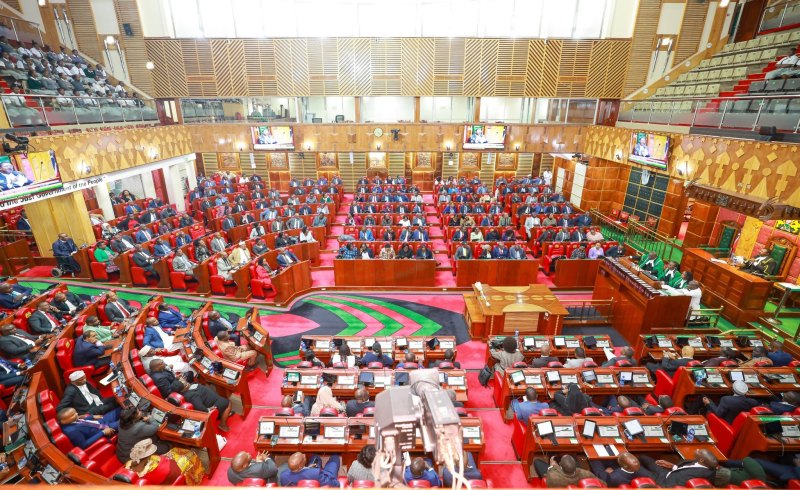
Governors are set for a fresh war with senators after lawmakers moved to summon the county bosses over persistent delays in paying county workers.
The Senate is demanding explanations for the recurring crisis that has left thousands of employees struggling to meet their financial obligations despite billions of shillings being allocated to devolved units.
Tharaka Nithi Senator Mwenda Gataya sparked the debate by submitting a petition to the Senate to open an inquiry into the persistent salary delays.
“I rise on a matter of national concern regarding the incessant delays in paying employees across several counties in the country,” Gataya said.
In the inquiry the Senate’s Labour and Social Welfare Committee is conducting, the House seeks to establish the causes of salary delays.
The panel seeks to establish a county-by-county account of the affected employees, the number of months unpaid and the total outstanding arrears.
“What is the status of budget submissions and approvals in the affected counties, clarifying any compliance requirement that has hindered access to funds,” Gataya said.
The committee will find out the immediate interventions and timelines for clearing all outstanding salary arrears and ensuring affected employees are paid.
“The committee should address the long-term strategies to prevent further delays, including steps to support seamless budget execution and timely payment of county employees,” he said.
The intervention comes amid growing pressure from workers' unions, which have accused governors of failing to protect employees from administrative failures and budgetary disputes.
In August, more than 35 counties experienced salary payment difficulties, with thousands of employees going without their July salaries.
Nairobi, Turkana, Baringo, Siaya and Trans Nzoia were among counties affected by the crisis.
In Nairobi, Governor Johnson Sakaja's administration blamed the delays on challenges surrounding the approval and uploading of the county budget.
"The management sincerely regrets the inconveniences and challenges that this situation may cause and wishes to assure all staff that the matter is receiving the highest priority," acting County Secretary Godfrey Akumali said.
Mombasa Governor Abdulswamad Nassir, however, said counties should explain their individual circumstances rather than collectively blaming the crisis on funding delays.
"For my county, my finance people are on it. It is important for every individual county to speak for itself," he said.
The Union of Kenya Civil Servants has accused county administrations of normalising salary delays at the expense of workers' welfare.
"The continued delay in payment of Nairobi County employees is unacceptable and must not be normalised. Workers have families to support, rent and school fees to pay, and financial obligations that do not wait for budget processes," the union said.
The union demanded a permanent payroll management framework to protect salaries from political disagreements and administrative failures.
"A bank facility may bridge a temporary cash-flow gap, but it cannot fix a broken payroll system," the union said.
Controller of Budget Margaret Nyakang'o has also blamed governors for failing to submit budgets on time and comply with expenditure approval requirements.
"As of August 10, 2026, 33 out of 47 county budgets, representing 70.2 per cent, had been submitted to the Controller of Budget, while 14 budgets, or 29.8 per cent, were still outstanding," she said.
The crisis has also exposed massive salary-related arrears and unremitted statutory deductions.
Nyakang'o recently told the Senate Labour Committee that counties had accumulated Sh100.24 billion in salary arrears and statutory deduction liabilities by June 30, 2026.
She said reforms linking payroll processing to the Integrated Financial Management Information System would prevent counties from diverting statutory deductions.
"I'm happy to say that issues of borrowing to pay salaries is a thing of the past," Nyakang'o said.
Governors have, however, maintained that inadequate funding and delayed disbursements from the National Treasury are partly responsible for the financial difficulties.
Council of Governors chairman Muthomi Njuki recently demanded at least Sh500 billion for counties in the 2027-28 financial year.
He said the proposed Sh440.84 billion allocation was inadequate to meet rising salary obligations, collective bargaining agreements and the absorption of Universal Health Coverage workers.
Kakamega Governor Fernandes Barasa warned that inadequate funding could trigger industrial unrest and disrupt county operations.
"When you have industrial unrest, there'll be no work. The economy where 47 governments are not working, that should be a key consideration," Barasa said.
County Government Workers Union secretary general Roba Duba has similarly opposed proposals to reduce county wage bills through staff rationalisation and recruitment freezes.
"Devolution cannot and will not be built on the graveyard of workers' livelihoods," Duba said.
The Senate's intervention now puts governors under pressure to account for the recurring delays and demonstrate how they intend to protect workers' salaries from future financial disruptions.
INSTANT ANALYSIS
Persistent salary delays in counties expose deep financial management weaknesses and growing tensions between governors and workers. While county bosses blame delayed Treasury disbursements and inadequate allocations, unions accuse them of misplaced priorities and poor planning. The Senate’s intervention could expose systemic failures, including ballooning wage bills and unremitted deductions. Unless accountability improves, the crisis risks triggering strikes, disrupting essential services and undermining public confidence in devolution ahead of 2027.