

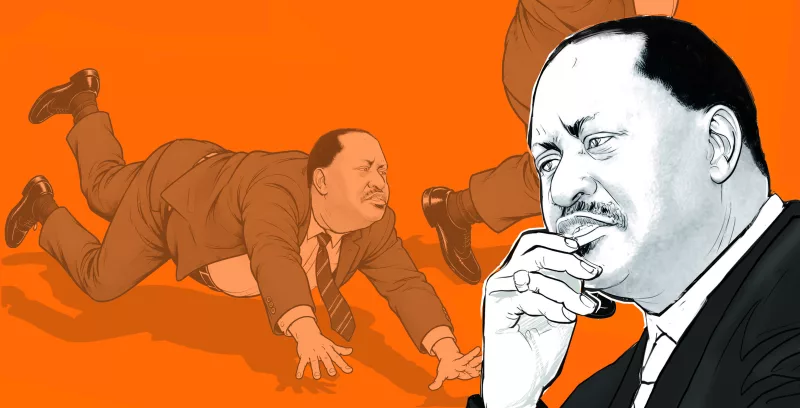
Friday, October 15 marks the first anniversary of Raila Odinga’s death. It will be one year since the world of politics in Kenya almost came to a standstill upon receiving the news of his demise.
He had travelled to India seeking specialised treatment for a condition that had affected him and considerably slowed down his public engagements. The man known as the enigma had bestridden the political spectrum not only of the country but also of the region and world at large.
He had begun his political journey as a young academic as a lecturer at the University of Nairobi. After earning his Master of Science in mechanical engineering from the Technical University of Magdeburg in East Germany in 1970, Raila returned to Kenya.
He joined the University of Nairobi as a lecturer/assistant lecturer in the Department of Mechanical Engineering, where he taught until 1974.
Raila moved to the Kenya Bureau of Standards from 1975 until his arrest in August 1982 after the failed Air Force coup that month against President Daniel arap Moi.
He had joined Kebs as standards manager after helping lobby for the passage of the 1973 Standards Act (championed through Trade Minister James Osogo) to establish local quality-control standards, particularly for his gas cylinder company, East African Spectre.
He was elevated to deputy director of Kebs, where he oversaw foundational quality guidelines, standards for industrial manufacturing (such as LPG cylinders) and staff training. Raila continued in his role as deputy director until his arrest, detention and eventual transition into full-scale political activism.
During this period, his political activities were less public due to the prevailing environment.
The country was a one-party state occasioned by the banning of his father’s KPU. Kenya’s first Vice President Jaramogi Oginga Odinga had fallen out with his Independence struggle hero and friend, Jomo Kenyatta.
However, the anti-government forces had relied on Raila’s extensive networks and exceptional mobilisation skills established while studying abroad and within the halls of academia.
At the same time, security intelligence agencies had kept close tabs on his activities. The incarceration during the ensuing de jure one-party state cemented his place in history as a liberator. He was somehow able to be influential in the fledgling opposition movement that pushed for the Second Liberation.
The movement eventually succeeded in forcing the Moi government to repeal Section 2A of the Constitution and reintroduce multiparty democracy.
Upon release from detention, Raila plunged headlong into management of the opposition movement. His father, the doyen of opposition, was the undisputed leader of Ford, the vehicle for the resistance. Ford would later succumb to tribal chauvinism inflamed by covert support of state machinery.
He fought tooth and nail for election to the national executive committee of Ford-Kenya as the deputy director of elections. He had lobbied for the creation of this position, but when the elections were called, he lost to veteran Waruru Kanja. The party chairman, no less than his father, had prevailed upon the delegates to reward his compatriot instead of his son.
At City Stadium, where the party elections were being held, the delegates had reconvened to ratify the deputy position and to endorse Raila for it, in defiance of his father. That event exposed to the world his extraordinary skills in organisation, mobilisation and ability to work across the ethnic fault lines.
The former Prime Minister’s rise to the pinnacle of Kenyan politics is a masterclass in resilience, grassroots mobilisation and strategic pragmatism.
Raila spent more than five decades at the absolute centre of the nation's political narrative, establishing himself as a colossal figure who profoundly shaped Kenya's democracy without ever holding the presidency.
Following his passing a year ago at the age of 80, his historical imprint remains massive. He proved that political power in Kenya is not merely derived from occupying the State House, but through the ability to mobilise the masses, challenge systems of inequality, and forge historic compromises necessary to hold a nation together.
Born into political prominence as the son of VP Odinga, Raila chose a path of radical activism over easy privilege. He possessed an innate understanding of political timing. His rise to true national command occurred when he recognised that defeating the long-ruling Kanu party required total opposition unity.
In 2002, Raila selflessly deferred his own presidential ambitions and famously declared "Kibaki Tosha" (“Kibaki is sufficient”).
This single endorsement galvanised the country, swept Mwai Kibaki into the presidency under the Narc coalition, and solidified Raila's status as a master strategist capable of tilting the national scale.
The disputed 2007 election plunged the nation into severe post-election violence. Demonstrating a characteristic willingness to step back from the brink for national stability, Raila agreed to a power-sharing deal.
He served as PM from 2008 to 2013, spearheading massive infrastructure overhauls such as the Thika Superhighway.
By the 2007 presidential election, he had broken away from Kibaki and commanded a fanatical, cross-ethnic grassroots following that affectionately called him "Baba" (Father) or "Tinga" (Tractor). As PM, his crowning achievement was driving the realisation of the 2010 Constitution.
This supreme law fundamentally reshaped Kenya by introducing devolution (creating the 47 counties), expanding human rights protections, and curtailing autocratic imperial presidencies.
As a primary political mobiliser, he helped transition Kenya from a closed state to a competitive political arena, co-founding and leading opposition platforms like Ford, National Development Party, Narc and ODM.
The Orange party, under the leadership of Raila, achieved major political milestones, institutional growth, and structural reforms. It transformed from the 2005 referendum campaign vehicle (the "Orange" side) into one of Kenya's most enduring political parties, consistently commanding vast parliamentary representation and national influence for over two decades.
It secured a power-sharing agreement following the disputed 2007 election, elevating him to the premier position. Through this arrangement, it championed the multi-party and civic campaigns leading to the passage and promulgation of the 2010 Constitution, which established a devolved system of government and expanded the Bill of Rights.
ODM has also pushed consistently for the equitable distribution of national revenue and strengthening of county governments to uplift marginalised regions. Most significantly, the party has promoted national cohesion and inclusion by using strategic political alignments — including the 2018 pact with President Uhuru Kenyatta and the 2025 broad-based cooperation framework with President William Ruto — to lower national political tensions and integrate party members into government roles.
The main role of a political party in a democracy is to act as an intermediary link between the citizens and the government, organising political competition to win elections, shape public policy, and provide democratic accountability.
Under Raila, ODM is considered the only party which has achieved these objectives and delivered consistently since its inception in 2005 as a referendum movement. However, the demise of the party leader last year has left the largest party without control and visionary guidance.
In a shocking twist of fate, the party’s fortunes have dwindled rapidly since. It was unable to organise a smooth leadership transition, leading to the departure of key leaders.
This has led to the formation of splinter groups and factions. The party rank and file do not agree on any major policy position.
They interpret Raila’s vision in versions that suit their respective parochial interests. The disunity is no longer concealable and the disintegration unstoppable. It has been accepted not to field a presidential candidate in the next election.
However, more baffling is the doubt about the party’s capacity to field candidates in all the other positions, as has been previously taken for granted. The party in its various leadership forms has undertaken activities to invigorate its bases since the supreme leader died.
They have found the process resource-draining since it’s expensive to move bodies where and when the spirit is weak and unwilling. ODM is facing its waterloo.





