For decades, construction
has largely followed the same fundamental process: transport materials to a
site, assemble them piece by piece and build upwards until a structure emerges.
That model has served us well. But Kenya is changing rapidly.
Our population is growing, our cities are expanding and demand for housing, commercial buildings and infrastructure continues to increase. At the same time, rising construction costs, labour costs, financing costs and material prices continue to put pressure on developers.
The question is therefore no longer whether Kenya should build more.
It is whether we can build differently.
This is where Modern Methods of Construction (MMC) come in.
MMC refers to technologies and processes that move some building away from traditional on-site construction towards manufacturing, prefabrication, standardisation and digitally controlled processes.
This includes prefabricated and modular construction, precast concrete, light-gauge steel, 3D construction printing, Building Information Modelling (BIM), panellised construction and other industrialised building systems.
These methods can address one of the industry’s biggest problems: how to reduce the time and resources required to construct quality buildings.
One of the biggest
advantages of modern construction is speed.
Traditional construction can be highly dependent on activities happening sequentially. One task may need to be completed before another begins.
Modern construction can change this equation.
For example, components of a building can be manufactured in a controlled environment while site preparation is happening simultaneously. Instead of waiting until the foundation is complete before beginning certain elements of the building, some components can already be prepared off-site.
This creates what is essentially a parallel construction process.
And in construction, time is money.
Every additional month on a project can mean additional site labour, security costs, equipment costs, financing costs and management expenses. For commercial developments, delays can also mean lost rental or sales revenue.
Reducing construction time can therefore translate directly into financial savings.
Another major opportunity is reducing material waste.
Traditional construction generates significant amounts of waste through cutting, excess materials, damaged products, incorrect measurements and construction errors.
When components are manufactured in controlled environments, production can be more precise.
Standardisation allows manufacturers to calculate the amount of material required before production begins. Digital modelling can also identify potential clashes and design problems before construction starts.
This is where BIM becomes particularly powerful.
BIM allows different professionals involved in a project to work around a digital representation of the building. Architects, structural engineers, mechanical engineers, electrical engineers and other specialists can coordinate their designs before construction begins.
Imagine discovering that a ventilation duct conflicts with a structural beam while the building exists only as a digital model rather than discovering the problem after concrete has already been poured.
The cost difference can be enormous.
Modern construction can also improve quality control.
A conventional construction site is exposed to weather, varying workmanship, changing site conditions and numerous other variables.
Manufacturing building components in controlled environments allows greater consistency in production.
This does not mean prefabricated buildings are automatically better. Poorly designed or poorly manufactured components can still produce poor buildings. The advantage is that quality can potentially be controlled more systematically.
There is also an opportunity to address Kenya’s labour productivity challenge.
Construction requires significant human labour, but that does not mean every component needs to be manually produced on-site.
Industrialised
construction allows some repetitive tasks to be automated or moved into
specialised manufacturing facilities.
The goal should not necessarily be to eliminate construction jobs.
Instead, the
industry can shift towards higher-productivity jobs involving manufacturing,
engineering, digital design, machinery operation, quality assurance, logistics
and project management.
This could create an entirely new construction ecosystem.
But there is an important misconception that needs to be addressed.
Modern construction does not automatically mean cheap construction.
The initial investment can actually be higher.
Specialised machinery, factories, transportation, technology, skilled personnel and design systems require capital. A company producing prefabricated components must also achieve sufficient scale to make its operations commercially viable.
This is one reason why adoption in Kenya can be challenging.
If a developer is constructing one unique house, traditional construction may sometimes remain more practical. But if a developer is constructing hundreds or thousands of similar housing units, the economics begin to change.
The more standardised the project, the greater the potential benefits of industrialised construction.
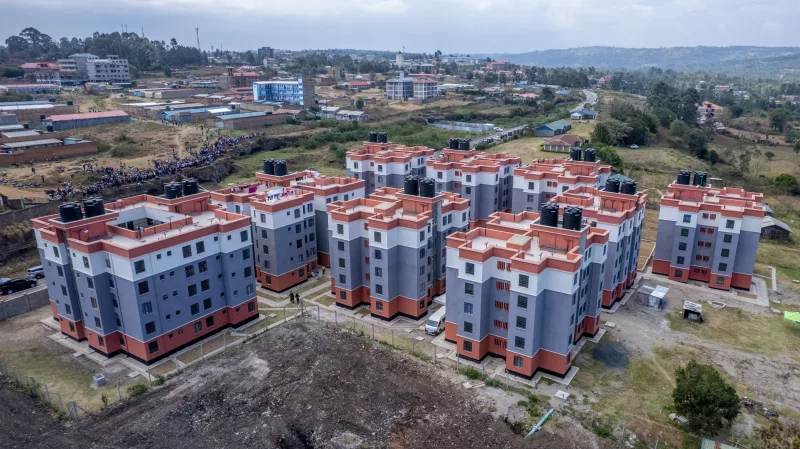
This is particularly relevant to Kenya’s affordable housing ambitions.
Instead of constructing every unit almost entirely from scratch on-site, developers could manufacture standardised components at scale and assemble them rapidly at different locations.
The factory becomes an extension of the construction site.
This approach could also create opportunities for local manufacturing.
Kenya imports a significant amount of technology and construction equipment. But the long-term, opportunity is not simply importing prefabricated buildings from elsewhere.
We should be asking:
Can Kenya manufacture the components ourselves?
Can we produce locally manufactured wall panels?
Can we manufacture precast structural elements?
Can we develop affordable modular housing systems suited to Kenyan climatic conditions?
Can we use locally available materials in modern construction systems?
Can Kenyan engineers and architects develop building systems that can eventually be exported to other African markets?
These are industrialisation questions as much as they are construction questions.
There is also an environmental argument.
Construction consumes enormous quantities of raw materials and generates waste. More efficient production can reduce material wastage, while better building design can improve energy and resource efficiency over a building’s lifetime.
Kenya therefore has an opportunity to connect modern construction with sustainable development.
However, technology alone will not transform the industry.
Kenya will need an enabling regulatory environment, professionals who understand these technologies, financiers willing to support new construction models, developers willing to experiment and consumers willing to embrace alternatives to conventional construction.
Building codes and approval processes must also evolve alongside innovation.
A technology cannot become mainstream if obtaining approval for it is excessively difficult or if professionals are uncertain about how regulators will evaluate it.
Education will be equally important.
Architects, engineers, contractors, quantity surveyors, technicians and policymakers need exposure to modern construction systems. Universities and technical institutions should increasingly prepare graduates for an industry where construction is becoming more digital, industrialised and data-driven.
There is also a cultural barrier.
Many clients still associate traditional construction with permanence and modern methods with experimentation.
That perception will change only when the industry demonstrates that new systems can produce buildings that are safe, durable, aesthetically appealing and economically viable.
Kenya has already demonstrated that it can leapfrog traditional systems in other sectors.
Mobile money transformed financial services without Kenya first building the conventional banking infrastructure found in many developed economies.
Construction could experience a similar transformation.
We do not necessarily need to follow the exact path that other countries followed.
We can develop construction systems designed around our own realities: our climate, our materials, our labour market, our housing needs and our urbanisation patterns.
The opportunity is much bigger than simply building faster.
Modern methods of construction could help Kenya reduce waste, improve productivity, lower project risks, create new manufacturing industries and ultimately make quality buildings more accessible.
The future construction site may therefore look very different from the one we know today.
There may be fewer piles of materials scattered around sites and more components arriving precisely when they are needed.
There may be less improvisation and more digital planning.
There may be fewer activities happening entirely on-site and more construction taking place inside factories.
And there may be a much closer relationship between construction, manufacturing, engineering and technology.
Kenya is going to build.
The question is whether we will continue building exactly as we have always built, or whether we will take the opportunity to build a smarter construction industry for the future.
The future of construction is not simply about putting buildings up faster. It is about rethinking how buildings are made in the first place.
Founder and MD, Crystal Pearl Real Estate