

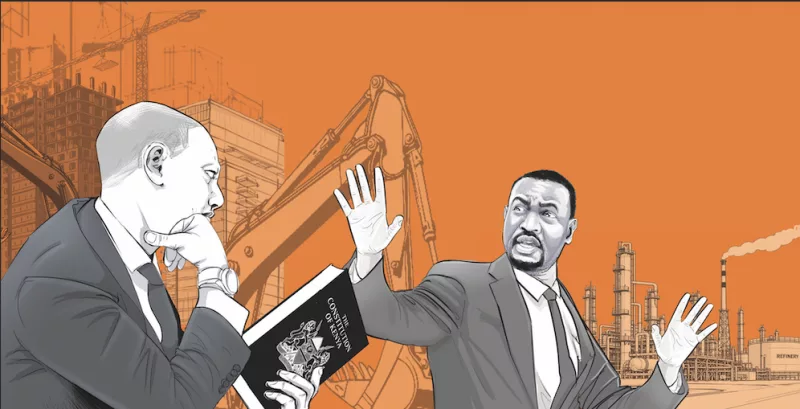
Through words and actions, President Ruto has left no doubt whom he considers his biggest opponent in the upcoming elections. In recent weeks, and at every turn, Ruto has taken a swipe at Nairobi senator and Linda Mwananchi boss Edwin Sifuna.
Most times, the President has lashed out angrily at the younger contender, labelling him “a fool” and a man “lacking any agenda”. Not to be outdone, Sifuna calls Ruto shenzi and has antagonised the President further by sustaining constant and withering criticism of his government.
Up until a few weeks ago, Ruto has incessantly referred to Sifuna as Mr Empty and his Linda Mwananchi brigade as a bandwagon lacking a plan on how to govern the country, and therefore not fit to be voted into power.
To a large extent, this period coincided with sustained political rallies by the opposition outfit, giving it limited room to churn out policy discussions in the typically charged rally atmosphere.
However, lately, during the break from public engagements, the Nairobi senator has begun to drop snippets of his governance agenda.
Of all the points of conflict between the two politicians, the one that seems to irk the President most is the attack on his pet affordable housing project.
In my view, Ruto gets outraged by this the most, largely because he has no real answers to the questions Sifuna perennially poses over the project.
To begin with, I have not met a single salaried Kenyan who is happy to have the housing levy deducted from their salary. It therefore makes the young senator quite popular among employed Kenyans by vowing to repeal the levy if elected president
The trouble for the President is that he is unable to answer these questions in a credible way. Perhaps the old question of how competent his communication team is must be asked again. If not, we must speculate that Ruto either does not take the advice of his communication teams, or he has intended the housing project to be deliberately opaque.
That, however, is an unsustainable posture, because in especially an election year, citizens, not just presidential contenders, will ask questions and demand answers.
Depending on where one stands, the affordable housing project is either a manifestation of great brilliance, or a monumental scam. And for the project to stand persuasively on its own feet, the public should know exactly it is.
It is inconceivable that the government can collect a levy every month, running into nearly Sh100 billion a year, but not be able to answer the basics of the who, the why and the how of the housing fund.
Even if Sifuna didn’t ask, the salaried Kenyans who contribute financially deserve to find out: Who is building the houses? What are contract terms? Who exactly has been allocated the units? What are the allocation modalities? And what is the stake of every contributor whose earnings have gone into the project?
And these are questions that don’t require the President to regale the nation with stories about Sifuna’s drink choices and nocturnal pursuits.
In fact, the easier option would be to buy space in the dailies and splash all this specific information for the consumption of Kenyans.
While ranting at the Linda Mwananchi supremo, the President has also in recent days added the rather interesting line about Sifuna’s recent sighting at an event, allegedly enjoying a drink. Surprisingly, the referenced event itself was something that was the pride of many Kenyans: the 50th media anniversary of broadcasting legend Fred Obachi Machoka, a man who has inspired a generation with his professionalism and longevity.
The Nairobi senator attended the event to support the media icon, regardless of what his drink choices may have been, which in any case, were totally within his rights.
I am reminded of the 2008 US presidential run as I watch the unfolding events back home in Nairobi right now. Then, one-term US Senator Barack Obama had to deflect a lot of tabloid-like personality attacks.
The rabid attacks from the media and the Republican fraternity revolved around his background, religion and general associations.
Obama had to repeatedly remind his rivals to stop personality-driven political attacks and instead focus on the national issues around the economy and the ongoing wars.
Today in Kenya, another one-term senator, like the Obama of 2008, is a youthful lawyer seeking to be president. The ruling UDA party politicos have tried desperately to malign his name, without success.
Instead, led by the President, it seems they have resorted to the usual personality attacks, a solace for many political types who run out of credible information with which to fight political battles. To his credit, and like Obama, Sifuna has insisted that the conversation must move away from his person to the bigger national agenda.
I sort of love the new-era campaigns. The age of the snake oil salesman is fading fast. In its place is the enlightened generation that has communication gadgets in their hands, on their wrists, in their ears, in their spectacles and everywhere around them.
Essentially, therefore, information flows fast, facts are checked on the go, and leaders are called to account faster. Well, there are still leaders in this country who are holdovers from a generation gone by, who are yet to adjust to the new world order of instant accountability.
What the 2027 campaign will teach everyone, more than anything else, is that times have changed. The exchanges between Sifuna and Ruto will bring this fact home in no small measure.
Perhaps Ruto hadn’t envisaged being challenged by a young opponent in the mould of Sifuna, especially one who would turn out to be suave and well spoken.
I suspect that in the President’s calculations, 2027 was supposed to offer him another smooth ride against a familiar opponent like Wiper leader Kalonzo Musyoka, or even his impeached former deputy Rigathi Gachagua.
Thus, he would fashion time-tested tribal messaging similar to what he deployed against departed ODM boss Raila Odinga. It should have been a straightforward thing. Not today.
Then the country sprang a surprise on him by propping up a man the head of state considers inexperienced and unworthy of this high pedestal, but who fearlessly challenges him and traps him into the verbal slurs that practically have only one loser.
In this scenario, Ruto’s irritation and anger are manifestly public. Yet the younger man is not one to back down, and fuels his counterattacks with comeback tweets when not answering articulately on the podium of political rallies. It is a joy to watch, and like any debate, the country must hope that the best man wins and romps home in the elections.
However, for the sake of the entire nation, facts must reign supreme in this rivalry. The debate must focus on what is important for the country: the state of the economy, declining jobs, capitation to schools, insecurity, the state of our infrastructure and food security.
From there, the country will choose who should be given the mandate in 2027 to steer the country for five years, in what we all hope will be a credible, peaceful and transparent process.
We therefore must reject the invitation to partake of details of personality attacks. Like that one-term senator in the US in 2008, we demand that the conversation stick to what matters to the masses. We can deal with who drinks alcohol or doesn’t, in September 2027 after we are done with the swearing-in!





