
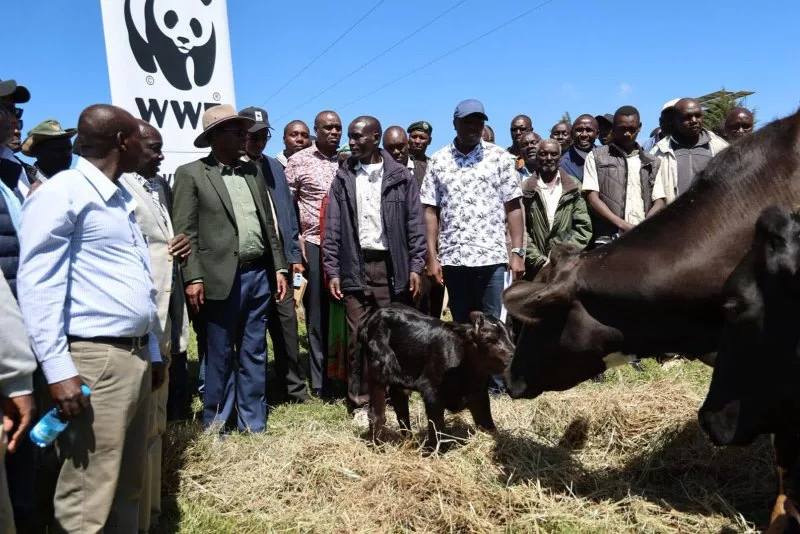
The Kaptagat Integrated Conservation Programme (KICP) is more than a conservation project. It is a human story unfolding around the edges of Kaptagat Forest, a vital ecosystem within the greater Cherangani Hills water tower system. Here, conservation is not treated as an abstract environmental obligation, but as a daily economic and social reality for families who live beside the forest and depend on it for survival.
KICP is built on four transformative, Swahili-named pillars — Pesa Mfukoni, Maji Nyumbani, Kawi Safi Nyumbani, and Mazingira Safi — each designed to stand on its own, yet intentionally woven together into a holistic model where people and nature rise together.
Pesa Mfukoni – Putting Money in the Pocket
At its heart, Pesa Mfukoni recognises an uncomfortable truth: when poverty deepens, forests disappear. For many households bordering Kaptagat, charcoal burning, illegal logging, and overharvesting are not acts of defiance — they are acts of survival. This pillar seeks to change that equation.
Pesa Mfukoni makes conservation economically rational. It nurtures beekeeping enterprises, indigenous tree nurseries, bamboo ventures, herbal plant cultivation, eco-tourism services, and other forest-friendly businesses that allow communities to earn dignified incomes without destroying the very ecosystem that sustains them. Youth-led conservation startups and women’s cooperatives are encouraged to innovate within a growing “forest economy.”
Through value addition, branding, and market linkages, forest honey becomes a premium product rather than a subsistence commodity. Savings groups and conservation-linked microcredit ensure that financial inclusion supports environmental responsibility. In this model, income growth is not separated from conservation — it is tied to it. When trees survive, livelihoods grow. When livelihoods grow, illegal logging declines.
Pesa Mfukoni ultimately reframes the forest from a resource to be exploited into an asset to be protected.
Maji Nyumbani – Bringing Water Home
Water tells the story of every forest. The slopes of the Cherangani Hills feed rivers that support farms, households, and hydropower systems far beyond Kaptagat. Yet when catchments degrade, springs dry up, and women and children walk farther each year in search of water.
Maji Nyumbani responds by restoring the natural water cycle while securing access at the household level. It rehabilitates riparian zones, protects springs, plants indigenous trees along riverbanks, and restores wetlands so that water can flow reliably once again. But restoration alone is not enough. The programme also invests in gravity-fed systems, solar-powered boreholes, rainwater harvesting, and community water kiosks that bring clean water closer to homes.
Beyond infrastructure, Maji Nyumbani builds water governance — empowering local water user associations to monitor quality, manage resources, and adopt climate resilience measures such as watershed mapping and drought preparedness planning.
In practical terms, this pillar reduces disease, shortens the distance women and girls walk for water, strengthens agriculture, and restores dignity. In ecological terms, it reconnects the forest to the farm, and the hilltop to the homestead.
Kawi Safi Nyumbani – Clean Energy for People and Forests
Energy is one of the silent pressures on Kaptagat Forest. Every cooking fire fueled by firewood, every sack of charcoal carried to market, carries with it a small fragment of forest loss.
Kawi Safi Nyumbani tackles this reality by promoting accessible clean energy alternatives. Household biogas digesters convert farm waste into usable cooking fuel. Schools and institutions adopt larger biogas units. Energy-efficient cookstoves reduce firewood consumption while cutting indoor air pollution — improving respiratory health, especially for women and children. Solar lighting kits, irrigation pumps, and community mini-grids extend energy access without extending deforestation.
Financing mechanisms, carbon credit integration, and pay-as-you-go models ensure that clean energy is not a luxury for the few but an attainable transition for many. As reliance on firewood declines, forest regeneration accelerates. As kitchens become smoke-free, health improves. Clean energy becomes both an environmental and a social intervention.
Kawi Safi Nyumbani proves that climate action can begin in the kitchen — and ripple outward to restore landscapes.
Mazingira Safi – Restoring the Land, Protecting the Future
If Pesa Mfukoni strengthens livelihoods, and Maji Nyumbani secures water, and Kawi Safi Nyumbani reduces pressure on trees, then Mazingira Safi focuses directly on healing the land itself.
This pillar leads forest landscape restoration through indigenous tree planting, assisted natural regeneration, and removal of invasive species. It supports biodiversity protection through habitat corridors, community forest scouts, and partnerships to curb illegal logging. Climate resilience is strengthened through carbon sequestration monitoring, environmental education, and participation in voluntary carbon markets.
Equally important is environmental awareness. School eco-clubs, conservation forums, and annual forest festivals cultivate a culture of stewardship among youth and community members. Mazingira Safi is not simply about planting trees — it is about nurturing a generation that understands why those trees matter.
Through measurable restoration targets, biodiversity indicators, and long-term monitoring, this pillar ensures that conservation outcomes are tangible and lasting.
The Integrated Model – Where Everything Connects
What makes KICP distinctive is not the individual pillars alone, but how they reinforce one another in a circular sustainability model.
When Mazingira Safi restores forest cover, water sources recover. When water flows reliably through Maji Nyumbani, agriculture improves and health stabilizes. When agriculture and forest-based enterprises generate income under Pesa Mfukoni, households no longer depend on destructive extraction. When clean energy through Kawi Safi Nyumbani reduces charcoal demand, the forest is given space to regenerate.
Forest restored leads to water secured.
Water secured leads to agriculture strengthened.
Income strengthened leads to reduced exploitation.
Clean energy adopted leads to accelerated regeneration.
Each pillar solves a different problem — poverty, water insecurity, energy pressure, ecosystem loss — yet each one sustains the others. The result is not a collection of projects, but a living system.
A Human-Centered Future
The Kaptagat Integrated Conservation Programme ultimately tells a simple story: conservation must work for people if it is to work at all. It must put money in pockets, bring water closer to homes, clean the air in kitchens, and restore dignity to landscapes and livelihoods alike.
In Kaptagat, the future of the forest and the future of the community are no longer competing interests. They are one and the same.





