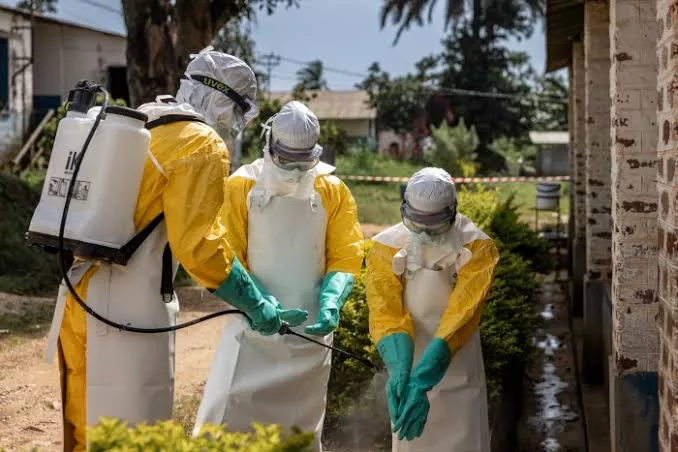
The government, through a press conference by Health Cabinet Secretary Aden Duale, has confirmed the presence of Ebola disease within Kenya’s borders.
Ebola has been a dreaded disease associated with primates and previously reported in the central areas of the African rainforest region. Thus, the Democratic Republic of Congo and neighbouring countries have witnessed sporadic outbreaks of the epidemic.
Kenya’s first-ever imported case and death was from the Bundibugyo Ebola virus on Monday, involving a Kenyan national who travelled from the Democratic Republic of the Congo.
According to Duale, the Kenyan citizen had lived in the DRC for seven years and fell ill about a month prior to travel. He used several transit routes as he travelled through multiple regions in the DRC, drove to Uganda and flew into Kenya.
He arrived at the Jomo Kenyatta International Airport in Nairobi on Saturday via Jambojet flight 8523, passing undetected through standard airport health screening.
A relative transferred him from the airport to the Nairobi Hospital, where clinicians immediately placed him in isolation upon noticing symptoms like fever, chills and bleeding under the skin. He tested positive for the virus and died late on Monday.
Authorities have since quarantined dozens of contacts, including family members and healthcare workers, and safely buried the deceased.
Ebola disease is a severe and often deadly viral illness that affects humans and other primates. It develops in stages and has different symptoms at every stage. The dry phase makes the patient suffer from sudden fever, fatigue, muscle pain, headache and sore throat.
During the wet phase, vomiting, diarrhoea, rash and internal or external bleeding are experienced. The onset stage is when symptoms appear mostly between two and 21 days after infection.
When the coronavirus wreaked havoc in the world and Kenya during the early 2020s, authorities moved with haste to institute stringent measures to control the spread. One of the most important fronts was factual and relevant information given to the public.
The government also provided regular, if not daily, updates on the status of the pandemic. Through global partnership, vaccines were manufactured and procured to help boost the immunity of the population through immunisation.
Ebola is spread through direct contact with the blood or bodily fluids of an infected person or animal. It is not airborne, and one cannot catch the virus by breathing the same air as an infected person. The virus-causing pathogen often originates from wildlife like fruit bats and non-human primates.
Early supportive care, such as fluid and electrolyte replacement, greatly improves survival rates. There are also available medications that include specific monoclonal antibodies for certain strains, such as the Zaire virus.
However, prevention remains the most viable option by avoiding contact with infected fluids, practising safe burials and using designated vaccines in high-risk settings. Ebola virus disease, formerly known as Ebola haemorrhagic fever, is severe and is often fatal in humans.
Recovery from acute Ebola infection typically takes one to two weeks from the start of the illness for those who survive, but full physical recovery and clearing of the virus can take much longer.
The rate of recovery depends heavily on receiving supportive care, including early medical care to replace fluids and manage symptoms.
The virus is persistent and can hide in immune-privileged parts of the body (like the eyes, central nervous system, and testes) for many months — sometimes for as long as a year or longer. These may cause secondary effects after the initial infection clears.
Many survivors experience lingering issues like extreme fatigue, joint pain, muscle aches, and headaches.
It is generally accepted, although too simplistically, that the control of Ebola disease belongs solely to the province of the Ministry of Health.
This is erroneous since the pandemic is a crosscutting development challenge. Key strategic sectors of the nation are directly or indirectly affected. The security of the country is directly under threat, and so are education, transport, commerce and essential services to the public by government agencies and the private sector.
Security and transport agencies play a critical role in controlling the spread of Ebola by restricting virus mobility, managing borders, and ensuring public safety during a health crisis.
Because Ebola spreads through direct contact with bodily fluids, controlling how people move and how communities interact is vital to breaking the chain of transmission. The transport sector acts as the first line of defence against the geographical spread of the disease, both domestically and internationally.
Transport authorities coordinate with health officials to set up mandatory thermal screening, health declarations, and handwashing stations at airports, seaports, train stations and land borders.
They are therefore very critical in enforcing health screening at transit hubs. Airlines, buses, and train operators must henceforth maintain accurate passenger manifests and contact information.
If a passenger tests positive, this data is critical for rapid contact tracing and implementing passenger tracking policy.
Respective agencies should undertake elaborate programmes to educate drivers, pilots, and station staff to recognise early symptoms of Ebola and safely isolate suspected cases using established protocols. Fleet managers must enforce strict and regular decontamination of public vehicles, commercial aeroplanes, and high-touch areas in transit terminals.
In the event that the country experiences severe outbreaks, the Transport ministry may suspend public transit, commercial flights, or cross-border travel to and from heavily affected zones to contain the virus.
On the other hand, the security sector comprising police, military and border patrol, together with private security service companies, provides the operational enforcement, logistics, and safety infrastructure needed to support medical interventions.
They man checkpoints and provide cordons around high-transmission neighbourhoods or villages to ensure infected or exposed individuals remain in designated areas. This ensures enforcement of quarantines and isolation zones.
The border patrol agencies must enhance monitoring of official and unofficial border entry points to prevent illegal crossings from neighbouring infected regions. They should direct travellers to authorised health screening points instead.
The protection of healthcare workers and facilities will have to be a priority concern for the government. Ebola outbreaks can cause widespread fear and civil unrest.
Security personnel will support this endeavour by guarding hospitals, Ebola Treatment Units, and mobile medical teams from community resistance or attacks. Security agencies will provide logistical and supply chain support.
Under such emergency circumstances, military and police transport units use their trucks, helicopters, and planes to deliver medical equipment, personal protective equipment (PPE), and vaccines to remote or high-risk areas.
Traditional burial practices often involve touching the highly infectious deceased body. Security forces escort burial teams to ensure safety compliance while remaining sensitive to local communities. Supporting safe and dignified burials will be a noble responsibility of the security agencies.
The private sector acts as a rapid operational partner, financial contributor, and logistics provider that can mobilise resources and local networks faster than traditional public institutions. They can do this by increasing the capacity of infrastructure for health delivery.
This expansion is achievable through opening private clinics and facilities for patient screening, isolation, and treatment. It will also enhance local laboratory diagnostic capacities.
By leveraging employee networks and partnering with local businesses, they will dispel community rumours and build compliance to push accurate health messaging.
The private sector will also accelerate scientific development and local manufacturing of therapeutics and vaccines by providing emergency trust funds, cash donations, and paying for frontline operational hours.
Not to forget procuring and distributing medical commodities across borders and into remote regions, including PPE, hand-washing supplies, and diagnostic tools.
The success of these efforts relies on deliberate coordination by the government and goodwill of all stakeholders.