

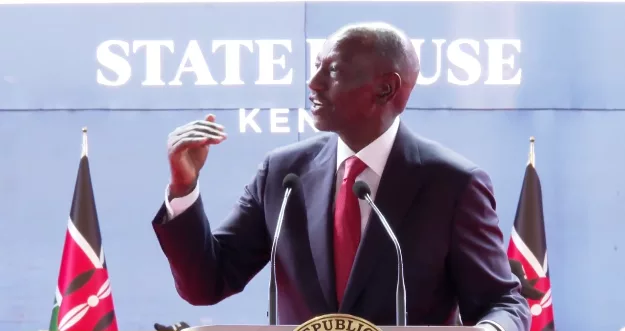
 President William Ruto speaking during the National Industrial Training Authority graduation ceremony at State House in Nairobi, October 8, 2026. His administration represents an inclusive government /SCREENGRAB
Time is moving very fast, and already, October is approaching its midpoint. The truth of the matter is that as we move closer to August 10, 2027, high-octane politics shall take centre stage.
It doesn’t help the fact that we are largely an oral society. Speeches matter, and it’s disconcerting to note that for one to gain political prominence in Kenya, one has to shout the loudest, throwing unprintable epithets at one’s greatest opponent.
This has led to a culture
whereby our youth have taken the same trait, not being so honourable, thanks to social media.
Amidst the entire hullabaloo is the quest to capture the soul of the nation. The competing groups of individuals who have bundled themselves into political outfits, otherwise known as political parties, have more often than not disagreed on how to govern the country.
At the core of these pursuits is the desire to occupy the top echelons of leadership for power, but also to determine the destiny of this great nation.
At times when the protagonists are throwing words at each other, one can’t help but think that this is just the adult version of mchongoano (taunting) that game that we used to play while young in primary school.
The political groupings have been organised largely around ethnic composition, although there is great improvement in having the face of Kenya amongst the officials.
The 2022 general election was a rare occurrence since they were largely issue-based, with the greatest contest around whether we needed a constitutional moment or an economic fix. The economic narrative carried the day, in a very closely contested election whose margin was 1.69 per cent of the vote.
The 2027 polls are already attracting some kind of degenerative politics back to ethnic cocoons and tribal jingoism. While all politics is local, it’s important to note that the big question of diversity must be answered.
The easiest formula for many is to manufacture a litany of grievances to galvanise a target group of people, with the aim of influencing their voting patterns and thereby determining who gets what seat at the table.
Currently, there are those who benefit from the status quo while others feel left out. While political coalitions are meant to bring in as many facets of Kenyan society as possible, it’s interesting to see how certain political formations fail to coexist with each other, such that an alliance with one means dissension with the other!
It’s therefore very important for us to ask ourselves, who is in the room? Who gets heard and who determines the agenda? These are the questions that we need to answer in order to have a fair representation of the societal mosaic of our great country.
For some time now, special interest groups such as women, youth, persons with disabilities, ethnic minorities and marginalised groups have been pushing for greater representation. While progress has been made considerably, this endeavour remains elusive due to the very nature of power.
Even in the mainstream of things, the political architecture that helps parties to win power in a general election often shifts six months after the victory. This means that it is very likely that one can be an MP, but the majority of the people have since moved on to support one’s opponent.
This shift is the true test of diversity and inclusion since political relevance is directly covariant with access to resources and opportunities, since any power wielder will most likely keep close those who can bring him or her their support bases with them.
Only exceptional leaders will rise despite the evidence of lack of support, prioritise the voices and therefore the needs of small groups of people whose numbers may be insignificant, but whose impact is big to society in terms of the transformation that comes from addressing their very concerns.
This goes a long way in determining a leader’s legacy, long after the noise has quieted, the boundaries of the political divide shift, and the power dynamics have changed.
In the end, what matters is not so much how long one was in power, but the lives of a people you were able to impact positively when you had the opportunity to do so, including those who may not know or have difficulty in reading and writing.
Dyslexia: Some little excursion
One in 20 learners have some difficulty in reading, comprehension, or writing well. This isn’t because they aren’t smart enough. It’s a result of a condition known as dyslexia that leads to not-so-good performance amongst many students.
Other than schooling, the rest of the lives of such pupils are similar to any other individual. It’s therefore considered to be a learning disability.
However, with proper intervention through teaching and examination access protocols, such learners are able to excel in life; one example is Sir Richard Branson, the famous UK billionaire!
Thursday was World Dyslexia Day, and the whole month of October is dedicated to creating awareness of the condition.
Let’s learn a thing or two about our children, for each voice, each need, and each life matters.
Happy International Dyslexia Awareness Day!





